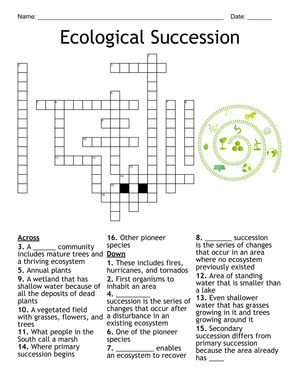
Ecological succession worksheets give you a low-prep way to check whether students can actually trace how a landscape rebuilds itself after disturbance, rather than just recite the vocabulary term. That distinction matters for planning, because a worksheet built around sequencing and evidence does more instructional work than a matching activity ever will.
For teachers building a full ecosystem-dynamics unit, succession fits naturally between population interactions and resilience concepts. Students need to see that ecosystems are not static backdrops for individual organisms; they shift over time in predictable stages, and that shift is something they can model, describe, and argue about using evidence.
Primary vs Secondary Succession: What Worksheets Should Teach First
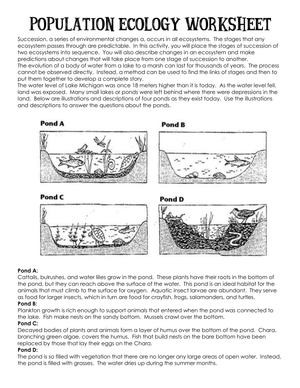
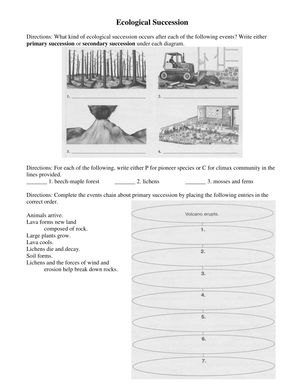
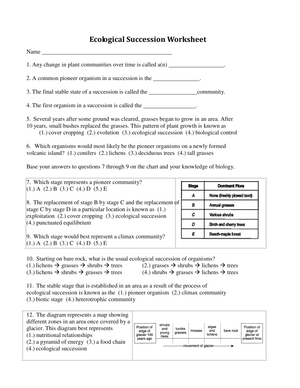
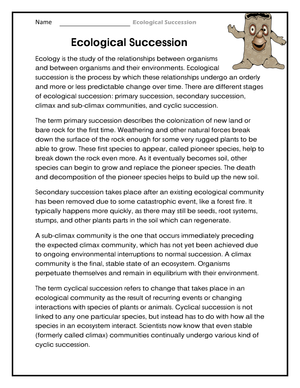
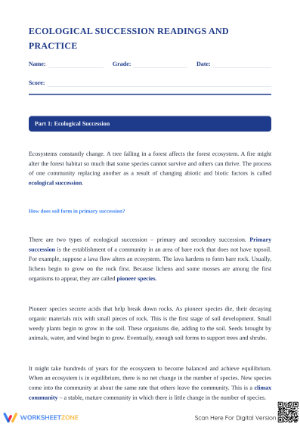
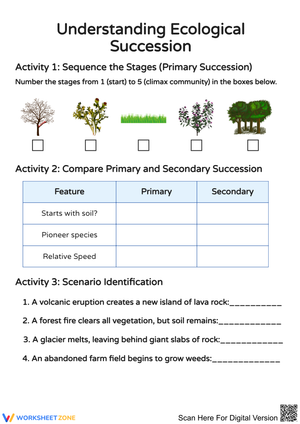
Most succession worksheets start with the same foundational distinction, and it is worth anchoring your unit there before moving into argumentation. Primary succession begins on surfaces with no prior soil or life at all, such as bare rock left behind after a glacier retreats or a volcanic eruption cools. Because there is no existing soil, recovery starts with pioneer species like lichens and mosses that can survive on rock and slowly help build the first thin layer of soil.
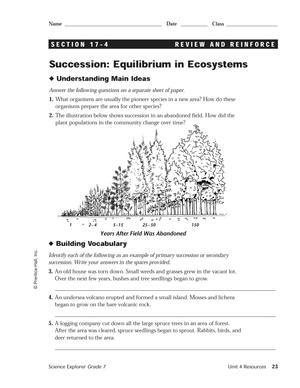
Secondary succession, by contrast, happens where soil already exists after a disturbance, such as a wildfire, an abandoned farm field, or a logged area. Since soil and some seed bank are already present, secondary succession recovers noticeably faster than primary succession. A worksheet that asks students to sort scenarios into primary or secondary succession, then justify the choice in a sentence, does more for conceptual understanding than one that only asks students to define the terms.
Building Toward the MS-LS2-4 Argument
Sorting and labeling are useful entry points, but the real instructional payoff comes when succession worksheets push students toward argumentation rather than recall alone. That shift matters because the standard driving this unit for most middle school teachers is not really about vocabulary at all.
NGSS performance expectation MS-LS2-4 asks students to construct an argument, supported by empirical evidence, that changes to the physical or biological components of an ecosystem affect populations. Succession worksheets are well suited to this practice because they hand students a built-in evidence set: a sequence of stages, a disturbance event, and observable population shifts across each stage that students can cite directly in a written argument.
According to the disciplinary core idea LS2.C, Ecosystem Dynamics, Functioning, and Resilience, from the MS-LS2-4 performance expectation on nextgenscience.org, ecosystems are dynamic and disruptions can shift the numbers of all populations they support, which is the exact claim students should be practicing how to defend with evidence from a succession sequence.
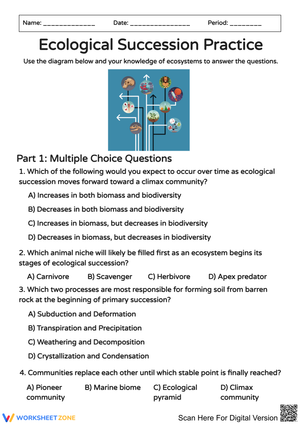
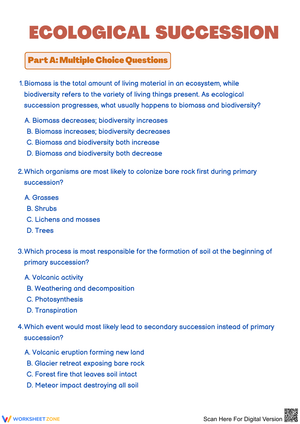
A strong worksheet sequence moves students from labeling stages, to explaining why each stage follows the last, to writing a short evidence-based argument about how a specific disturbance changed population numbers over time. That last step is where MS-LS2-4 actually lives, and it is worth building at least one worksheet in your unit around it rather than saving argumentation for the test.
Using Succession Worksheets for Review, Intervention, and Reteach
Succession worksheets are also useful outside the main unit sequence. A short diagram-labeling worksheet works well as a bell-ringer review before a test, while a scenario-sorting worksheet, primary versus secondary, gives you a quick formative check partway through the unit without needing a full quiz.
For small-group intervention or reteach stations, a simplified worksheet that isolates just the stage sequence, without the argumentation demand, lets students who are still catching up on the core concept practice separately from students who are ready to write evidence-based claims. That separation keeps intervention time focused on the actual gap rather than re-teaching the whole unit at once.
Frequently Asked Questions
1. What is the difference between primary and secondary succession, and how should worksheets teach that distinction?
Primary succession starts on bare rock or other surfaces with no existing soil, such as after a volcanic eruption, and begins with pioneer species like lichens and mosses. Secondary succession starts where soil already exists after a disturbance like a wildfire or abandoned farmland, so recovery is faster. Worksheets should have students sort scenarios into each category and justify the choice, not just memorize the definitions.
2. What grade level typically covers ecological succession under NGSS?
Ecological succession is commonly taught in middle school life science, grades 6-8, under the MS-LS2-4 performance expectation, and it is often reinforced again in high school environmental science or biology courses.
3. How can teachers use succession worksheets to build toward the MS-LS2-4 argumentation practice rather than simple recall?
Sequence worksheets from labeling and sorting toward a short written task where students state a claim about how a disturbance affected an ecosystem and support it with specific evidence from a stage sequence or data table, which mirrors the argumentation demand in MS-LS2-4.
4. What real-world examples help students understand pioneer species and climax communities?
The 1980 Mount St Helens eruption is a widely used primary succession example, showing pioneer species establishing on bare volcanic rock. Post-wildfire forest regrowth is a useful secondary succession comparison, since existing soil allows faster recovery than the rock-to-soil process required after a volcanic event.
5. How can succession worksheets be used for review versus formal assessment?
Use short labeling or sorting worksheets as bell-ringers or mid-unit formative checks, and reserve a full evidence-based writing worksheet, scored against a claim-evidence-reasoning rubric, for a formal assessment that reflects the MS-LS2-4 argumentation standard.












 Interactive Worksheet Maker
 Quiz Maker
 Word Search Maker
 Crossword Puzzle Maker
 Word Scramble Generator
 Sentence Scramble Generator
 Handwriting Worksheet Generator
 Name Tracing Generator
 Fill In The Blank Generator