




























1 / 4
0
Views
0
Downloads


0.0
0
Save
0 Likes
Share
States of Matter: Draw & Describe - Science Worksheet (Gr. 3-6)
0 Views
0 Downloads

Paste this activity's link or code into your existing LMS (Google Classroom, Canvas, Teams, Schoology, Moodle, etc.).
Students can open and work on the activity right away, with no student login required.
You'll still be able to track student progress and results from your teacher account.
Information
Description
What It Is:
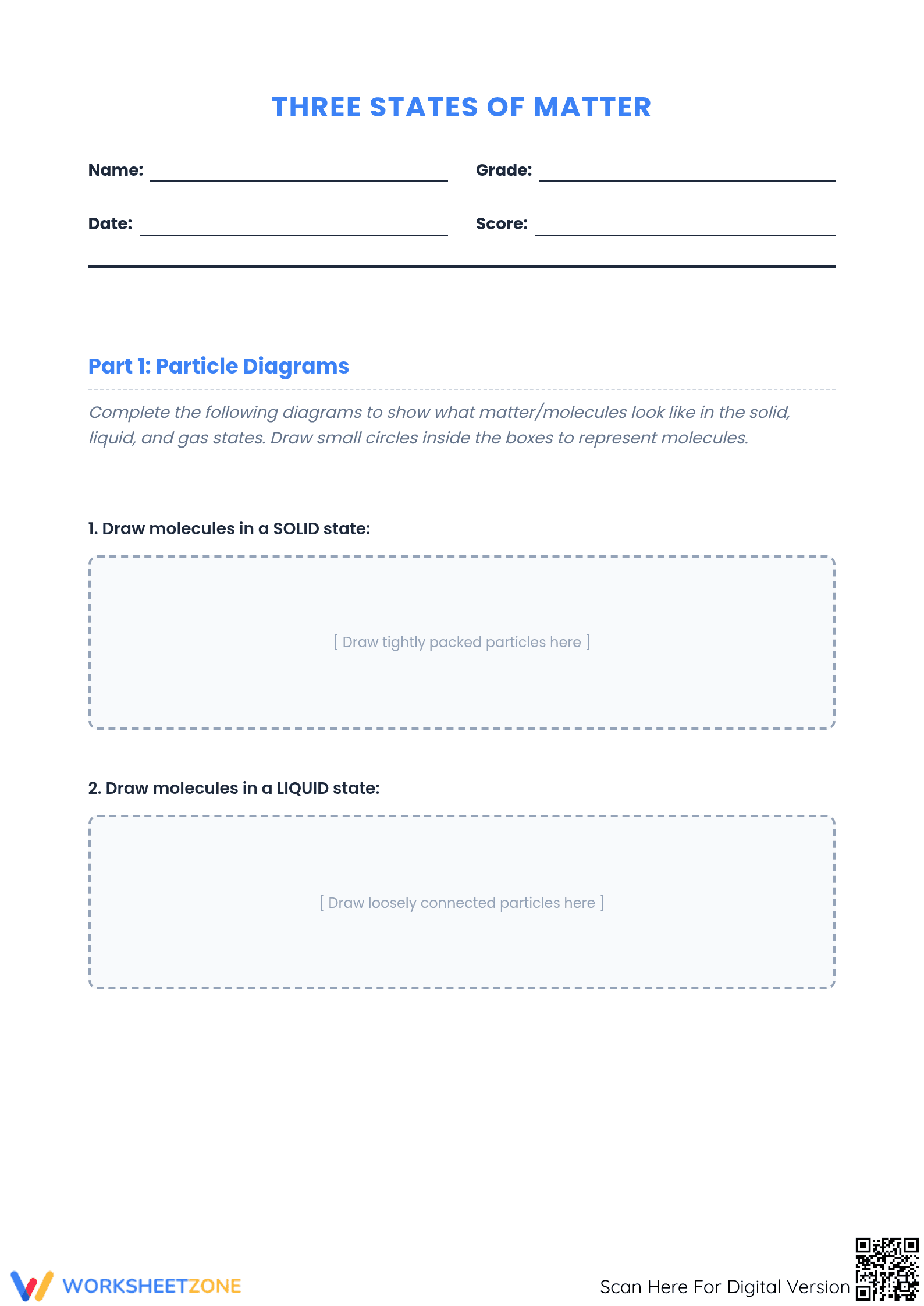
This is an educational worksheet focusing on the three states of matter: solid, liquid, and gas. It prompts students to draw diagrams illustrating the arrangement and behavior of matter/molecules in each state. Below the diagrams, there is space provided for students to describe the arrangement and movement of particles in each state of matter.
Grade Level Suitability:
This worksheet is suitable for elementary and middle school students, specifically grades 3-6. The concepts are introductory and the activity involves both visual representation and written description, making it accessible to this age range.
Why Use It:
This worksheet helps students visualize and understand the differences between solids, liquids, and gases at a molecular level. It encourages critical thinking by requiring students to connect the physical properties of each state with the arrangement and movement of its particles. It also reinforces scientific vocabulary and descriptive writing skills.
How to Use It:
Students should first read the directions and then draw diagrams in the provided cylinders to represent the arrangement of molecules in solids, liquids, and gases. Then, they should use the lines provided to write descriptions of the particle arrangement and movement for each state of matter.
Target Users:
This worksheet is ideal for science teachers, homeschool educators, and students learning about the states of matter. It can be used as a classroom activity, homework assignment, or review exercise.
This is an educational worksheet focusing on the three states of matter: solid, liquid, and gas. It prompts students to draw diagrams illustrating the arrangement and behavior of matter/molecules in each state. Below the diagrams, there is space provided for students to describe the arrangement and movement of particles in each state of matter.
Grade Level Suitability:
This worksheet is suitable for elementary and middle school students, specifically grades 3-6. The concepts are introductory and the activity involves both visual representation and written description, making it accessible to this age range.
Why Use It:
This worksheet helps students visualize and understand the differences between solids, liquids, and gases at a molecular level. It encourages critical thinking by requiring students to connect the physical properties of each state with the arrangement and movement of its particles. It also reinforces scientific vocabulary and descriptive writing skills.
How to Use It:
Students should first read the directions and then draw diagrams in the provided cylinders to represent the arrangement of molecules in solids, liquids, and gases. Then, they should use the lines provided to write descriptions of the particle arrangement and movement for each state of matter.
Target Users:
This worksheet is ideal for science teachers, homeschool educators, and students learning about the states of matter. It can be used as a classroom activity, homework assignment, or review exercise.


