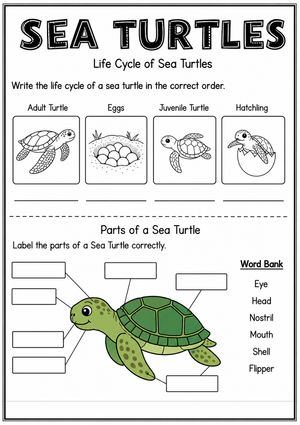
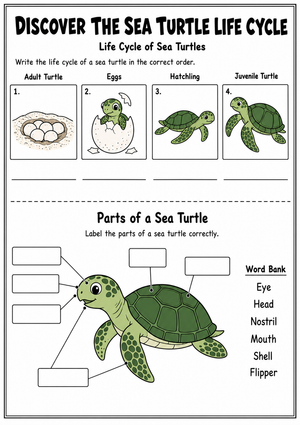
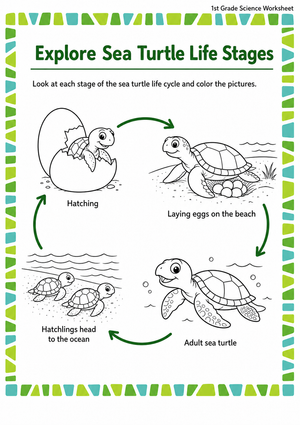
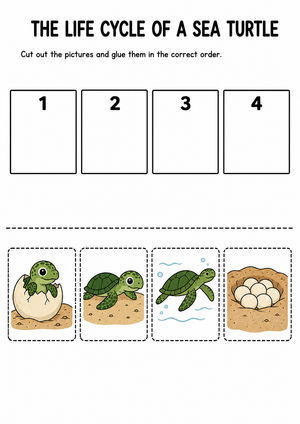
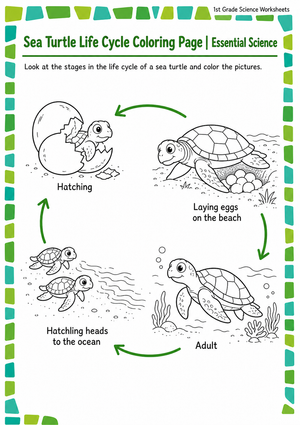
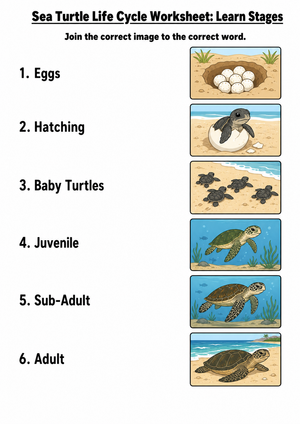
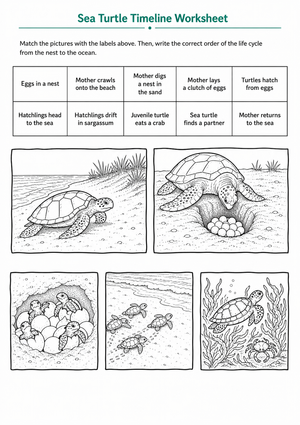
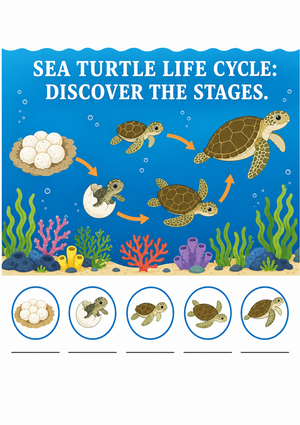
Sea turtle life cycle worksheets are built around four core stages: egg, hatchling, juvenile, and adult. Each stage looks different, happens in a different location, and lasts a different length of time, which makes the sequence useful for sorting and ordering activities in elementary classrooms. Presenting the stages as a cycle rather than a straight line also reinforces the broader concept that many animal life cycles loop back to reproduction rather than ending at adulthood.
For a K-2 or early elementary lesson, a simple four-box sequencing worksheet works well: students place picture cards of an egg, a hatchling, a juvenile, and an adult turtle in order, then write one sentence describing what happens at each stage. For upper elementary and middle school, you can extend the same four stages into a labeling diagram that asks students to add details like nest location, ocean habitat, and approximate duration of each stage.
Egg Stage: Nesting and Incubation
Female sea turtles come ashore to lay eggs in nests dug into sand, typically depositing 100 to 200 eggs per nest. Nesting happens every 2 to 4 years for an individual female, and each clutch incubates in the sand for about 45 to 50 days before hatching. This timeframe gives you a natural link to measurement and time-based math activities if you want to combine a life cycle worksheet with a numeracy extension.
One detail worth building a discussion question around is nest depth and sand covering, since students often assume eggs are laid directly on open sand rather than buried for protection. A worksheet prompt asking students to predict why turtles bury their eggs, then check their prediction against a short reading passage, works well as a formative check before moving into the hatchling stage.
Temperature-Dependent Sex Determination
A detail that consistently surprises students and supports a stronger classroom discussion is that nest sand temperature during incubation determines the sex of sea turtle hatchlings, a phenomenon called temperature-dependent sex determination. Warmer sand tends to produce more female hatchlings, while cooler sand produces more males, so incubation conditions rather than genetics alone shape the outcome for many reptile species.
This is a strong entry point for discussing environmental factors and organism traits with upper elementary or middle school students, since it moves beyond a simple stage-by-stage description into a cause-and-effect relationship. A worksheet question asking students to explain how a warming beach might shift hatchling sex ratios over time gives you a built-in bridge to climate and ecosystem units later in the year.
Hatchling Stage: Emergence and the Journey to Water
Once eggs hatch, hatchlings dig out of the nest, typically at night, and make their way across the beach toward the ocean. This stage is short but dramatic, and it is often the centerpiece of documentaries and classroom videos, which makes it a strong anchor for building background knowledge before students tackle worksheet questions about instinct and animal behavior.
A useful classroom question ties directly into a citation-worthy statistic. According to a 2023 analysis published by the Royal Society, the commonly cited figure that roughly 1 in 1,000 sea turtle hatchlings survives to adulthood is a rough estimate rather than a precise measurement, with researchers noting that actual survival rates likely range between about 1 in 400 and 1 in 2,000 depending on species and location. This 40-60 word detail works well as a stand-alone citation on a worksheet or discussion slide, since it gives students both a specific number and a caution about how scientists interpret wildlife statistics.
This nuance is a good discussion starter for middle school classes: ask students why a range might be more scientifically honest than a single number, and how that connects to how field researchers collect data on wild animals that are hard to track.
Juvenile Stage: The Long Wait to Adulthood
After surviving the dangerous trip from nest to ocean, hatchlings that make it to open water enter a juvenile stage that can last anywhere from 10 to 50 years depending on the species before they reach reproductive adulthood. This extended juvenile period is one of the most striking facts for students, since it contrasts sharply with animals like butterflies or frogs, which complete their entire life cycle in weeks or months.
Worksheets built around this stage can ask students to compare sea turtle development time to a familiar animal life cycle they have already studied. This comparison activity reinforces the idea that life cycle length varies widely across species and is not a fixed pattern that applies to every animal a student encounters.
Adult Stage: Nesting and Returning Home
Adult female sea turtles eventually return to nest on or very near the beach where they themselves hatched decades earlier, a behavior called natal homing. This completes the cycle and gives students a clear visual for why the diagram loops back to the egg stage rather than ending with adulthood.
A short-answer worksheet prompt asking students to explain what natal homing means and why it might matter for beach conservation efforts connects the life cycle content to real-world environmental stewardship, which many state science standards emphasize for upper elementary and middle grades.
Classroom Implementation
To get the most out of sea turtle life cycle worksheets, pair the four-stage sequencing activity with a short informational reading passage so students have context before they label or sort. For younger grades, keep vocabulary simple and rely on picture-based sorting; for older grades, layer in the temperature-dependent sex determination detail and the hatchling survival range as extension questions for early finishers or small-group stations.
Consider running a station rotation with one station per life stage, each with a short reading and a worksheet question, so students build knowledge incrementally rather than reading one long passage. This also supports differentiation, since you can adjust question difficulty at each station without changing the overall structure of the lesson.
Frequently Asked Questions
1. What are the four stages of a sea turtle's life cycle?
The four stages are egg, hatchling, juvenile, and adult. Eggs incubate in a sand nest, hatchlings emerge and travel to the ocean, juveniles spend years maturing in open water, and adults eventually return to nest near their birth beach.
2. How long does it take a sea turtle egg to hatch?
Sea turtle eggs typically incubate in sand for about 45 to 50 days before hatching, with exact timing influenced by nest temperature and sand conditions.
3. What determines whether a sea turtle hatchling is male or female?
Nest sand temperature during incubation determines hatchling sex through a process called temperature-dependent sex determination, with warmer sand generally producing more females and cooler sand producing more males.
4. What grade levels are sea turtle life cycle worksheets appropriate for?
Sequencing versions work well for elementary grades, while worksheets that include temperature-dependent sex determination and survival rate statistics suit upper elementary and middle school life science units.
5. Why do so few sea turtle hatchlings survive to adulthood?
Estimates suggest roughly 1 in 400 to 1 in 2,000 hatchlings survive to adulthood, commonly cited as about 1 in 1,000, due to predation on the beach and in open water along with other survival challenges during the long juvenile stage.