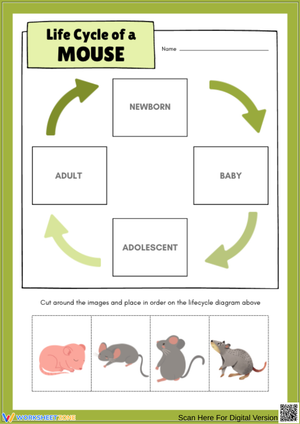
Mouse Life Cycle printable worksheets – Science Activities for Elementary Students
Mouse life cycle printable worksheets resources give teachers in grades 1–4 a structured entry point into one of elementary life science's most concrete topics: how a mammal develops from birth to reproductive adult. These worksheets — covering labeling, sequencing, fill-in-the-blank passages, drawing prompts, and compare-and-contrast tasks — work as both guided practice during instruction and independent work once content has been introduced.
Four Stages, Five Skill Types
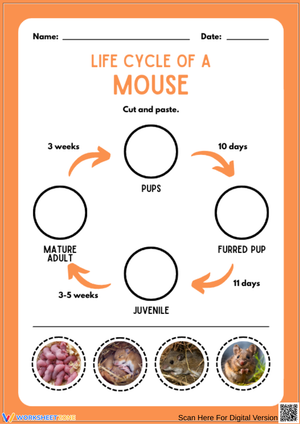
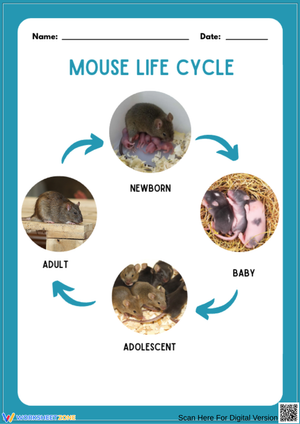
The mouse life cycle moves through four stages: pup, juvenile, adolescent, and adult. Newborn pups arrive hairless and blind, entirely dependent on the mother for warmth and nutrition. Between days 10 and 14, eyes open and fur develops. Around day 21, weaning marks the shift toward independence. Young adolescent mice develop coordination and foraging instincts before reaching sexual maturity at roughly 6 to 8 weeks. From there, a healthy adult lives one to three years, with females capable of producing five to ten litters annually — each containing five to twelve pups.
Each worksheet in the set targets one or more specific skills:
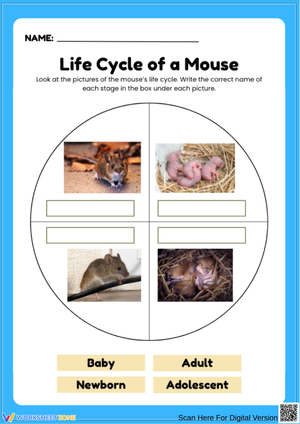
- Labeling diagrams — Students write stage names onto a circular diagram, reinforcing vocabulary and sequencing at the same time.
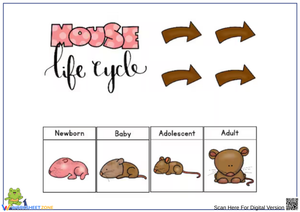
- Cut-and-paste sequencing — Students arrange image or text cards in order before gluing them down; the physical sorting step helps early learners hold sequence in working memory before committing it to the page.
- Fill-in-the-blank reading passages — A short informational paragraph with missing vocabulary terms trains students to read for meaning while building science-specific language.
- Drawing and writing prompts — Students illustrate each stage and write a descriptive sentence about it, requiring retrieval and production rather than simple recognition.
- Compare-and-contrast formats — Students place two mammal life cycles side by side and identify both shared patterns and species-specific differences.
Why the Mouse Works as a Teaching Subject
For teachers who want a mammal-focused set, mouse life cycle printable worksheets offer something insect-based formats cannot: developmental parallels to human biology that students recognize without prompting. When a second-grader notes that a pup depends on its mother for warmth and nutrition the same way a human infant does, that's not a digression — it's the comparative reasoning the standard calls for. The mouse's fast development also gives teachers something concrete to put on a classroom calendar. Mapping the full pup-to-adult transition, which takes under eight weeks, alongside the school year makes biological time feel real rather than abstract. That kind of anchor is exactly what second and third graders need before they can reason meaningfully about variation across species.
Mistakes Students Make That These Worksheets Help Teachers Catch
The most common sequencing error is placing "adolescent" before "juvenile" — a logical mistake, because adolescent is a word students encounter constantly in reference to older siblings or television characters, while juvenile belongs almost exclusively to science and legal contexts. A student trusting word familiarity over content knowledge will reverse those middle stages every time. After the sequencing worksheet, a quick verbal check — "describe what the mouse looks like at the juvenile stage" — reanchors the order to observable physical features rather than vocabulary recognition.
A subtler error involves the cyclic structure itself. Students who correctly sequence pup → juvenile → adolescent → adult often draw it as a straight line, treating adulthood as an endpoint rather than a stage that produces the next generation. The labeling worksheet uses a circular diagram with a return arrow, which makes that relationship unavoidable visually. Even so, a meaningful number of students will describe the life cycle as ending at adulthood when asked to explain it aloud. That gap between completing a visual task and articulating the underlying concept is worth a targeted follow-up question during whole-class discussion.
Fitting These Worksheets Into a Structured Life Science Sequence
The labeling worksheet belongs on Day 1, immediately after direct instruction — a read-aloud or projected diagram walk-through. Keep it as guided practice on that first day, not independent work: students fill in labels while you narrate each stage, building accurate vocabulary before they have to produce it alone. The cut-and-paste sequencing worksheet moves naturally into Day 2 as a partner or small-group activity. Having students debate the correct order before gluing anything down turns the task into a low-stakes oral language moment. The fill-in-the-blank passage works well for Day 3 independent work and doubles as a reading comprehension checkpoint at the same time.
Reserve the compare-and-contrast worksheet for Day 4, after students are secure in the mouse's stages. Introducing a second animal before the primary content is stable splits attention in a way that weakens understanding of both species. The drawing-and-writing prompt worksheet makes a natural end-of-unit formative check: a student who can draw each stage and write a sentence about it without a word bank has genuinely internalized the content. Students who struggle specifically with the adolescent description are telling you the intermediate stages need one more round of direct instruction before any summative work begins.
Standard Alignment
These worksheets align to NGSS 3-LS1-1, which asks students to develop models describing that organisms share birth, growth, reproduction, and death across their unique and diverse life cycles. The labeling and sequencing tasks function as the models this standard describes — students build a visual representation of an actual biological process rather than recalling a definition. For teachers in states that have adopted Next Generation Science Standards, mouse life cycle printable worksheets formats map directly onto 3-LS1-1 without supplemental modification. Many state frameworks also address life cycles at grades 1 and 2 under early life science strands, making the simpler labeling and sequencing worksheets appropriate below third grade as well.
Adjusting the Set for a Range of Learners
For grades 1 and 2, the cut-and-paste and labeling worksheets with a provided word bank require no modification for most students. Removing the word bank shifts the same task from recognition to retrieval — one small change that produces a meaningfully different cognitive demand. For students working below grade level in grades 3 and 4, pre-teaching the four stage names before distributing any worksheet reduces the vocabulary load and frees up attention for the actual sequencing work. Mouse life cycle printable worksheets sets that include both word-bank and no-word-bank versions of the same labeling task make this kind of quick adjustment practical without requiring teachers to prepare two entirely separate documents. For extension, students who finish early can write a short prediction about how the mouse's reproduction rate might change if a key predator were removed from its habitat — a no-prep prompt that connects life science content to introductory ecological reasoning.
Frequently Asked Questions
What grade levels are these worksheets designed for?
The labeling and cut-and-paste formats work well for grades 1 and 2. Fill-in-the-blank passages and compare-and-contrast worksheets are better suited for grades 3 and 4. Including a word bank on the labeling task makes the lower grade range accessible; removing it creates an appropriate stretch for more advanced students at the same grade level.
How long does it take for a mouse to move from pup to adult?
Eyes open between days 10 and 14. Weaning occurs around day 21. Sexual maturity arrives at approximately 6 to 8 weeks. The full pup-to-adult transition takes less than two months — faster than almost any other mammal students are likely to study. That speed is worth discussing explicitly in class because it connects life cycle content to introductory ideas about reproduction strategy and species survival.
Should I use these worksheets alongside a read-aloud or video?
Yes, and the sequence matters. Introduce the stages through a projected diagram or a short informational read-aloud first, then distribute the labeling worksheet while the vocabulary is still fresh. These worksheets reinforce content that has already been introduced — they do not work well as first exposure without any prior instruction in place.
Do the worksheets include specific facts like weaning timelines and litter sizes, or only stage names?
The fill-in-the-blank reading passages include specific detail — eye-opening around days 10 to 14, weaning at approximately day 21, and litter sizes of five to twelve pups. The labeling and sequencing worksheets focus on stage names and order. Teachers can select the format that matches the depth of content coverage their unit requires.
Clear All