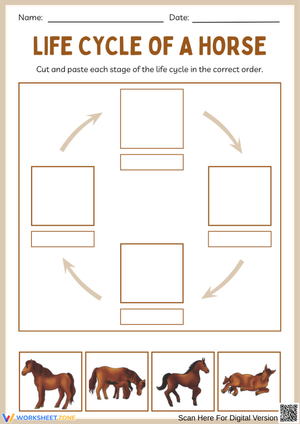
These horse life cycle printable worksheets give elementary students a concrete mammalian sequence that most of them already have emotional investment in — horses appear in books, farm trips, and media long before third grade. The set moves through four named stages: foal, yearling, young adult (colt or filly), and adult (mare or stallion), with each worksheet targeting a distinct skill rather than simply asking students to color a diagram. That specificity makes them useful as both formative checks and anchor activities in a broader life sciences unit.
What the Set Covers, Stage by Stage
The developmental sequence here is tighter than a typical animal life cycle unit because equine terminology forces students to track multiple variables at once — age, sex, and maturity status each carry their own vocabulary. A foal is any newborn horse regardless of sex; once the animal passes one year, it becomes a yearling; after that, sex-differentiated terms emerge — colt for young males, filly for young females; adulthood brings mare, stallion, or gelding depending on the individual. Worksheets in the set ask students to label, sort, and sequence across these categories, not just draw arrows in a circle.
One fact worth building a whole lesson moment around: foals are precocial, meaning they emerge from the womb neurologically advanced enough to stand and nurse within roughly two hours of birth. That contrasts sharply with human infants, who take close to a year to walk independently. Each worksheet that includes a side-by-side comparison column uses this contrast to anchor the biological concept rather than list it as trivia.
Vocabulary Errors Students Consistently Make — and What They Reveal
The most predictable error in student work is treating "foal" as a permanent label rather than a time-bounded one. A student who correctly names a newborn horse a foal will often write "the foal" when describing a two-year-old horse in a reading passage, because the word feels attached to the first image they encountered. Sequencing activities that require students to match each image to a specific label — and then justify why "yearling" replaces "foal" at the one-year mark — surface this confusion early and create a natural discussion point before moving on.
A second pattern worth watching: students regularly place colt and filly as stages that come after yearling in a strict linear sequence, rather than understanding them as sex-specific names that apply across a developmental window. If a cut-and-paste activity asks students to arrange five cards in order and they place colt at stage four, that is diagnostic — it tells you they are reading the life cycle as a single-sex linear ladder rather than a branching biological reality. A brief class discussion before the adult stage vocabulary saves a round of re-teaching later.
Standard Alignment
The primary standard these worksheets address is NGSS 3-LS1-1, which asks third graders to develop models showing that organisms have unique and diverse life cycles but all share birth, growth, reproduction, and death. Horse life cycle printable worksheets fit this standard particularly well because horses offer a mammalian counterpoint to the amphibian and insect life cycles that most third-grade units introduce first. Where frog metamorphosis requires students to accept dramatic physical transformation as normal biology, the horse's more gradual growth demonstrates that "diverse life cycles" does not mean every animal looks unrecognizable at each stage. A completed Venn diagram comparing the two — produced directly from the worksheets — is exactly the kind of evidence-based reasoning 3-LS1-1 asks students to generate.
Building These Worksheets Into Your Weekly Lesson Flow
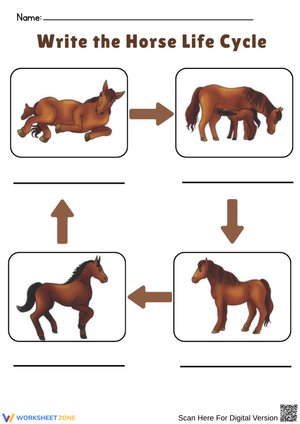
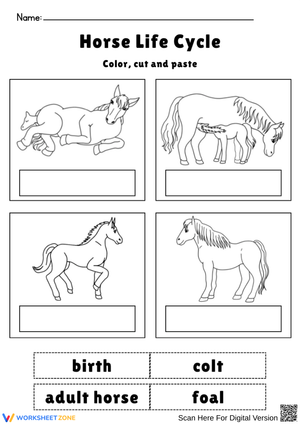
The most effective approach is to open the unit with a whole-class discussion — no worksheets yet, just images — and have students name all four stages aloud before any independent work begins. That oral preview reduces the cognitive load of encountering new vocabulary and unfamiliar images at the same moment, which is the combination that produces rushed, careless work. Once students can say "yearling" and "filly" out loud without hesitation, distribute horse life cycle printable worksheets for independent sequencing. The physical act of arranging cut-and-paste cards slows students down productively; they make a deliberate decision with each piece rather than filling in a blank from memory.
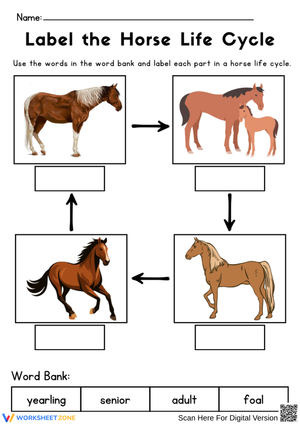
Labeling activities — matching colt, filly, and mare to the correct images — translate naturally into science station work later in the week. One station might ask students to read a short passage about a foal's first 24 hours and answer three targeted comprehension questions; another might present a blank life cycle diagram to complete from recall alone. That second station functions as a low-stakes retrieval check — more informative than a quiz because students who blank out reveal their gaps through their diagram choices rather than through a wrong letter on a multiple-choice item.
Adjusting the Worksheets for a Range of Learners
For students still building reading fluency, start with the visual-heavy activities — sequencing cards with images and word-bank labels — before moving to any reading comprehension work. The horse life cycle printable worksheets that pair a short paragraph with follow-up questions assume a second- to third-grade reading level; students reading below that level benefit from hearing the passage read aloud while following along, then completing the questions independently. That modification keeps the science content accessible without removing the vocabulary demand.
Advanced students move past sequencing and labeling quickly. The more productive extension for them is comparison work: a structured two-column chart documenting how a horse's eleven-to-twelve-month gestation differs from other mammals, or an open-response prompt asking why a prey animal like a horse would evolve precocial young while a predator like a bear produces altricial cubs. Those prompts push into 3-LS1-1 at a depth that approaches middle-school life science reasoning — appropriate for strong third- and fourth-grade students who have already demonstrated mastery of the sequence itself.
Frequently Asked Questions
What grade level are these worksheets designed for?
The sequencing and labeling activities suit second and third grade. Reading comprehension and comparison worksheets are written at a third- to fourth-grade level, making the full set usable across a two-grade span with minimal adjustment for either end of the range.
What is the difference between a foal, a colt, and a filly?
Foal refers to any horse in the newborn-to-weaning stage regardless of sex. Colt designates a young male horse past the foal stage; filly designates a young female. Both terms are generally retired when the horse reaches maturity — around four to five years of age — at which point the animal is called a stallion, gelding, or mare depending on sex and reproductive status.
Can these worksheets be used alongside a frog or butterfly life cycle unit?
Yes, and the comparison strengthens both units. NGSS 3-LS1-1 explicitly asks students to recognize that life cycles are diverse across organisms. Having students complete a horse sequence alongside an amphibian metamorphosis sequence — then compare the two using a Venn diagram — produces side-by-side evidence the standard is asking for. The contrast between gradual mammalian growth and dramatic amphibian transformation makes each concept more memorable precisely because they are studied together.
How long does a typical worksheet take to complete?
Sequencing and labeling activities generally run ten to fifteen minutes for on-level third graders. Reading comprehension worksheets with follow-up questions take closer to twenty minutes. Either format fits comfortably into a science block warm-up, a station rotation, or the independent work period that follows direct instruction.