


























Views
Downloads
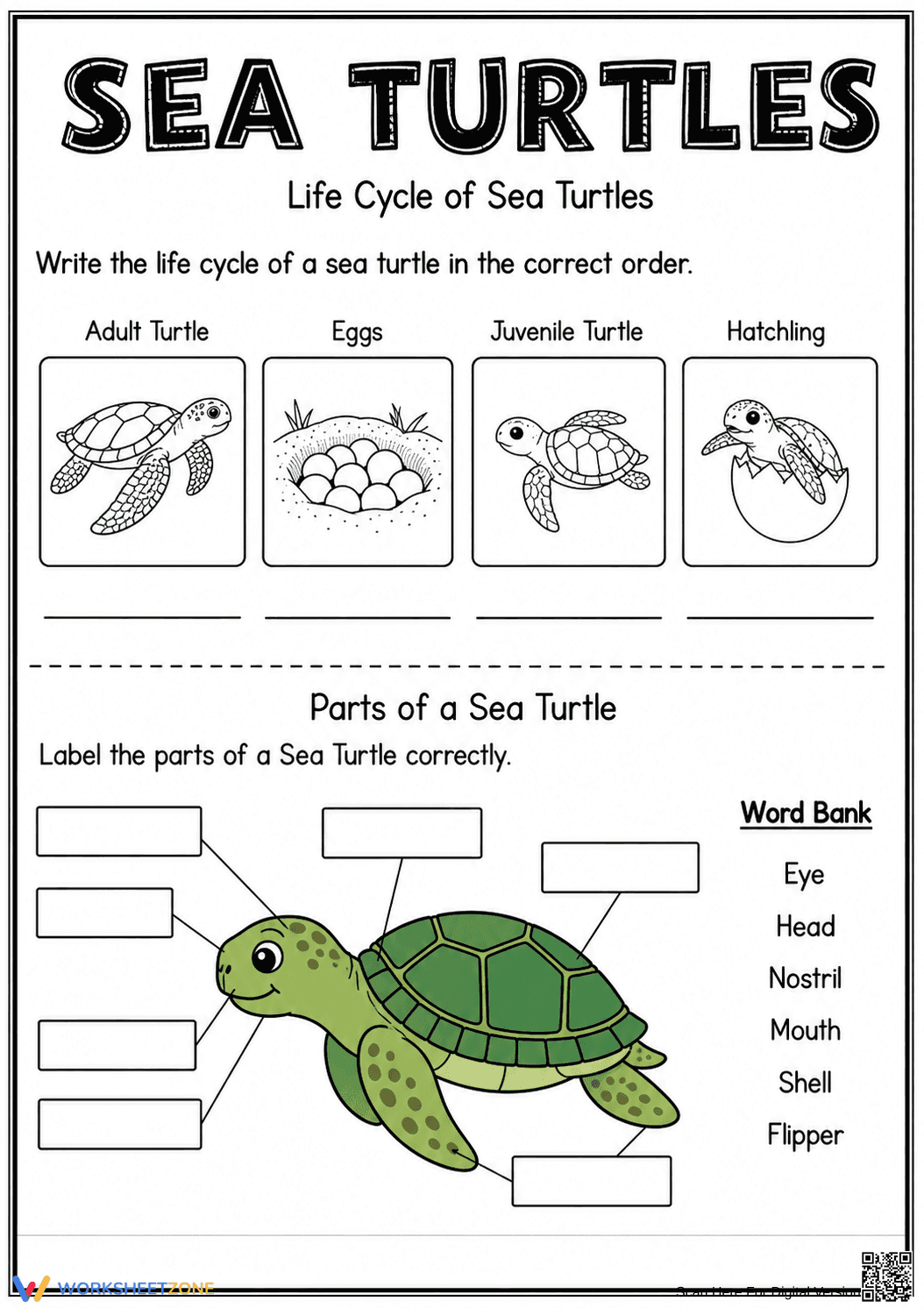

Grade 3 Sea Turtle Life Cycle — Printable No-Prep Worksheet
Paste this activity's link or code into your existing LMS (Google Classroom, Canvas, Teams, Schoology, Moodle, etc.).
Students can open and work on the activity right away, with no student login required.
You'll still be able to track student progress and results from your teacher account.
This Grade 3 science worksheet helps students master animal life cycles and basic anatomy by sequencing the developmental stages of a sea turtle. By organizing growth stages and labeling physical traits, young learners build foundational biology skills and reinforce scientific vocabulary in a visual format.
At a Glance
- Grade: 3 · Subject: Science
- Standard:
3-LS1-1— Describe that organisms have unique and diverse life cycles- Skill Focus: Life Cycle Sequencing & Anatomy Labeling
- Format: 1 page · 10 problems · Answer key included · PDF
- Best For: Independent practice or science centers
- Time: 10–15 minutes
This single-page resource features two distinct activities. The top half requires students to sequence four life cycle stages—eggs, hatchling, juvenile, and adult—using clear illustrations. The bottom half challenges students to label six anatomical parts of a sea turtle, supported by a word bank containing terms like flipper and shell. A complete answer key is provided.
This resource is designed for immediate classroom implementation:
- Print (1 minute): Generate copies directly from the PDF. No color ink required.
- Distribute (1 minute): Hand out the worksheets. The clear instructions and word bank let students begin immediately.
- Review (3 minutes): Use the answer key to quickly check responses or project it for self-correction.
With under two minutes of total teacher prep time, this activity is excellent for emergency sub plans.
This worksheet aligns with 3-LS1-1: Develop models to describe that organisms have unique and diverse life cycles but all have in common birth, growth, reproduction, and death. It supports early vocabulary development by requiring students to identify physical traits. Both standard codes can be copied directly into lesson plans, IEP goals, or district curriculum mapping tools.
Deploy this worksheet during independent practice in a marine biology unit. It serves perfectly as a follow-up activity after reading a book about sea turtles. As a formative assessment tip, observe whether students correctly order the hatchling and juvenile stages without prompting, indicating a solid grasp of sequential growth. Expect completion within a 10 to 15-minute timeframe.
This activity is designed for third-grade science students, though it functions well for advanced second graders. The visual scaffolds and word bank make it accessible for English Language Learners. Pair this worksheet with an anchor chart detailing marine habitats to deepen the instructional impact.
Aligning instructional materials with established scientific frameworks ensures that students develop accurate mental models of biological processes. This resource directly supports 3-LS1-1 by asking students to describe that organisms have unique and diverse life cycles through direct sequencing and anatomical identification. According to a ScienceDirect TpT Analysis, integrating visual models with targeted vocabulary exercises significantly improves the retention of domain-specific science concepts in elementary classrooms. By combining the chronological ordering of developmental stages with the precise labeling of physical characteristics, educators provide a highly effective dual-coding learning experience. This method not only reinforces the immediate content regarding marine reptiles but also establishes a broader understanding of how specific physical traits support survival at different stages of growth. Such structured, visually supported tasks are absolutely essential for building early scientific literacy and preparing students for complex ecological studies.


