


























Views
Downloads
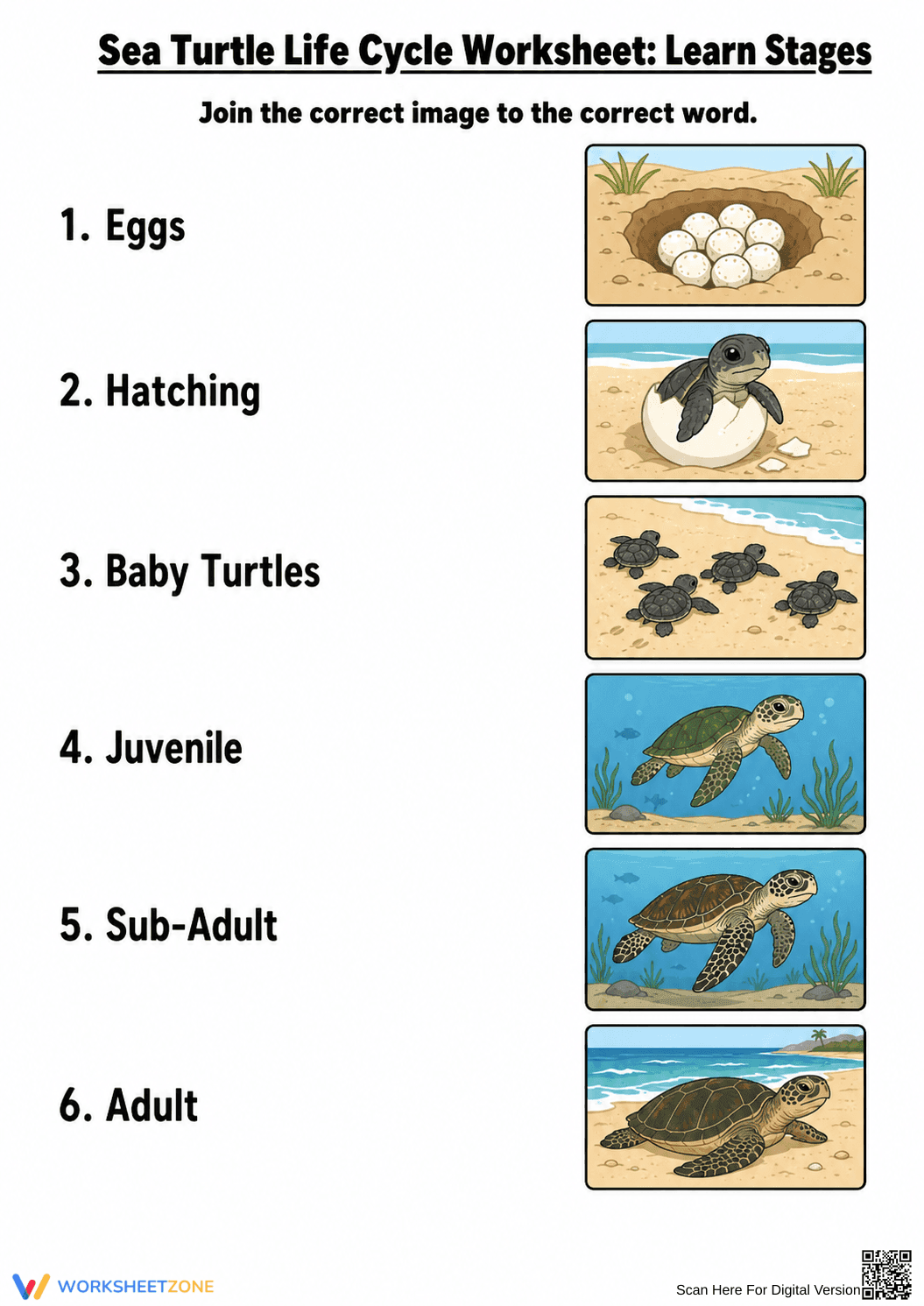

Sea Turtle Life Cycle Worksheet | Grade 3 Essential
Paste this activity's link or code into your existing LMS (Google Classroom, Canvas, Teams, Schoology, Moodle, etc.).
Students can open and work on the activity right away, with no student login required.
You'll still be able to track student progress and results from your teacher account.
This Grade 3 science worksheet provides a clear visual framework for students to identify the developmental stages of a sea turtle. By connecting vocabulary terms to high-quality illustrations, learners build a concrete mental model of biological growth and development. This activity ensures students can distinguish between early hatching phases and mature adult characteristics before moving to more complex biological systems.
At a Glance
- Grade: 3 · Subject: Science
- Standard:
3-LS1-1— Develop models to describe that organisms have unique and diverse life cycles- Skill Focus: Sea Turtle Life Cycle Stages
- Format: 1 page · 6 problems · Answer key included · PDF
- Best For: Independent practice or science centers
- Time: 10–15 minutes
The worksheet features a clean, vertical layout with six specific vocabulary terms on the left: Eggs, Hatching, Baby Turtles, Juvenile, Sub-Adult, and Adult. On the right, six detailed color illustrations correspond to these biological milestones. This single-page PDF is designed for immediate use, requiring no additional cutting or gluing, making it an efficient tool for reinforcing marine biology concepts in a busy classroom environment.
Zero-Prep Workflow:
- Print (30 seconds): Simply download the PDF and print enough copies for your class or small group.
- Distribute (30 seconds): Hand out the sheets as a warm-up or a quick check for understanding after a lesson on marine life.
- Review (1 minute): Use the provided answer key to quickly verify student accuracy or project the worksheet for a whole-class review.
Total teacher preparation time is under 2 minutes, making this an ideal resource for substitute folders or last-minute lesson additions.
This resource is aligned with 3-LS1-1, which requires students to develop models to describe that organisms have unique and diverse life cycles. By matching the stages, students are essentially constructing a linear model of growth. Both standard codes can be copied directly into lesson plans, IEP goals, or district curriculum mapping tools.
Use this worksheet as a formative assessment after reading a text about sea turtles. As students work, circulate to observe if they can distinguish between the "Juvenile" and "Sub-Adult" stages, which requires careful attention to visual scale and detail. It also works well as a quiet activity for students who finish their primary science lab work early. Expected completion time ranges from 10 to 15 minutes.
This activity is designed for elementary students in grades 2 through 4 who are exploring life sciences. It is particularly effective for English Language Learners (ELLs) because the heavy visual scaffolding supports vocabulary acquisition without overwhelming text. Pair this with a short video of a sea turtle nesting or an anchor chart showing various marine animal life cycles for a complete instructional block.
According to the RAND AIRS 2024 report on elementary science instruction, visual-to-text matching activities significantly improve the retention of domain-specific vocabulary in early learners. This worksheet addresses the 3-LS1-1 standard by requiring students to recognize the specific sequence of birth, growth, and maturation in a marine organism. By isolating the six distinct stages of the sea turtle life cycle—from eggs to adult—the resource provides a structured pathway for students to meet NGSS expectations for modeling biological processes. Research indicates that such scaffolded visual models help bridge the gap between abstract scientific concepts and observable natural phenomena. This standalone summary confirms that the worksheet is a research-backed tool for developing foundational biology skills in a classroom setting, ensuring that students can accurately describe how organisms change over time.


