


























Views
Downloads

Sea Turtle Life Cycle Printable Worksheet | Grade 3
Paste this activity's link or code into your existing LMS (Google Classroom, Canvas, Teams, Schoology, Moodle, etc.).
Students can open and work on the activity right away, with no student login required.
You'll still be able to track student progress and results from your teacher account.
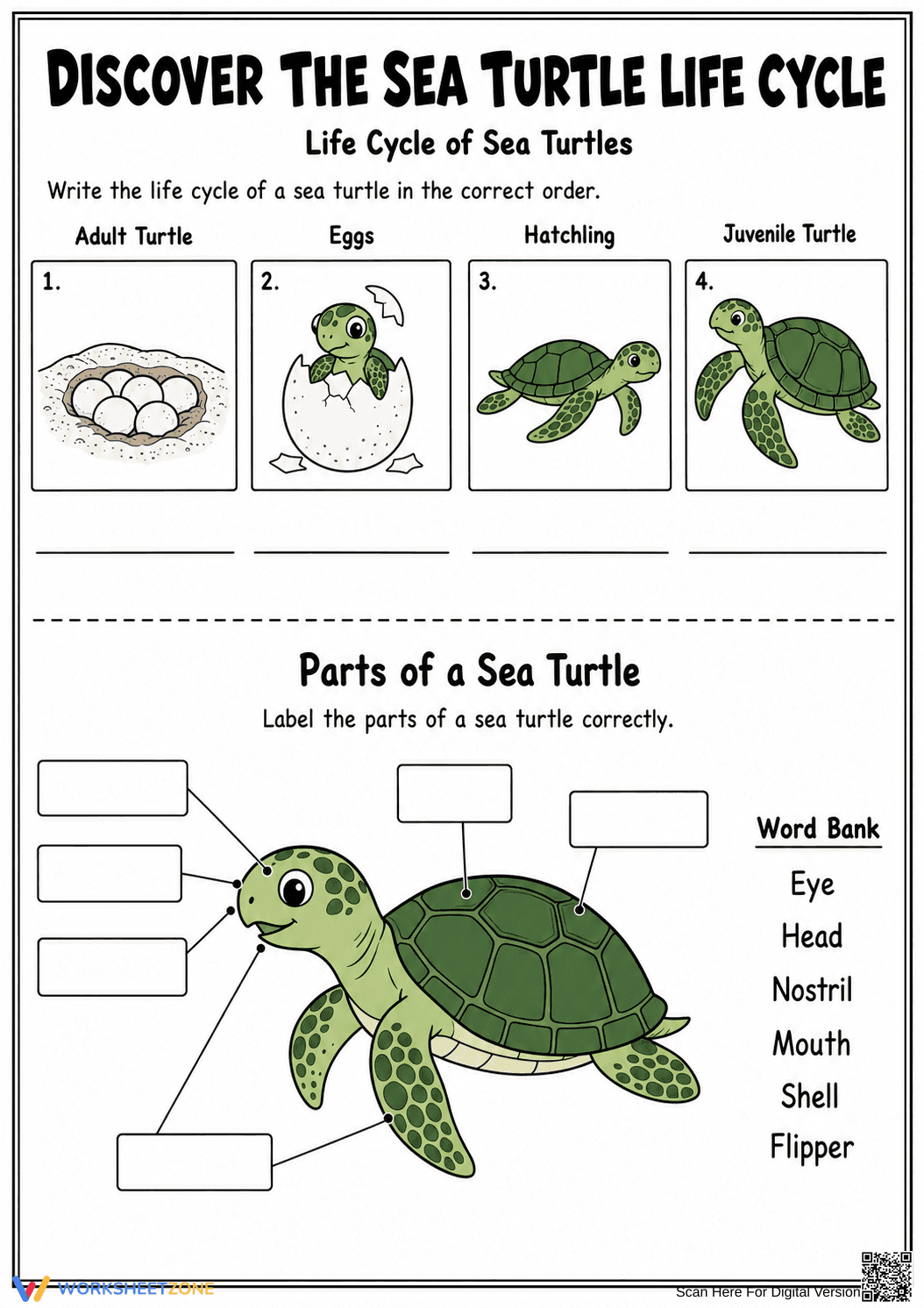
This Grade 3 science worksheet helps students master the stages of a sea turtle's development and basic marine anatomy. By sequencing the life cycle and labeling physical traits, learners build foundational biology skills while reinforcing domain-specific vocabulary.
At a Glance
- Grade: 3 · Subject: Science
- Standard:
3-LS1-1— Describe that organisms have unique and diverse life cycles.- Skill Focus: Sequencing life cycles and labeling anatomy
- Format: 1 page · 10 problems · Answer key included · PDF
- Best For: Independent practice
- Time: 10–15 minutes
This single-page resource features two distinct activities to solidify student understanding. The top section requires learners to sequence four developmental stages—eggs, hatchling, juvenile, and adult—using clear visual cues. The bottom section provides a diagram of a sea turtle alongside a six-term word bank, prompting students to accurately label anatomical features like the shell, flipper, and nostril. A complete answer key is included for quick grading.
Designed for immediate classroom implementation, this resource requires minimal teacher setup:
- Print (1 minute): Generate copies of the single-page PDF for the entire class.
- Distribute (1 minute): Hand out the worksheets along with pencils. No scissors or glue required.
- Review (2 minutes): Quickly check student responses using the provided answer key.
With under two minutes of total prep time, this activity is an excellent addition to emergency sub plans or busy instructional days.
This worksheet is directly aligned to 3-LS1-1: Develop models to describe that organisms have unique and diverse life cycles but all have in common birth, growth, reproduction, and death. It also supports early vocabulary acquisition by requiring students to match scientific terms to visual representations. Both standard codes can be copied directly into lesson plans, IEP goals, or district curriculum mapping tools.
Integrate this worksheet into your science block. It serves as an excellent independent practice activity following a direct instruction lesson on marine biology or animal life cycles. Alternatively, use it as a formative assessment tool at the end of a unit to gauge student retention of key vocabulary and sequencing concepts. While students work, teachers can observe whether they rely heavily on the word bank or can identify anatomical parts independently. Expect most students to complete the tasks within 10 to 15 minutes.
This resource is primarily designed for third-grade students, though it is easily adaptable for second or fourth graders studying marine life. The clear visuals and structured word bank provide built-in scaffolding for English Language Learners and students needing additional reading support. Pair this worksheet with an informational text about sea turtles or a classroom anchor chart detailing animal life cycles for maximum impact.
Understanding biological sequencing through resources like this 3-LS1-1 aligned activity is crucial for early science education. When students describe that organisms have unique and diverse life cycles, they develop foundational systems-thinking skills necessary for advanced scientific inquiry. According to a 2024 report by EdReports, integrating visual models with domain-specific vocabulary significantly improves long-term retention of biological concepts in elementary learners. By combining a sequencing task with an anatomical labeling exercise, this worksheet provides multiple pathways for students to encode the information. The dual-format approach ensures that learners not only memorize the stages of development but also understand the physical adaptations associated with marine survival. This targeted practice helps solidify core science standards while building the academic language required for future STEM success.


