


























Views
Downloads
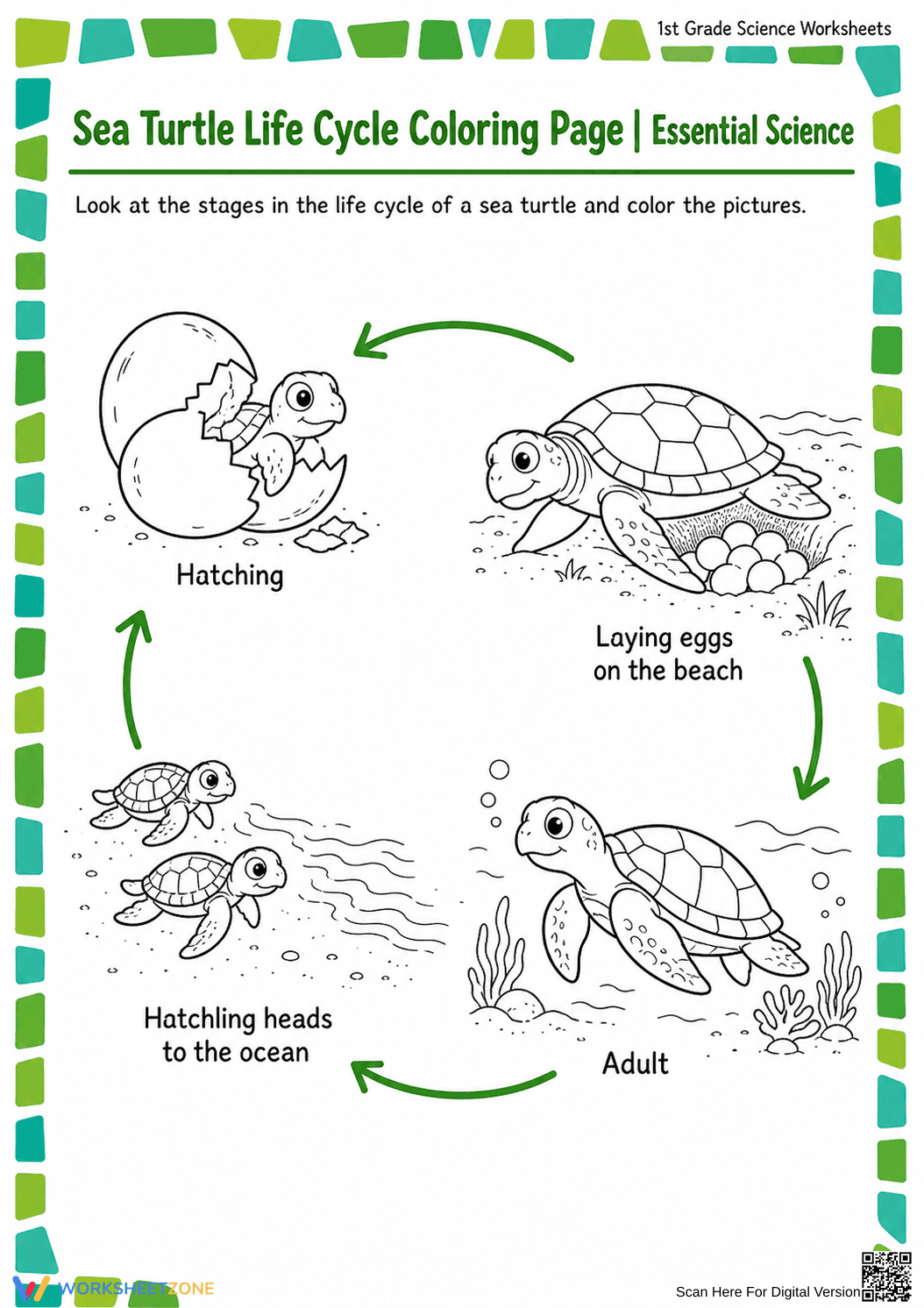

Grade 1 Sea Turtle Life Cycle — Printable No-Prep Worksheet
Paste this activity's link or code into your existing LMS (Google Classroom, Canvas, Teams, Schoology, Moodle, etc.).
Students can open and work on the activity right away, with no student login required.
You'll still be able to track student progress and results from your teacher account.
This Grade 1 science worksheet introduces students to the biological progression of marine life by exploring the sea turtle life cycle. By coloring and reviewing the four distinct stages of growth, young learners develop a foundational understanding of how animals grow, reproduce, and continue their species.
At a Glance
- Grade: 1 · Subject: Science
- Standard:
3-LS1-1— Develop models to describe organism life cycles- Skill Focus: Life cycle sequencing
- Format: 1 page · 4 tasks · No answer key needed · PDF
- Best For: Independent practice and science centers
- Time: 15–20 minutes
Inside this single-page PDF, students find a circular diagram illustrating a sea turtle's journey from egg to adult. The worksheet features four specific coloring tasks corresponding to the life stages: hatching from the egg, the hatchling's journey to the ocean, the fully grown adult, and the nesting process on the beach. Each stage includes easy-to-read labels and directional arrows to emphasize the continuous, cyclical nature of life.
This resource is designed for immediate classroom implementation with a zero-prep workflow. First, print the required number of copies (30 seconds). Second, distribute the pages during your science block or as a transition activity (1 minute). Third, review the sequence as a class to reinforce vocabulary before students begin coloring (5 minutes). Total teacher prep time is under two minutes, making this an excellent, self-explanatory option for emergency sub plans or quick science centers.
This worksheet aligns with 3-LS1-1, which requires students to develop models to describe that organisms have unique and diverse life cycles. While designed with 1st-grade appropriate visuals and vocabulary, it serves as an excellent introductory model for this foundational life science standard. Both standard codes can be copied directly into lesson plans, IEP goals, or district curriculum mapping tools.
Use this worksheet as a formative assessment after reading a picture book about sea turtles or marine biology. Observe if students can correctly identify the nesting stage as the beginning of a new cycle rather than just the end of the adult's journey. It also works exceptionally well as a quiet-time activity for students who finish their primary science lab early. Expected completion time is 15 to 20 minutes, depending on the level of detail students put into their coloring.
This resource is perfect for 1st-grade science students, but the highly visual nature makes it incredibly effective for English Language Learners (ELLs) and students with IEPs who benefit from non-linguistic representations of academic concepts. Pair this coloring page with a short video of a real sea turtle hatching to bridge the gap between the printed diagram and real-world biology.
According to research by Fisher & Frey (2014) on the gradual release of responsibility, visual models like this sea turtle life cycle worksheet are essential for scaffolding complex scientific vocabulary. The resource addresses standard 3-LS1-1 by allowing students to develop models to describe organism life cycles through the birth, growth, and reproduction phases of a marine reptile. By coloring and identifying the four stages—hatching, hatchling migration, adulthood, and nesting—students internalize the concept that life cycles are continuous loops rather than linear paths. This type of graphic organizer reduces cognitive load, enabling younger learners to grasp biological sequences that might otherwise be too abstract. Educational analysis suggests that integrating creative tasks like coloring with factual labeling increases retention of science terminology. This worksheet provides a reliable, research-backed method for introducing life science fundamentals in a low-stakes, high-engagement format suitable for diverse classroom environments.


