


























Views
Downloads
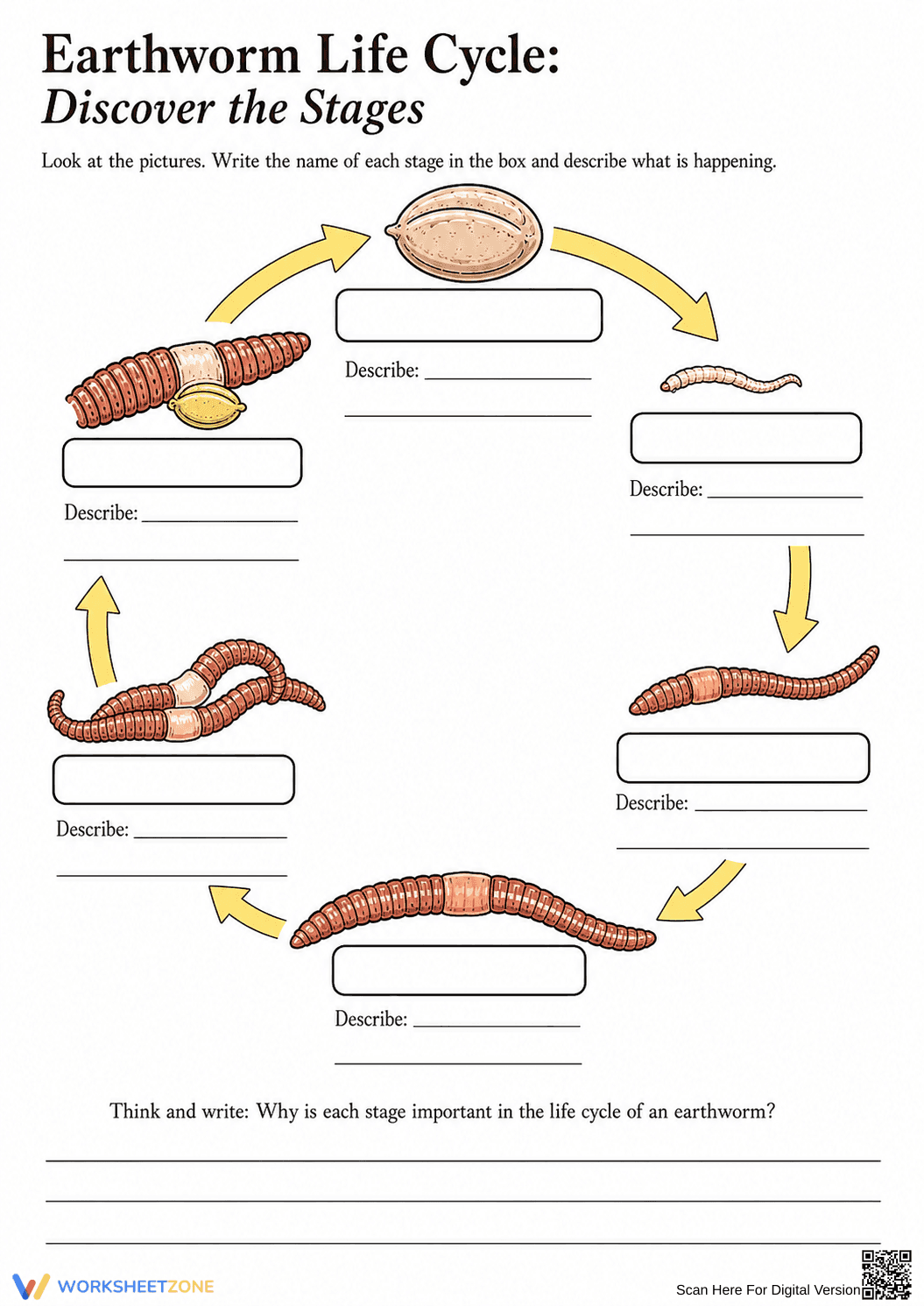

Earthworm Life Cycle Printable Worksheet | Grade 3 Science
Paste this activity's link or code into your existing LMS (Google Classroom, Canvas, Teams, Schoology, Moodle, etc.).
Students can open and work on the activity right away, with no student login required.
You'll still be able to track student progress and results from your teacher account.
This Grade 3 science worksheet helps students visualize the earthworm life cycle. By labeling a diagram and writing brief descriptions, learners solidify their understanding of how organisms grow and reproduce. It provides a structured way to master biological life cycles.
At a Glance
- Grade: 3 · Subject: Science
- Standard:
3-LS1-1— Develop models to describe organism life cycles- Skill Focus: Identifying and describing life cycle stages
- Format: 1 page · 7 problems · Answer key included · PDF
- Best For: Independent practice or science centers
- Time: 15–20 minutes
This single-page resource features a six-stage circular diagram illustrating the progression from cocoon to adult earthworm. Students name each stage and write a short description of the biological changes. The worksheet concludes with a critical-thinking prompt asking students to explain the importance of each phase. A complete answer key is included.
- Print (1 min): Download the PDF and print a class set.
- Distribute (1 min): Hand out as a standalone assignment or alongside a science reading.
- Review (2 mins): Use the included answer key to quickly check responses.
Total teacher prep time is under two minutes, making this an excellent option for sub plans.
This resource is aligned to 3-LS1-1: Develop models to describe that organisms have unique and diverse life cycles but all have in common birth, growth, reproduction, and death. By analyzing the visual model, students meet the core expectations. Both standard codes can be copied directly into lesson plans, IEP goals, or district curriculum mapping tools.
Deploy this worksheet during independent practice, following direct instruction on invertebrate life cycles. It also serves as an interactive science center station. As a formative assessment tip, review the final short-answer question to gauge whether students understand the broader biological purpose of reproduction and growth. Expect completion in 15 to 20 minutes.
Designed for third-grade students, this easily scales for fourth graders reviewing biology concepts. The visual scaffolds make it accessible for English Language Learners needing visual aids. Pair this activity with a hands-on earthworm observation lab to maximize engagement.
Effectively teaching biological concepts requires visual modeling and structured writing opportunities. Standard 3-LS1-1 requires students to develop models to describe organism life cycles, moving beyond simple memorization to conceptual understanding. According to a ScienceDirect TpT Analysis, integrating visual diagrams with descriptive writing tasks significantly improves vocabulary retention and conceptual mapping in elementary science education. When students actively label and describe the earthworm life cycle, they process the information through multiple modalities, strengthening their cognitive schema for how organisms grow and reproduce. This dual-coding approach ensures that learners can transfer their understanding of this specific invertebrate to broader biological principles. By combining clear illustrations with targeted prompts, educators can reliably assess student mastery of life science standards while fostering critical thinking about ecosystem dynamics and organism survival strategies.


