What Isotope Practice Worksheets Actually Build
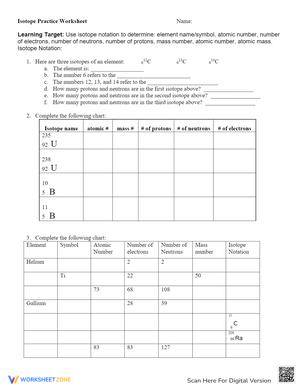
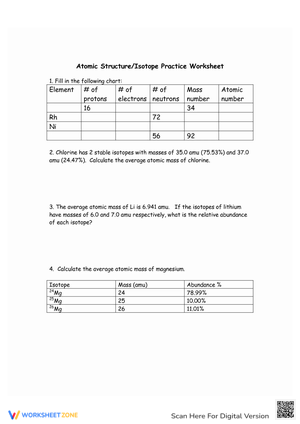
When students first meet isotopes, the vocabulary moves faster than the reasoning. They can define an isotope, but they stumble the moment they have to count neutrons or explain why the periodic table lists 35.45 for chlorine instead of a whole number. Good isotope practice worksheets close that gap. They give students repeated, low-stakes reps on the three skills that anchor an atomic structure unit: counting subatomic particles, reading and writing isotope notation, and calculating weighted average atomic mass.
For US physical science and chemistry teachers, this is usually a grades 8-10 skill. The worksheets work as bell-ringers, formative checks, sub plans, and review before a unit test. Because every problem has a clear right answer, they're easy to grade quickly and easy to hand to a substitute without a long explanation.
Protons, Neutrons, and Isotope Notation
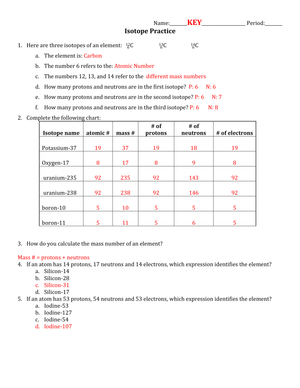
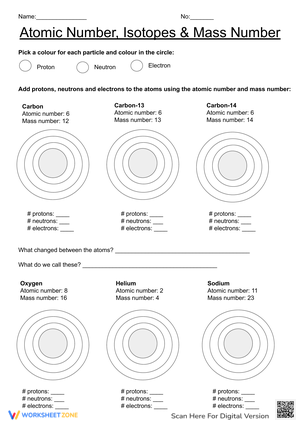
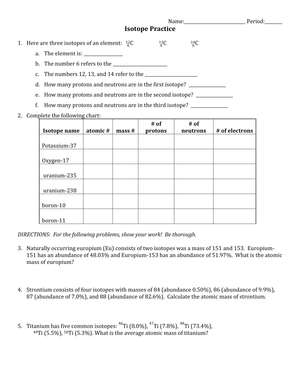
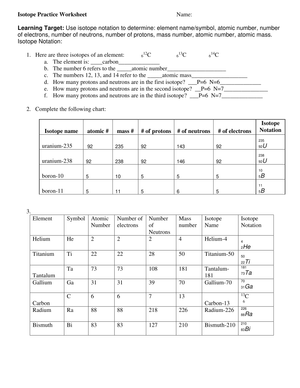
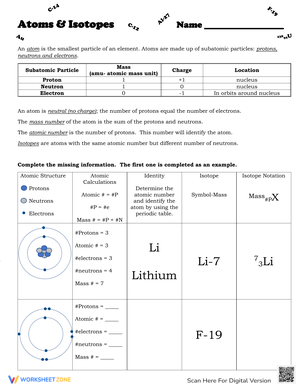
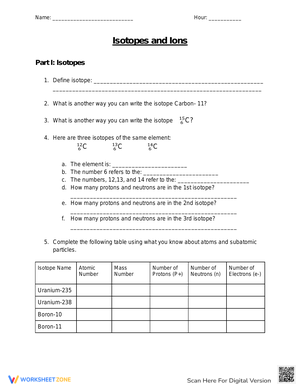
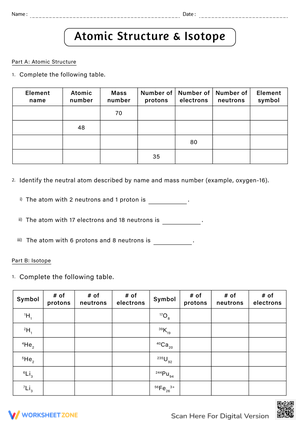
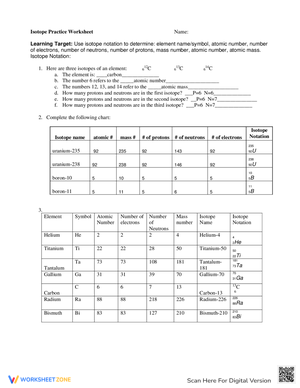
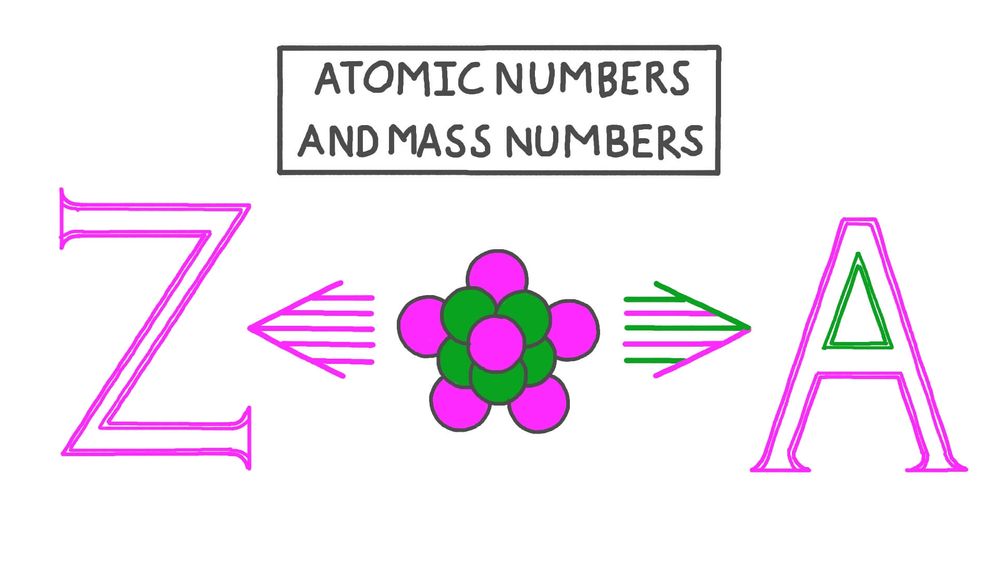
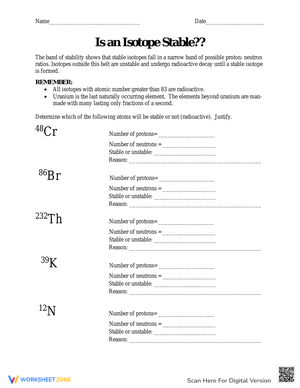
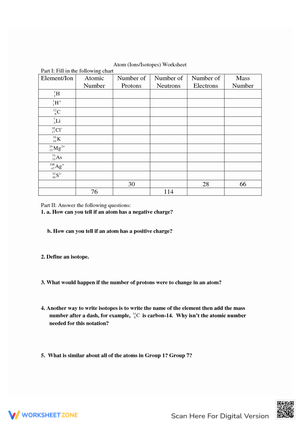
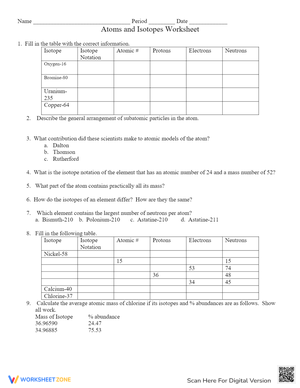
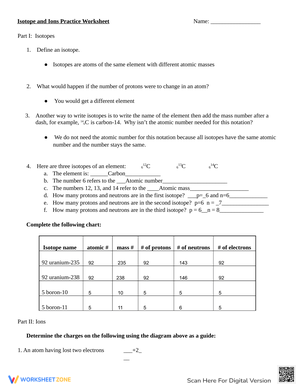
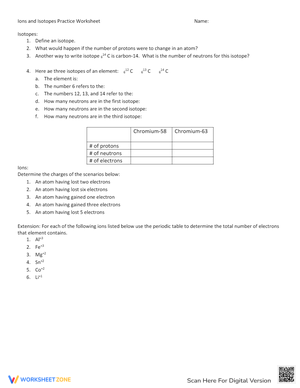
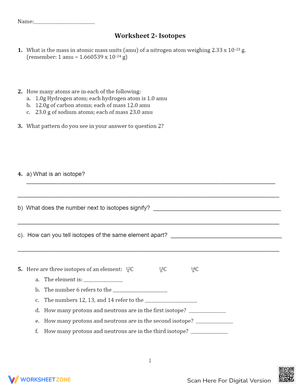
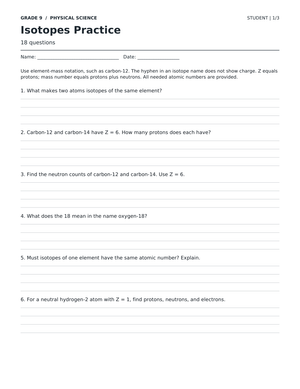
The first fluency target is particle counting. Students need to internalize that the atomic number equals the proton count, that neutrons equal mass number minus atomic number, and that a neutral atom has electrons equal to its protons. Isotopes of the same element keep the same proton count but differ in neutrons, which is exactly what changes the mass number.
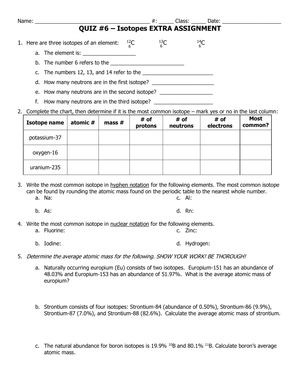
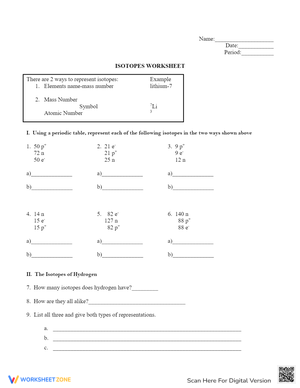
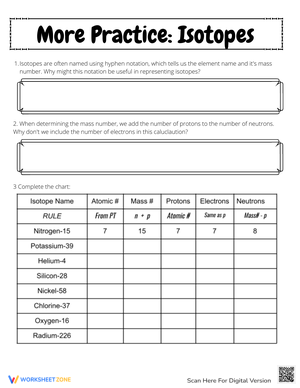
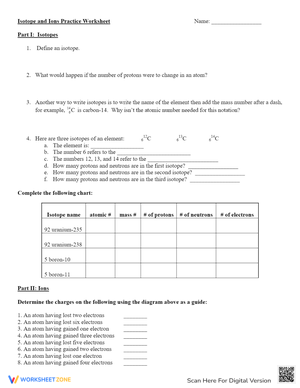
The second target is notation. Students routinely confuse A/Z notation with hyphen notation, and mixing the two is a frequent source of errors. A worksheet that asks students to convert carbon-14 into its full symbol, then read the atomic number and mass number back out, forces the connection instead of letting them memorize a format. Ask for both directions in the same problem set so students can't lean on one representation.
Teaching Weighted Average Atomic Mass
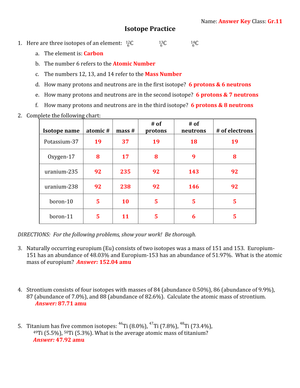
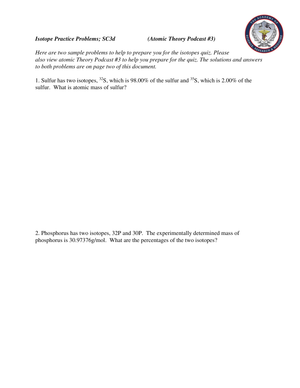
The step that separates on-level from advanced work is weighted average atomic mass. Students often assume they should average mass numbers directly, so they take chlorine-35 and chlorine-37 and land on 36. The correction is abundance. Chlorine-35 makes up about 75.8% of natural chlorine and chlorine-37 about 24.2%, and weighting each mass by those percentages gives roughly 35.45 amu, which matches the periodic table exactly.
Here is the move that pays off on the unit test: have students predict, before calculating, which isotope the average sits closer to. Because the answer is nearer 35 than 37, they should reason that the lighter isotope is more abundant. Students who can explain that direction almost always set up the arithmetic correctly, while students who jump straight to the calculator tend to invert the percentages. The prediction step is a thirty-second habit that catches the most common weighted-average error.
According to the Next Generation Science Standards, performance expectation HS-PS1-1 asks students to use the periodic table as a model to predict the properties of elements based on the patterns of electrons in atoms. That framing makes isotope and atomic-mass practice a direct on-ramp to the standard, because students are reading the table as a model rather than a lookup chart.
Sequencing Atoms, Isotopes, and Ions
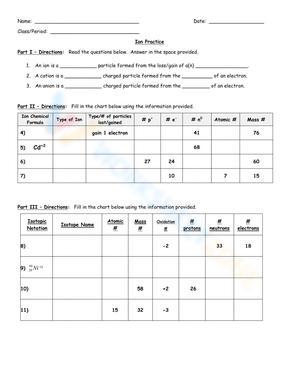
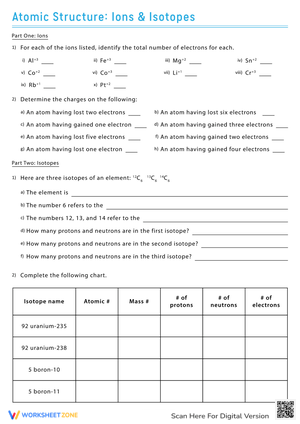
Isotope practice lands better when it sits inside a clear progression: neutral atoms first, then isotopes, then ions. Students who are still shaky on neutral atoms will conflate the two changes that a symbol can show. An isotope changes the neutron count and the mass number; an ion changes the electron count and the charge. When both ideas arrive in the same week without a clear order, students start believing that a charge and a mass difference are the same thing.
Pairing an isotope worksheet with an ion worksheet the following day, using the same elements, lets students see that the proton count never moved. That controlled comparison is where the distinction finally sticks.
Differentiating for On-Level and Advanced Students
One worksheet topic can serve very different learners. For students who need support, keep the task to counting protons, neutrons, and electrons from a given symbol, and to translating between hyphen and A/Z notation. Success there is a real win and builds the confidence needed for the next layer.
For advanced students, move to abundance and mass calculations, including reverse problems: given the average atomic mass and two isotope masses, solve for the percent abundance of each. That reverse setup pushes students into algebraic reasoning and reveals whether they truly understand weighting or have only memorized a formula.
Using These Worksheets In Chemistry Lectures
Start with a five-minute bell-ringer that asks for the neutrons in three different isotopes of the same element. It surfaces the same-protons, different-neutrons pattern before you say a word. Mid-unit, use a half-page formative check to sort students into two small groups: one that still needs particle-counting reps and one ready for weighted-mass problems.
Keep an answer key visible during independent practice for self-checking, but ask students to write a short reason next to any answer they correct. For small-group intervention, shrink the number of problems and increase the number of representations, so a struggling student works the same element three ways instead of racing through ten unrelated items. Before the unit test, a mixed review sheet that blends notation, particle counting, and one abundance problem gives you a reliable read on who is ready.
Frequently Asked Questions
1. How do isotope practice worksheets align with NGSS standards?
They support HS-PS1-1, which asks students to use the periodic table as a model to predict element properties from atomic structure. Reading average atomic mass and interpreting isotope notation are concrete ways students practice treating the table as a predictive model rather than a static reference.
2. What grade level is isotope practice appropriate for?
Isotope practice fits grades 8-10, spanning middle school physical science and high school chemistry. Younger students focus on counting protons, neutrons, and electrons and on notation, while high school students add weighted average atomic mass and abundance calculations that require algebraic reasoning.
3. How can teachers use these worksheets to teach average atomic mass?
Use real abundance data instead of round numbers. Chlorine-35 at about 75.8% and chlorine-37 at about 24.2% weight out to roughly 35.45 amu, matching the periodic table. Having students predict which isotope the average sits closer to prevents the most common setup error.
4. How should isotope and ion worksheets be sequenced?
Teach neutral atoms first, then isotopes, then ions. Isotopes change neutrons and mass number; ions change electrons and charge. Pairing the two worksheets on consecutive days with the same elements shows students that the proton count never changes, which keeps the two ideas from blurring together.
5. How can these worksheets support small-group intervention?
For struggling students, reduce the number of problems and work one element in multiple representations rather than many unrelated items. Keep an answer key available for self-checking, and ask students to justify each correction in a short sentence so you can see where the reasoning breaks down.












 Interactive Worksheet Maker
 Quiz Maker
 Word Search Maker
 Crossword Puzzle Maker
 Word Scramble Generator
 Sentence Scramble Generator
 Handwriting Worksheet Generator
 Name Tracing Generator
 Fill In The Blank Generator