


























Views
Downloads

Isotopes Practice Worksheet | Grade 9 Science Essential
Paste this activity's link or code into your existing LMS (Google Classroom, Canvas, Teams, Schoology, Moodle, etc.).
Students can open and work on the activity right away, with no student login required.
You'll still be able to track student progress and results from your teacher account.
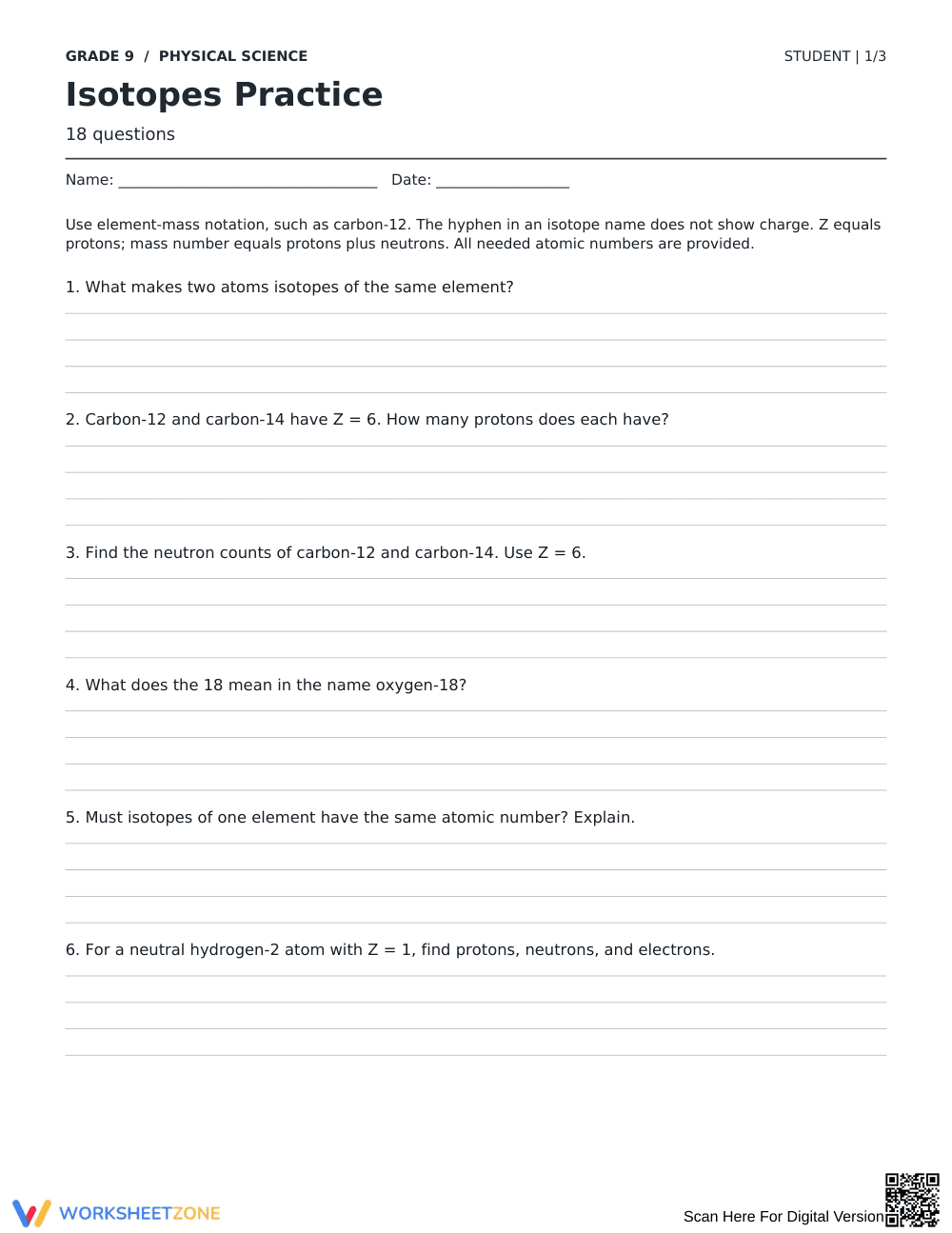
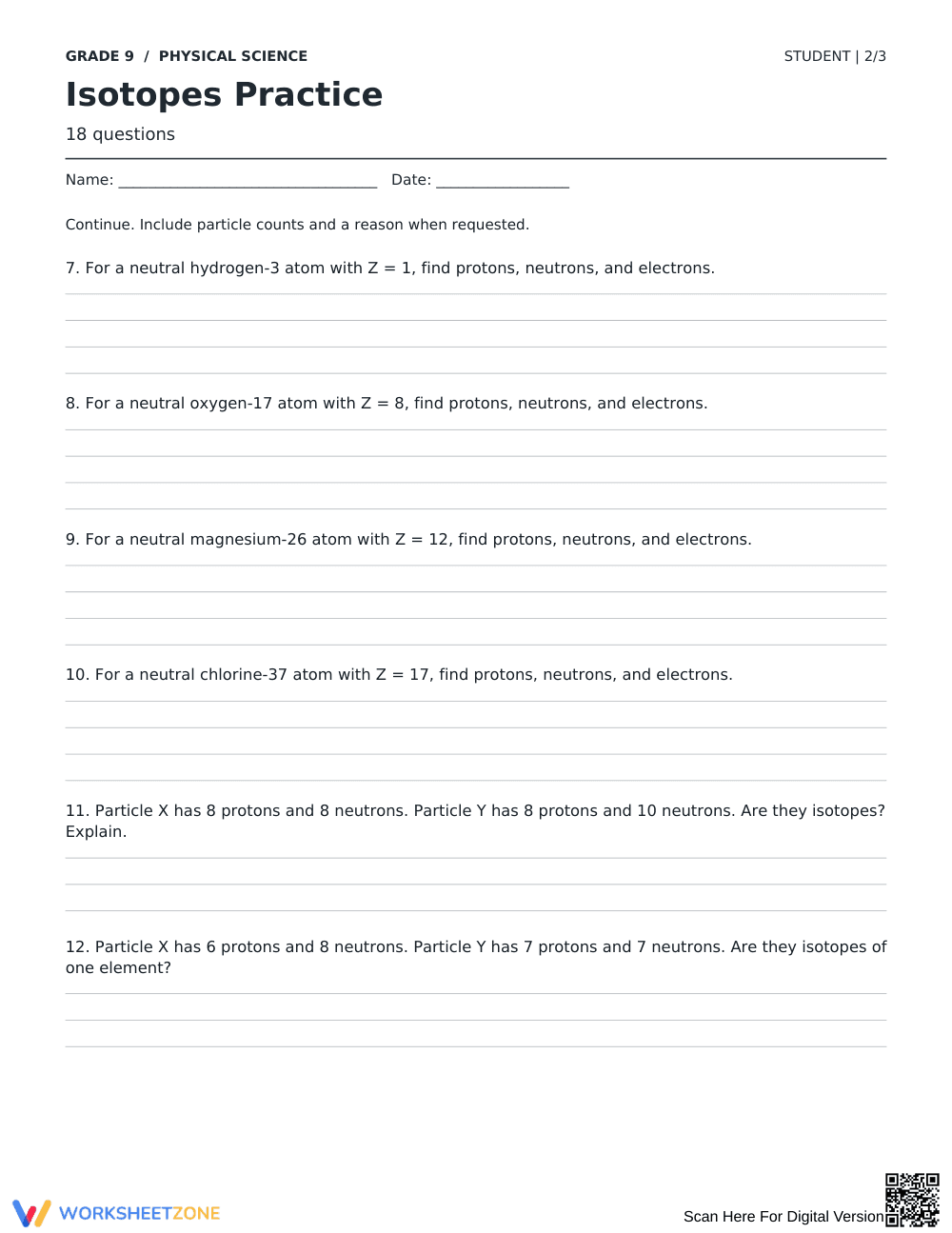
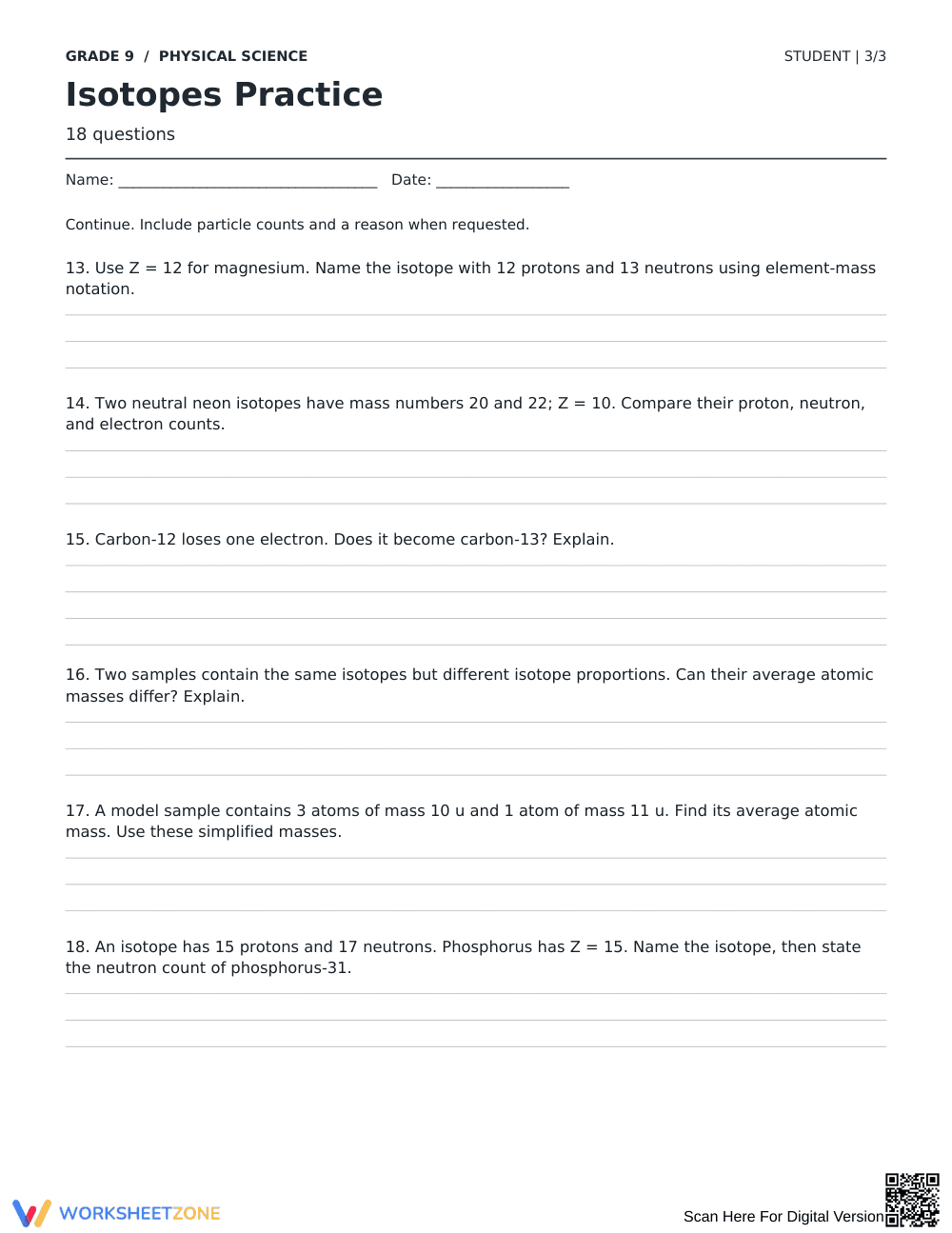
This Grade 9 physical science worksheet reinforces how subatomic particles define atomic identity and isotopic variation. Students analyze mass numbers, calculate protons, neutrons, and electrons across 18 targeted questions, and evaluate average atomic mass concepts. By connecting isotope notation directly to nuclear composition, learners build fundamental chemical literacy for secondary science coursework.
At a Glance
- Grade: 9 · Subject: Physical Science
- Standard:
HS-PS1-1— Use subatomic structures to understand atomic identity and isotopic composition- Skill Focus: Subatomic particle calculations, mass numbers, and isotope notation
- Format: 3 student pages · 18 practice problems · Full answer key included · PDF document
- Best For: Independent practice, homework review, or sub plans
- Time: 25–40 minutes
This three-page printable resource features 18 structured questions arranged in clear progression. Students interpret element-mass notation, determine nuclear composition from atomic number and mass number, classify particle pairs as isotopes, and calculate simple average atomic masses. A two-page answer key provides complete numerical solutions and conceptual explanations for rapid grading.
Skill Progression
- Guided practice (Problems 1–5): Conceptual prompts establish isotope terminology, verify that atomic numbers remain constant, and scaffold neutron calculations.
- Supported practice (Problems 6–12): Structured questions prompt students to deduce proton, neutron, and electron counts for neutral isotopes and evaluate mystery particle pairs.
- Independent practice (Problems 13–18): Application items challenge students to distinguish ions from isotopes, interpret abundances, and compute average atomic mass.
This sequence follows an "I Do, We Do, You Do" gradual-release framework, moving students smoothly from basic recall to quantitative mastery.
Standards Alignment
This resource supports `HS-PS1-1`: Use the periodic table as a model to predict the relative properties of elements based on the patterns of electrons in the outermost energy level of atoms. While focused on prerequisite atomic substructure under Disciplinary Core Idea PS1.A, it provides essential groundwork for modeling atomic structure. Both standard codes can be copied directly into lesson plans, IEP goals, or district curriculum mapping tools.
How to Use It
Assign this worksheet following direct instruction on nuclear notation. During independent practice, check whether students subtract atomic number from mass number rather than confusing electrons with neutrons. The resource functions effectively as a 25–40 minute class assignment, homework set, or sub plan review.
Who It's For
This practice set serves Grade 9 Physical Science and introductory Chemistry students requiring targeted reinforcement of atomic structure. Reference formulas at the top of page one scaffold learning for diverse needs. Pair this activity with a classroom periodic table chart to anchor understanding.
Aligned to standard `HS-PS1-1`, this printable worksheet develops student competence in calculating subatomic particles, writing element-mass notation, and distinguishing isotopes based on neutron variance. Mastery of atomic composition forms a vital prerequisite for understanding periodic trends, chemical bonding, and nuclear stability. According to research documented in Fisher & Frey (2014), systematic gradual-release sequences that move from guided conceptual definitions to independent quantitative problem sets significantly enhance content retention and problem-solving automaticity in secondary STEM classrooms. By grounding abstract atomic terminology in concrete arithmetic tasks across 18 sequential exercises, this resource reinforces conceptual clarity while helping educators identify common student misconceptions regarding electric charge and mass numbers. The accompanying two-page detailed answer key facilitates targeted feedback, supporting educators in delivering standards-aligned physical science instruction that bridges prerequisite subatomic facts with advanced chemical modeling expectations.


