


























Views
Downloads



Complete Isotopic Composition Worksheet | Grade 11 Chemistry
Paste this activity's link or code into your existing LMS (Google Classroom, Canvas, Teams, Schoology, Moodle, etc.).
Students can open and work on the activity right away, with no student login required.
You'll still be able to track student progress and results from your teacher account.
This worksheet teaches students to evaluate a sample's isotopic composition using weighted averages and abundance constraints. Students decide which abundance sets are possible, solve for unknown abundances, and judge whether a written conclusion holds up against the numbers.
At a Glance
- Grade: 11 · Subject: Chemistry
- Standard: Not specified — students apply weighted averages and abundance limits to test isotope data
- Skill Focus: Evaluate a sample's isotopic composition with weighted averages
- Format: 5 pages · 10 problems · Answer key included · PDF
- Best For: Weighted-average practice after isotope instruction
- Time: 35–45 minutes
What's Inside
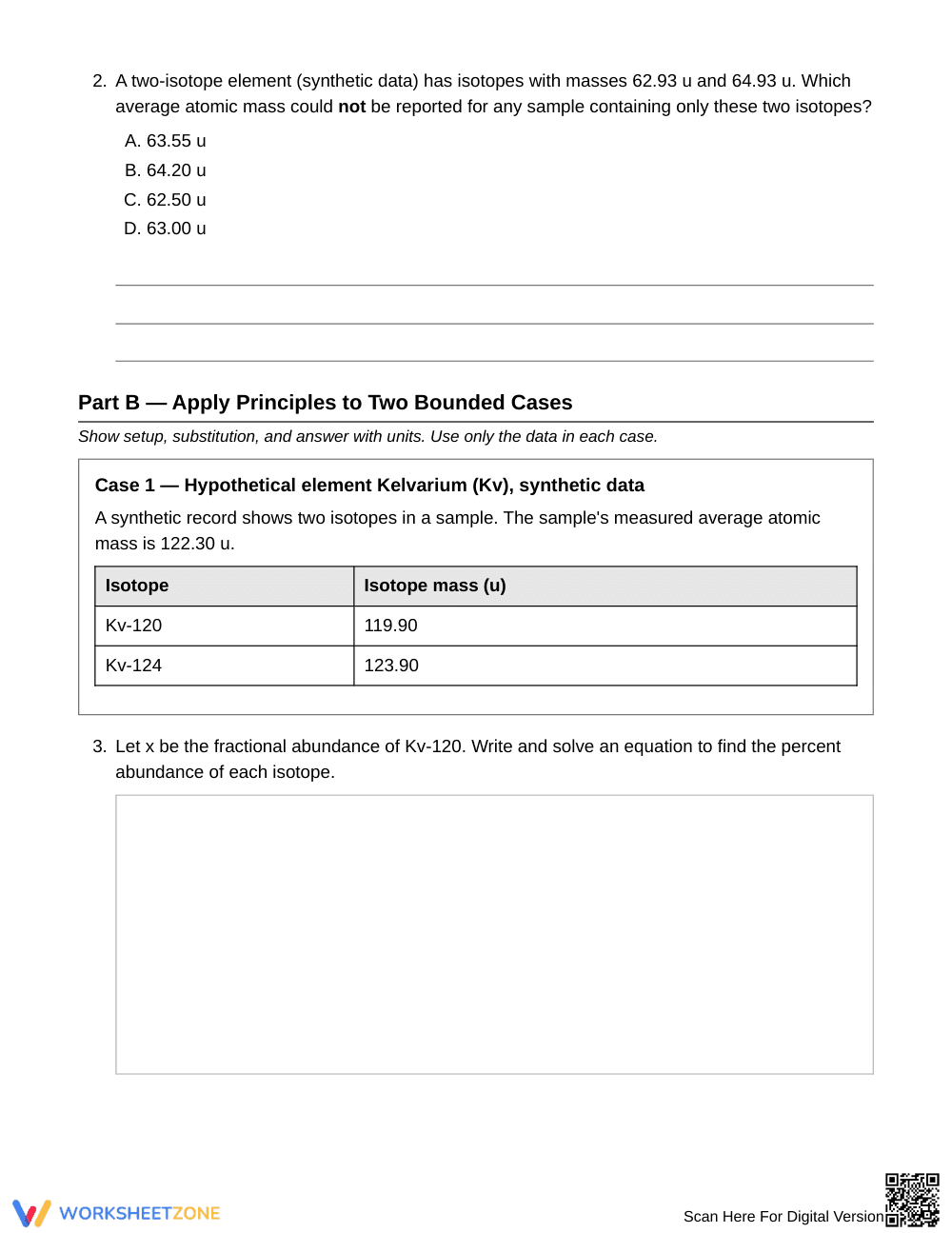
The worksheet has three parts: multiple-choice items with written justification, two bounded calculation cases (a synthetic element and chlorine), and two evaluate-the-conclusion tasks. A reference box states the weighted-average formula, abundance constraints, and rounding rules. A 2-page answer key is included.
Skill Progression
- Guided practice (Part A, 2 items): Students apply the constraints to pick a possible abundance set and a possible average mass, then justify the choice in a sentence or two.
- Supported practice (Part B, 6 items): Students set up and solve equations for abundances, ion counts, enrichment, and natural chlorine, with the reference box available.
- Independent practice (Part C, 2 items): Students test a claim about Kv and a boron report using their own calculations.
The sequence follows a gradual-release model: I Do, We Do, You Do.
Standards Alignment
No standard code was supplied for this resource, so none is listed. The tasks target a core atomic structure skill: using isotope masses and relative abundances to calculate and reason about average atomic mass. Teachers can paste that skill statement into lesson plans, IEP goals, or district curriculum mapping tools and attach their local standard.
How to Use It
- After direct instruction: Assign Parts A and B as in-class practice once students have seen a weighted-average example.
- As a check for understanding: Use Part C as an exit task or homework.
Formative tip: watch Items 5 and 10 to see whether students check results against the 100% total and the mass range. Expect 35 to 45 minutes for the full set.
Who It's For
Grade 11 chemistry students in an atomic structure and isotopes unit. Students who need support can start with Part A and the reference box, while stronger students can spend more time on the reasoning in Part C. It pairs well with a mass spectrum anchor chart or a lesson on atomic mass.
This Grade 11 chemistry worksheet, Evaluating a Sample's Isotopic Composition, asks students to test isotope data against two rules: abundances must total 100%, and a weighted average atomic mass must fall between the lightest and heaviest isotope masses. Across 10 tasks and 5 pages, students identify possible abundance sets, solve for unknown abundances from a measured average mass, convert abundances to ion and atom counts, and judge written conclusions with calculations. The resource carries no assigned standard code, so teachers can map it to their own atomic structure objectives. Its sequence from selecting and justifying, to computing, to evaluating follows the gradual-release model described by Fisher & Frey (2014), in which responsibility shifts from teacher-supported work toward independent reasoning. A two-page answer key supports quick checking and feedback during the 35 to 45 minute session.


