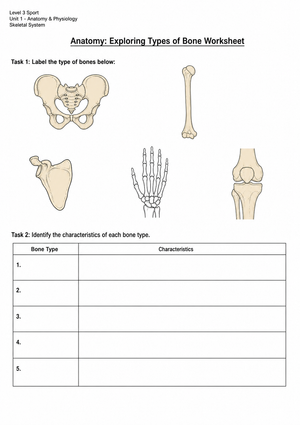
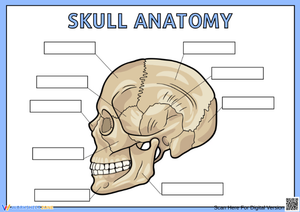
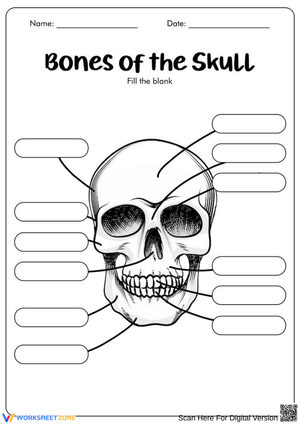
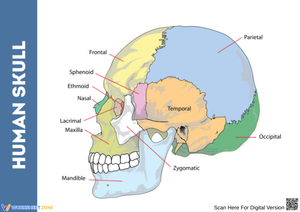
Elementary teachers are often asked to cover the skeletal system in a single week or two, which makes ready-to-use worksheets especially valuable. Rather than building labeling diagrams and vocabulary sheets from scratch, teachers can pull a worksheet set that already sequences from simple bone identification toward more complex reasoning about how bones work with muscles and joints. This saves prep time during a busy unit and keeps the content grade-appropriate.
Bones worksheets also give teachers a low-stakes way to check for understanding before moving into more hands-on activities. A quick labeling page at the start of class tells you within minutes whether students remember the skull, ribs, spine, and femur from the day before, which helps you decide whether to review or move forward.
Aligning Bones Worksheets with NGSS 4-LS1-1
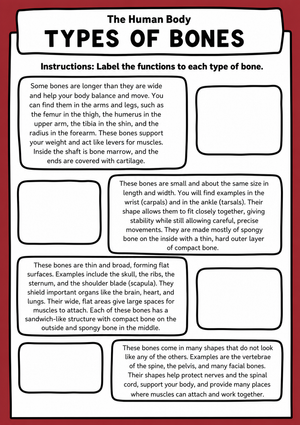
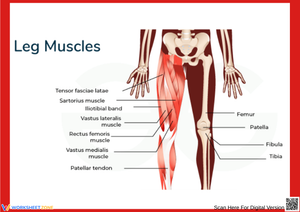
Upper elementary teachers planning around NGSS 4-LS1-1 will find that bones worksheets map directly onto the standard's focus on how internal and external structures of animals, including humans, function in growth, survival, and movement. A worksheet that asks students to match a bone to its job, such as the ribs protecting the lungs or the femur supporting body weight during movement, gives direct evidence of structure-and-function thinking.
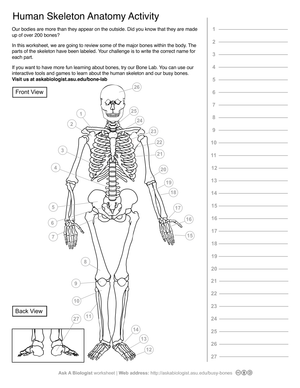
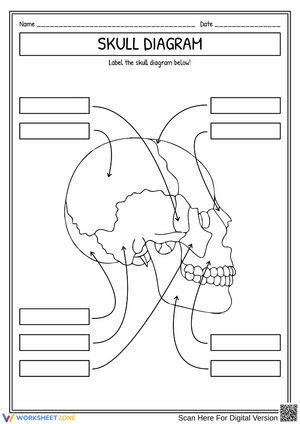
One useful application in a fourth-grade classroom is a worksheet that pairs a labeled skeleton diagram with short-answer prompts such as explain how the skull protects the brain during a fall. This kind of prompt pushes students past memorization and toward the structure-and-function reasoning that NGSS 4-LS1-1 asks for, and it produces a quick written artifact teachers can use as a formative assessment.
Building Skeletal System Vocabulary Through Labeling Practice
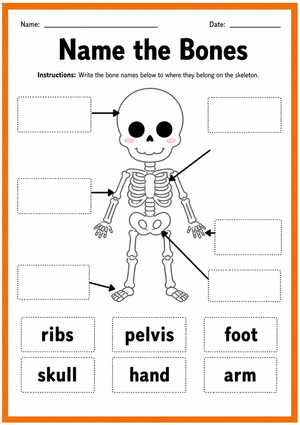
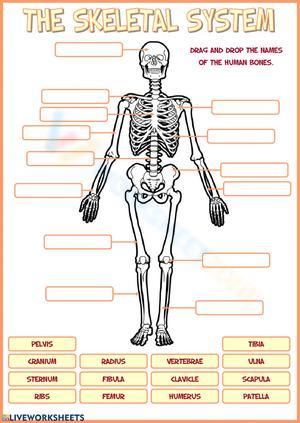
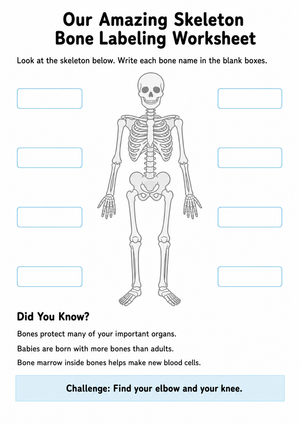
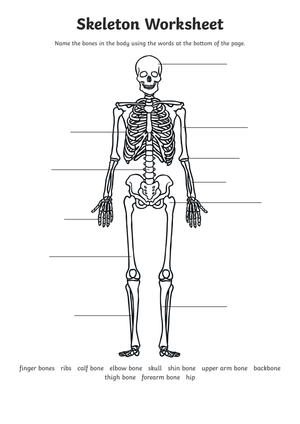
Vocabulary is often the biggest hurdle in a body systems unit, and bones worksheets are well suited to repeated, low-pressure practice with terms like skull, spine, ribs, femur, and joint. A diagram with a word bank works well for students who are still building confidence, while a blank diagram without labels challenges students who are ready for recall rather than recognition.
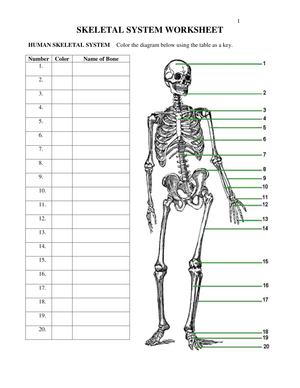
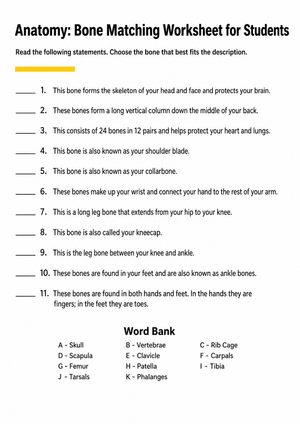
Teachers can rotate through a short sequence across a week: a matching worksheet on day one, a fill-in-the-blank labeling sheet on day two, and a blank diagram quiz by day three or four. This progression lets the same core vocabulary set become gradually more demanding without requiring new content each day.
Using the Baby Bones vs Adult Bones Fact as a Discussion Starter
One detail that reliably grabs student attention is that babies are born with about 300 bones, while adults have only 206. A worksheet prompt built around this fact can ask students to predict why the number goes down as people grow, before revealing that many bones fuse together over time. By the time a child learns to walk, the count has already dropped to around 270 as fusion begins, and kneecaps do not fully form until around age 3, a detail that surprises many students and opens up a natural discussion about how the body changes with age.
Framing a worksheet section around this fusion process also introduces the idea that cartilage in an infant skeleton is gradually replaced by hardened bone tissue containing calcium, a process that continues through childhood and is not complete until about age 25. This gives older elementary students a preview of a concept they will revisit in more depth in later grades.
Classroom Implementation
Bones worksheets work best when paired with a short hands-on component rather than used in isolation. After a labeling worksheet, consider having students build a simple skeleton model with craft materials or complete a kinesthetic activity where they touch and name bones on their own bodies, such as tapping their ribs, spine, and kneecaps. This combination reinforces the vocabulary from the worksheet while giving kinesthetic learners a chance to engage with the content physically.
For small-group intervention or review stations, a shortened version of the worksheet focusing on just four or five key bones works well, since it keeps struggling students from feeling overwhelmed while still building toward the same vocabulary goals as the whole-class version. Teachers running centers can rotate a bones worksheet alongside a skeleton puzzle or matching card game so students get repeated exposure to the same content in different formats.
Frequently Asked Questions
1. What grade levels are bones worksheets appropriate for?
Bones worksheets can be adapted across K-5 classrooms. Younger students benefit from simple labeling with picture support, while students in grades 3-5 are ready for worksheets that connect specific bones to their functions.
2. How do bones worksheets align with NGSS structure-and-function standards?
NGSS 4-LS1-1 asks students to explain how internal and external structures serve functions related to growth, survival, and movement. A bones worksheet that pairs a labeled diagram with short-answer questions about bone function directly supports this standard.
3. What is the best way to introduce the difference between a babys and an adults bone count using a worksheet?
A worksheet prompt that asks students to predict why bone count drops from about 300 at birth to 206 in adulthood works well as a discussion starter, especially when paired with the detail that kneecaps do not fully form until around age 3.
4. How can teachers pair bones worksheets with hands-on skeleton activities?
After completing a labeling worksheet, students can build a simple skeleton model or complete a kinesthetic activity where they identify bones on their own bodies, reinforcing the vocabulary through physical movement.
5. What key skeletal system vocabulary should a bones worksheet cover?
Core terms include skull, ribs, spine, femur, and joint. Worksheets can also introduce the three main functions of bones: giving the body shape, enabling movement, and protecting internal organs.












 Interactive Worksheet Maker
 Quiz Maker
 Word Search Maker
 Crossword Puzzle Maker
 Word Scramble Generator
 Sentence Scramble Generator
 Handwriting Worksheet Generator
 Name Tracing Generator
 Fill In The Blank Generator