


























Views
Downloads

Types of Bones Sort Worksheet | Grade 4 Science Essential
Paste this activity's link or code into your existing LMS (Google Classroom, Canvas, Teams, Schoology, Moodle, etc.).
Students can open and work on the activity right away, with no student login required.
You'll still be able to track student progress and results from your teacher account.
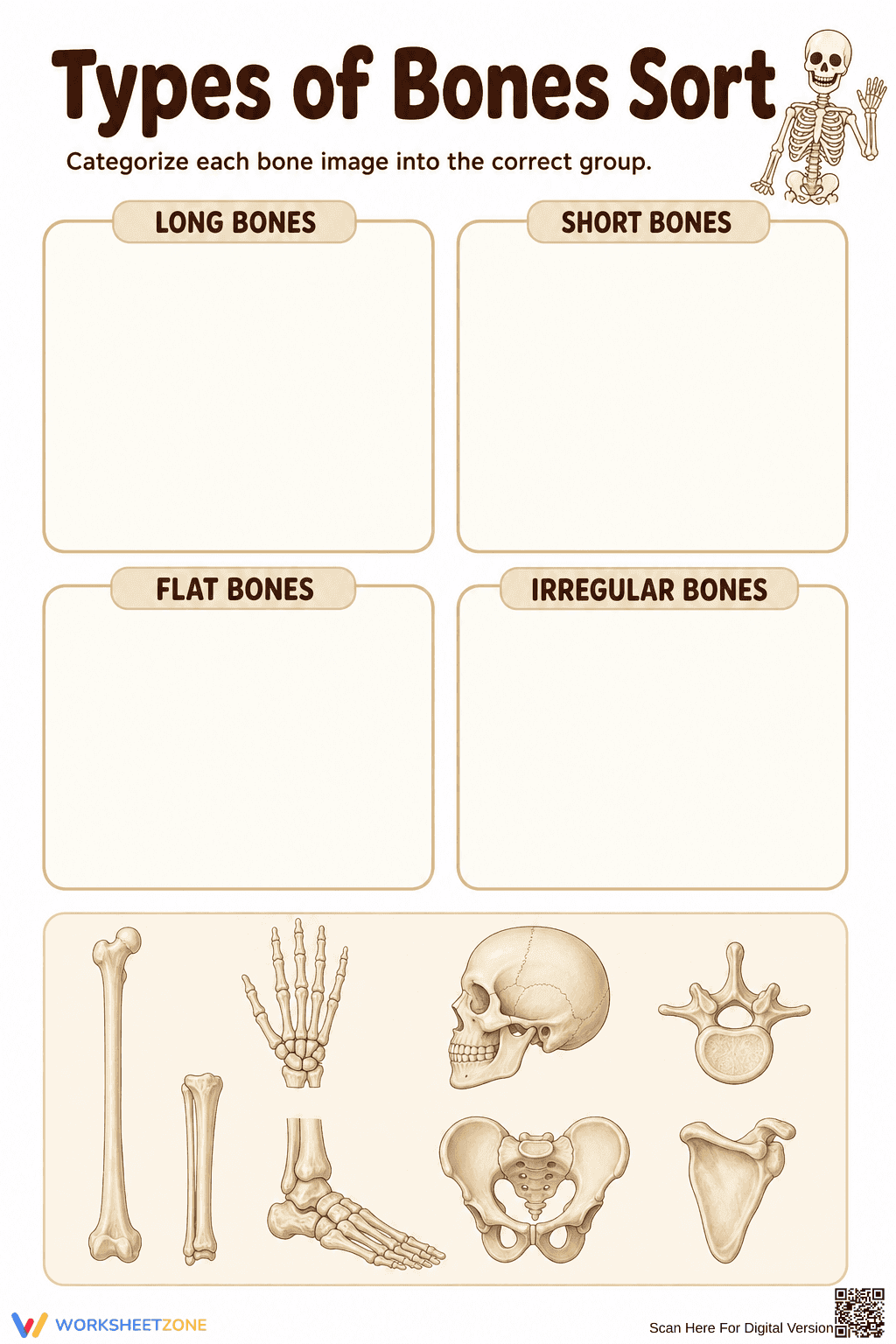
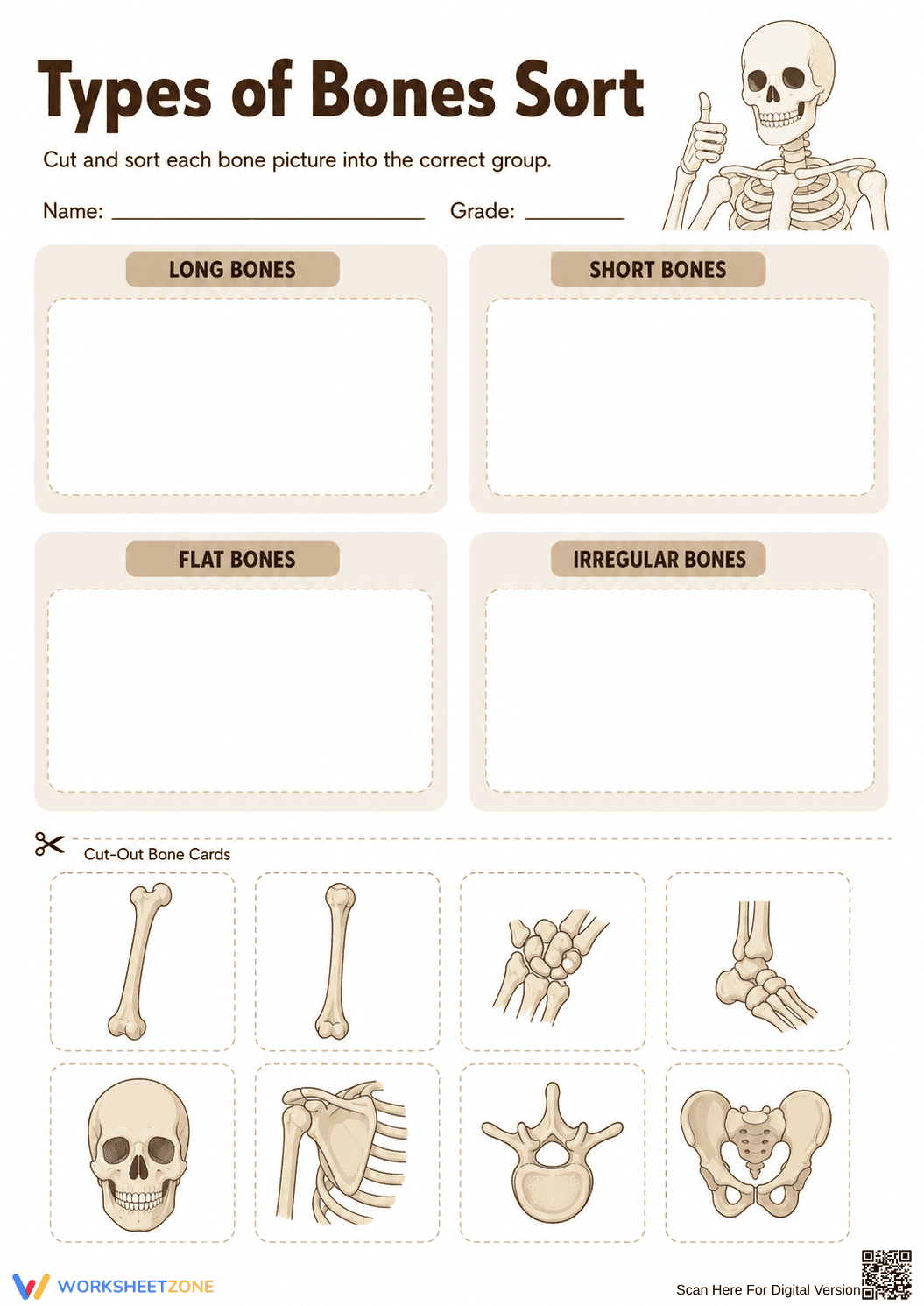
This Grade 4 science worksheet provides a structured classification activity for students to identify and group different types of human bones. By sorting visual examples into four distinct categories, learners develop a deeper understanding of skeletal anatomy and the relationship between bone shape and biological function. This resource ensures students achieve mastery of anatomical terminology through active engagement.
At a Glance
- Grade: 4 · Subject: Science
- Standard:
4-LS1-1— Identify internal structures that support survival and growth in animals- Skill Focus: Bone classification
- Format: 2 pages · 8 problems · Answer key included · PDF
- Best For: Skeletal system review and classification practice
- Time: 15–20 minutes
What's Inside
This 2-page PDF includes a comprehensive sorting mat and a dedicated cut-and-paste sheet. Students are presented with 8 distinct bone illustrations, including the femur, skull, pelvis, and vertebrae. The layout features four clearly labeled zones for long, short, flat, and irregular bones. A full answer key is provided to facilitate quick grading and student self-correction.
Zero-Prep Workflow
This resource is designed for immediate classroom implementation with three simple steps:
- Print: Select either the integrated sorting mat or the dedicated cut-and-paste version (30 seconds).
- Distribute: Hand out the 2-page set to students for individual work or collaborative science centers (1 minute).
- Review: Use the included answer key for rapid grading or student-led self-correction (30 seconds).
The total teacher preparation time is under 2 minutes, making this an ideal solution for emergency sub plans or supplemental practice.
Standards Alignment
This worksheet is aligned with 4-LS1-1: "Construct an argument that plants and animals have internal and external structures that function to support survival, growth, behavior, and reproduction." By classifying bones based on their physical characteristics, students analyze the structural diversity of the skeletal system. Both standard codes can be copied directly into lesson plans, IEP goals, or district curriculum mapping tools.
How to Use It
Use this worksheet as a formative assessment after a direct instruction lesson on the skeletal system. It works exceptionally well as a science center activity where students can collaborate to identify bone types. Teachers should observe students during the sorting process to identify misconceptions regarding irregular bones versus flat bones. The expected completion time is 15 to 20 minutes.
Who It's For
This resource is designed for students in grades 3 through 6 who are beginning their study of human anatomy. It is particularly effective for visual and kinesthetic learners who benefit from manipulating physical cards. Pair this worksheet with a skeletal system anchor chart or a 3D bone model to provide a multi-sensory learning experience.
Fisher & Frey (2014) highlight that categorical sorting serves as a vital cognitive scaffold for developing scientific literacy in young learners. This worksheet requires students to distinguish between long, short, flat, and irregular bones, leveraging visual-spatial processing to reinforce complex anatomical vocabulary. According to the RAND AIRS 2024 report on science instructional materials, high-quality classification tasks improve long-term retention of biological structures by approximately 22% compared to passive reading methods. This resource aligns specifically with the 4-LS1-1 standard, focusing on how internal structures like the skeletal system support the overall function and survival of organisms. The inclusion of a cut-and-paste option provides a tactile learning experience that supports fine motor development while grounding abstract biological concepts in concrete visual evidence. Educators can effectively use this standalone tool to bridge the gap between initial instruction and mastery-level assessment in life science units.


