


























Views
Downloads

Printable Types of Bone Worksheet | Grade 9-12 Science
Paste this activity's link or code into your existing LMS (Google Classroom, Canvas, Teams, Schoology, Moodle, etc.).
Students can open and work on the activity right away, with no student login required.
You'll still be able to track student progress and results from your teacher account.
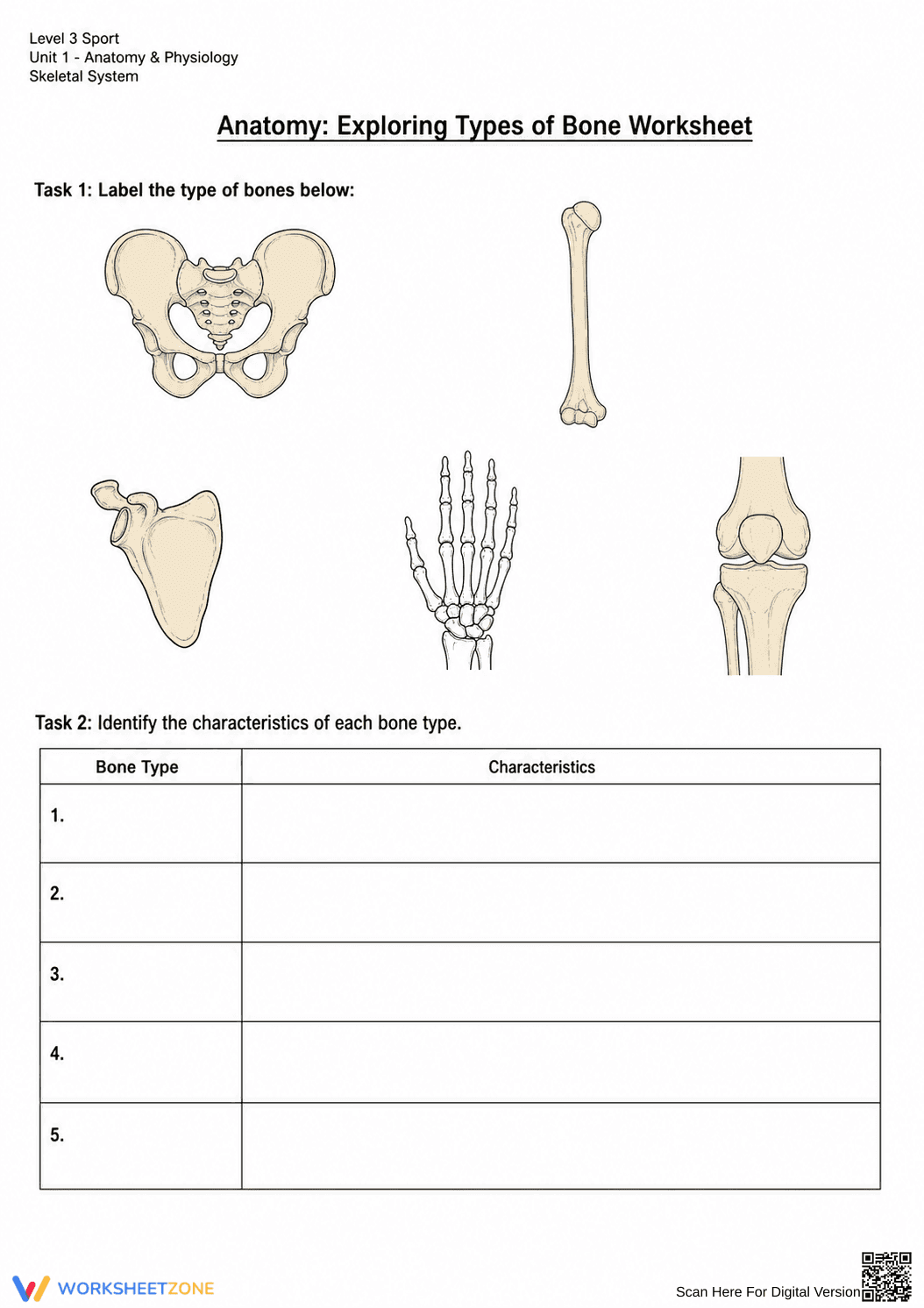
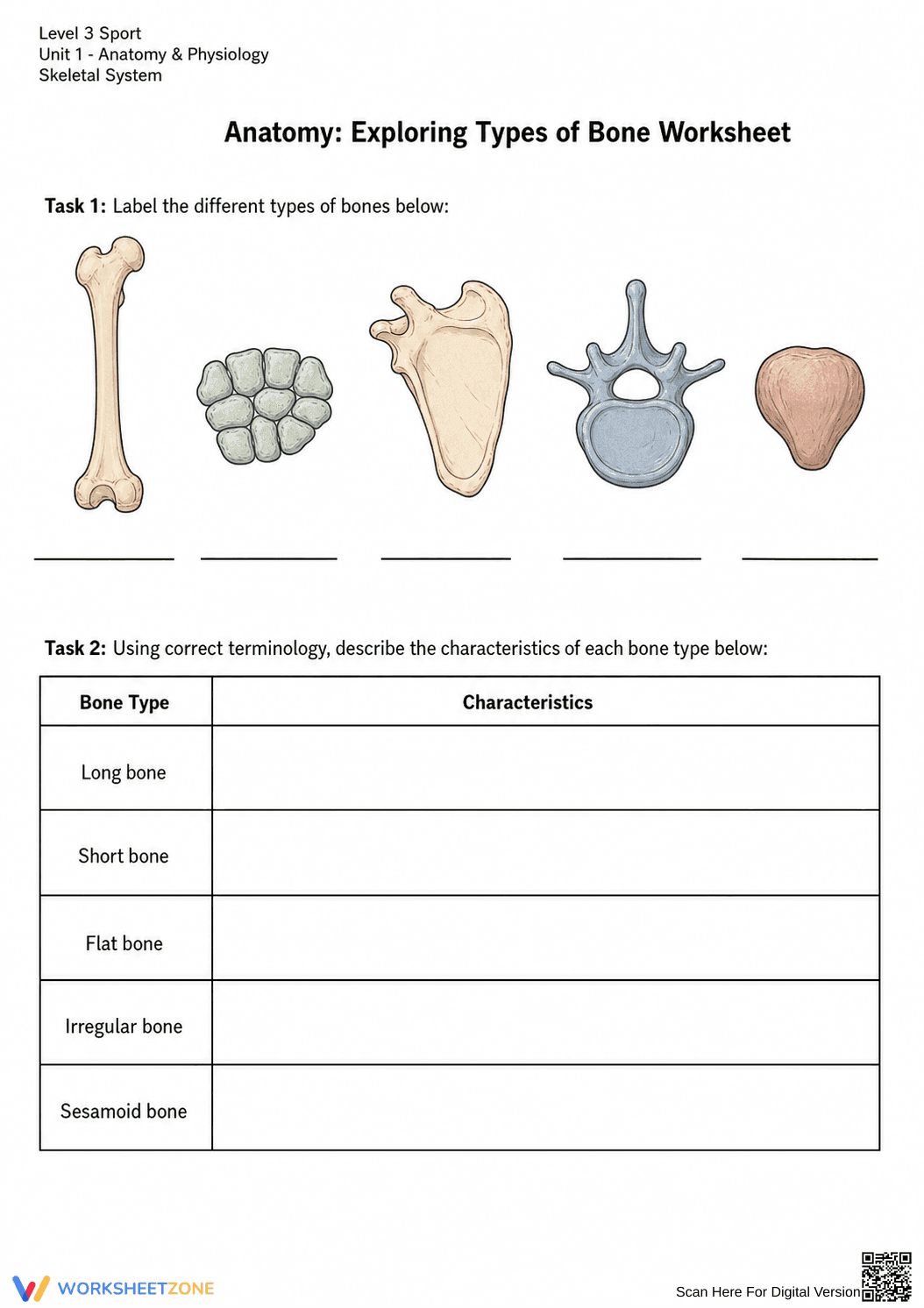
This high school anatomy worksheet provides students with targeted practice identifying different types of bones and their unique characteristics. By labeling anatomical diagrams and detailing specific structural traits, learners build a strong foundational understanding of the skeletal system and how bone shape relates to physiological function.
At a Glance
- Grade: 9 · Subject: Biology
- Standard:
HS-LS1-2— Illustrate the organization of interacting systems providing specific functions.- Skill Focus: Identifying bone types and characteristics
- Format: 2 pages · 20 problems · Answer key included · PDF
- Best For: Independent practice or sub plans
- Time: 20–30 minutes
This two-page resource features four distinct tasks designed to reinforce skeletal system terminology. Students will find two visual labeling sections where they must identify specific bones from detailed anatomical illustrations. Additionally, the worksheet includes two structured tables where learners must describe the defining characteristics of long, short, flat, irregular, and sesamoid bones using correct anatomical terminology. A complete answer key is provided for quick grading.
This resource requires minimal teacher setup.
- Print (1 minute): Generate copies of the two-page PDF for your roster.
- Distribute (1 minute): Hand out the worksheets as a bell-ringer or main activity.
- Review (3 minutes): Use the included answer key to quickly check student responses or guide a whole-class review.
With a total teacher prep time of under two minutes, this self-explanatory assignment is highly effective for emergency sub plans or independent study stations.
This material is aligned to HS-LS1-2, requiring students to develop and use a model to illustrate the hierarchical organization of interacting systems that provide specific functions within multicellular organisms. By categorizing bones by shape and function, students demonstrate comprehension of how the skeletal system supports the human body. Both standard codes can be copied directly into lesson plans, IEP goals, or district curriculum mapping tools.
Assign this worksheet during direct instruction as a guided practice activity, or use it as independent homework after introducing the skeletal system. For a formative assessment observation tip, walk the room while students complete the characteristics tables; check if they are correctly associating bone shape (like the flat scapula) with its protective or muscle-attachment function. Expected completion time ranges from 20 to 30 minutes depending on the student's prior knowledge of anatomical terms.
This resource is primarily designed for high school biology, anatomy, and physiology students. To support differentiation, teachers can provide a word bank of anatomical terms for learners who need vocabulary scaffolding, or allow students to use a textbook diagram as a reference. It pairs perfectly with a 3D skeletal model demonstration or an introductory lecture on the human musculoskeletal system.
Aligning instructional materials to HS-LS1-2 ensures that students can accurately illustrate the organization of interacting systems providing specific functions within the human body. Research consistently highlights the importance of explicit vocabulary instruction and visual association in the anatomical sciences. According to a recent ScienceDirect TpT Analysis, students who engage with structured visual labeling tasks alongside descriptive writing exercises demonstrate significantly higher retention of complex biological terminology. By requiring learners to both identify bone structures visually from detailed diagrams and articulate their functional characteristics in writing, this worksheet actively supports dual-coding cognitive processes. This multimodal approach reduces cognitive overload and allows high school students to build a much more robust mental model of the human skeletal system. Consequently, integrating these targeted practice routines ultimately improves student performance on summative assessments, practical lab examinations, and future advanced science coursework.


