


























Views
Downloads

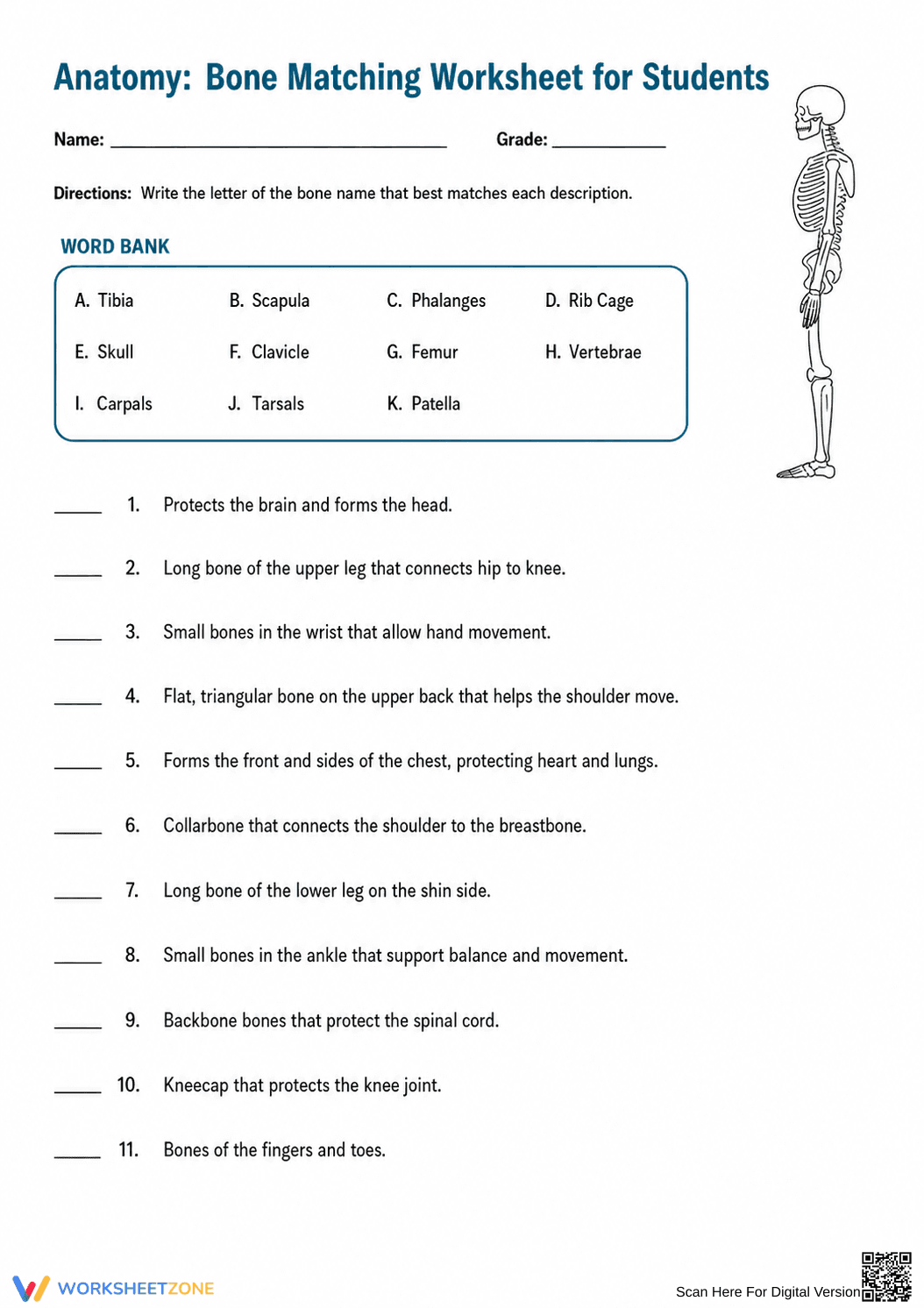

Bone Matching Worksheet | Grade 6-9 Essential Anatomy
Paste this activity's link or code into your existing LMS (Google Classroom, Canvas, Teams, Schoology, Moodle, etc.).
Students can open and work on the activity right away, with no student login required.
You'll still be able to track student progress and results from your teacher account.
This anatomy worksheet helps middle school students master the human skeletal system by matching 11 major bones to their physiological descriptions. Students analyze functional clues to identify structures like the femur, scapula, and vertebrae, reinforcing biological vocabulary and structural understanding through targeted matching practice.
At a Glance
- Grade: 6-9 · Subject: Biology
- Standard:
MS-LS1-3— Use argument supported by evidence for how the body is a system of interacting subsystems- Skill Focus: Skeletal system identification
- Format: 1 page · 11 problems · Answer key included · PDF
- Best For: Quick assessment or sub plans
- Time: 15–20 minutes
The download features a clean, single-page layout containing 11 descriptive prompts paired with a comprehensive word bank. Key anatomical terms include the patella, clavicle, and phalanges. The worksheet uses a letter-matching format to streamline grading and includes a full answer key for immediate feedback, ensuring students can self-correct their understanding of the human frame.
This resource is designed for immediate classroom implementation with a total teacher prep time of under 2 minutes. Simply print the PDF, distribute it to students as a warm-up or exit ticket, and use the provided answer key for a 5-minute peer-review or whole-class check. It serves as an ideal "plug-and-play" activity for unexpected sub days or as a transition between lesson segments.
Primary alignment is to `MS-LS1-3`, which requires students to understand how the body is a system of interacting subsystems composed of groups of cells. This worksheet focuses on the skeletal subsystem's structural components and their specific roles in protecting organs and providing support. Both standard codes can be copied directly into lesson plans, IEP goals, or district curriculum mapping tools.
Use this as a formative assessment after a lecture on the human body to gauge student retention of bone names and locations. Alternatively, assign it as a silent "Do Now" activity to activate prior knowledge before a lab. Expected completion time is 15 to 20 minutes depending on student familiarity with the vocabulary and their reading speed.
Designed for middle school life science students, this worksheet is also appropriate for high school health or introductory biology review. It pairs naturally with a skeletal system anchor chart or a 3D bone model demonstration to provide a multi-sensory learning experience for students who need visual or tactile reinforcement of anatomical concepts.
According to Fisher & Frey (2014), the use of structured matching tasks with word banks supports the development of domain-specific vocabulary in science by reducing cognitive load during the initial acquisition phase. This MS-LS1-3 worksheet provides the necessary scaffolding for students to connect anatomical names with their biological functions. By focusing on 11 distinct bone structures, the activity aligns with the NAEP framework for life science, which emphasizes the identification of organ systems and their primary components. Research from the RAND AIRS 2024 report suggests that high-quality, focused practice sheets improve long-term retention of scientific terminology when used as part of a spaced-repetition curriculum. This resource ensures that students can accurately identify the skull, vertebrae, and other critical skeletal elements required for advanced biological study and health literacy.


