


























Views
Downloads

Grade 4 Types of Bones — Printable No-Prep Worksheet
Paste this activity's link or code into your existing LMS (Google Classroom, Canvas, Teams, Schoology, Moodle, etc.).
Students can open and work on the activity right away, with no student login required.
You'll still be able to track student progress and results from your teacher account.
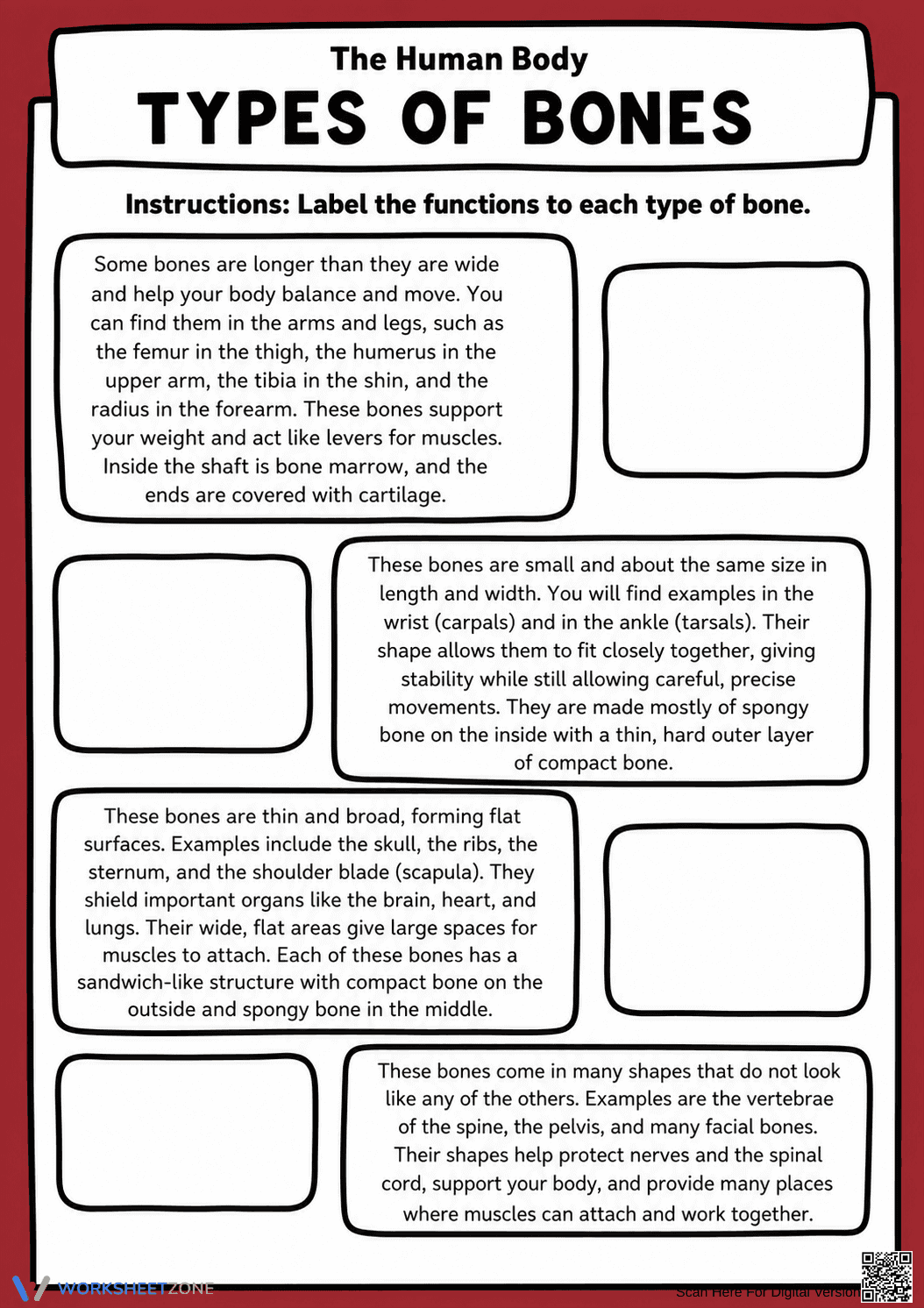
This Grade 4 science worksheet introduces students to the human skeletal system by focusing on the four main types of bones. Students read informational text about long, short, flat, and irregular bones, then apply reading comprehension skills to correctly label each bone type based on its unique function.
At a Glance
- Grade: 4 · Subject: Science
- Standard:
4-LS1-1— Identify internal structures that support survival and growth- Skill Focus: Identifying bone types and functions
- Format: 1 page · 4 problems · Answer key included · PDF
- Best For: Independent practice and science centers
- Time: 10–15 minutes
This single-page resource features four informational paragraphs describing the characteristics and functions of different bone categories. Beside each text block is a blank box where students write the correct classification: long, short, flat, or irregular. The layout combines reading practice with science content, and an answer key is provided.
Zero-Prep Workflow
This resource is designed for immediate classroom implementation with minimal teacher setup:
- Print (1 minute): Simply print the PDF. The black-and-white design ensures crisp copies without draining school ink supplies.
- Distribute (1 minute): Hand out the single-page activity. The instructions are self-explanatory, requiring no complex modeling.
- Review (3 minutes): Use the included answer key to quickly check student responses or project it for whole-class self-correction.
With a total prep time of under two minutes, this activity is excellent for emergency sub plans.
Standards Alignment
This activity aligns with Next Generation Science Standard 4-LS1-1: Construct an argument that plants and animals have internal and external structures that function to support survival, growth, behavior, and reproduction. By analyzing how different bone shapes protect organs or facilitate movement, students build a foundational understanding of internal body systems. Both standard codes can be copied directly into lesson plans, IEP goals, or district curriculum mapping tools.
How to Use It
Deploy this worksheet during the middle of a human body unit, right after direct instruction on the skeletal system. It serves as an excellent independent reading activity where students must extract key details to solve the labeling task. As a formative assessment tip, observe whether students are relying on the examples (like "femur" or "skull") or the functional descriptions (like "shield important organs") to make their matches. Most students will complete the reading and labeling within 10 to 15 minutes.
Who It's For
This resource is primarily designed for fourth-grade science students, though it functions well as a review tool for fifth and sixth graders studying human anatomy. The embedded informational text provides built-in differentiation for students who need context clues to recall science vocabulary. It pairs perfectly with a physical classroom skeleton model or an introductory video on how the human body moves.
Integrating literacy skills into science instruction improves content retention. When students engage with targeted informational text to solve classification problems, they develop stronger analytical frameworks for biological systems. This worksheet supports 4-LS1-1 by requiring learners to identify internal structures that support survival and growth, focusing on how bone morphology dictates function. According to a ScienceDirect TpT Analysis, cross-curricular resources combining reading comprehension with scientific labeling tasks increase engagement and reduce cognitive overload. By connecting structural descriptions to anatomical categories, educators efficiently assess reading proficiency and scientific knowledge simultaneously. This approach ensures instructional minutes are maximized while providing clear evidence of mastery.


