


























Views
Downloads
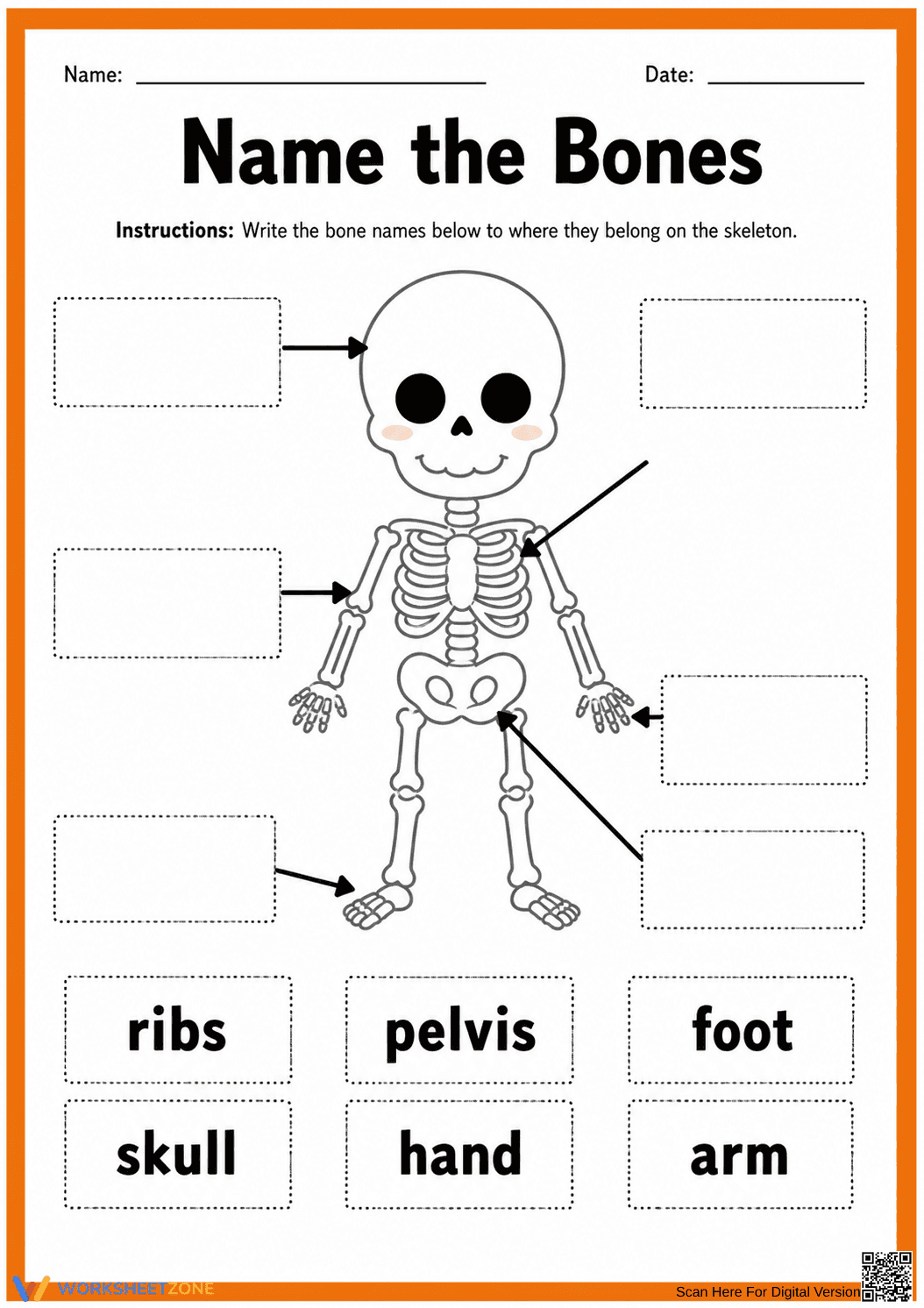

Name the Bones Labeling Worksheet | Essential Grade 3-5
Paste this activity's link or code into your existing LMS (Google Classroom, Canvas, Teams, Schoology, Moodle, etc.).
Students can open and work on the activity right away, with no student login required.
You'll still be able to track student progress and results from your teacher account.
This Name the Bones Labeling Worksheet helps elementary students identify key components of the human skeletal system. By matching anatomical terms to a visual model, learners develop a foundational understanding of body structure and support. It provides a clear, accessible entry point for life science units focusing on human biology and physical health.
At a Glance
- Grade: 3 · Subject: Science
- Standard:
4-LS1-1— Identify internal and external structures that support survival and growth- Skill Focus: Skeletal system identification
- Format: 1 page · 6 problems · Answer key included · PDF
- Best For: Introductory anatomy and science centers
- Time: 10–15 minutes
What's Inside
This single-page PDF features a friendly, cartoon-style skeleton with six clear pointer lines. At the base of the page, students find six distinct word cards: ribs, pelvis, foot, skull, hand, and arm. The layout is designed for high legibility, providing ample space in the labeling boxes for students to practice their handwriting while recording their answers.
Zero-Prep Workflow
- Print: Generate the required number of copies for your roster in less than one minute.
- Distribute: Hand out the sheets as a warm-up or independent practice task; the clear instructions allow students to begin immediately.
- Review: Check student work as a whole group in under five minutes using the provided answer key for instant feedback.
Standards Alignment
This worksheet aligns with `4-LS1-1`, which requires students to construct an argument that plants and animals have internal and external structures that function to support survival, growth, behavior, and reproduction. By identifying the skeleton as a primary internal structure, students build the vocabulary necessary to discuss how bones protect organs and provide support. This standard code can be copied directly into lesson plans, IEP goals, or district curriculum mapping tools.
How to Use It
Use this worksheet as a formative assessment after a read-aloud about the human body to check for basic recognition. Alternatively, place it in a science center alongside a plastic skeleton model for a tactile learning experience. Teachers should observe if students can correctly orient the "arm" versus "hand" labels to gauge their spatial awareness of anatomical positioning. Completion typically takes 10 to 15 minutes.
Who It's For
This resource is ideal for Grade 2 through Grade 5 students, particularly those who benefit from visual aids and word banks. It serves as an excellent scaffold for English Language Learners (ELLs) who are building scientific vocabulary. Pair this worksheet with a diagram of the muscular system or a short video on how bones grow to create a comprehensive lesson.
The use of visual labeling tasks in early science education is supported by research into dual coding and cognitive load. According to Fisher & Frey (2014), providing students with graphic organizers and labeled models helps bridge the gap between abstract scientific concepts and concrete visual representation. This Name the Bones Labeling Worksheet specifically targets the `4-LS1-1` standard by requiring students to identify the skeletal framework as a vital internal structure. By limiting the task to 6 high-frequency anatomical terms, the worksheet prevents cognitive overload while ensuring mastery of foundational biology vocabulary. Such structured practice is essential for developing the scientific literacy required for more complex anatomical studies in middle school. This resource provides a measurable way to track student progress in identifying body systems, making it a reliable tool for both general education and specialized instructional settings.


