


























Views
Downloads
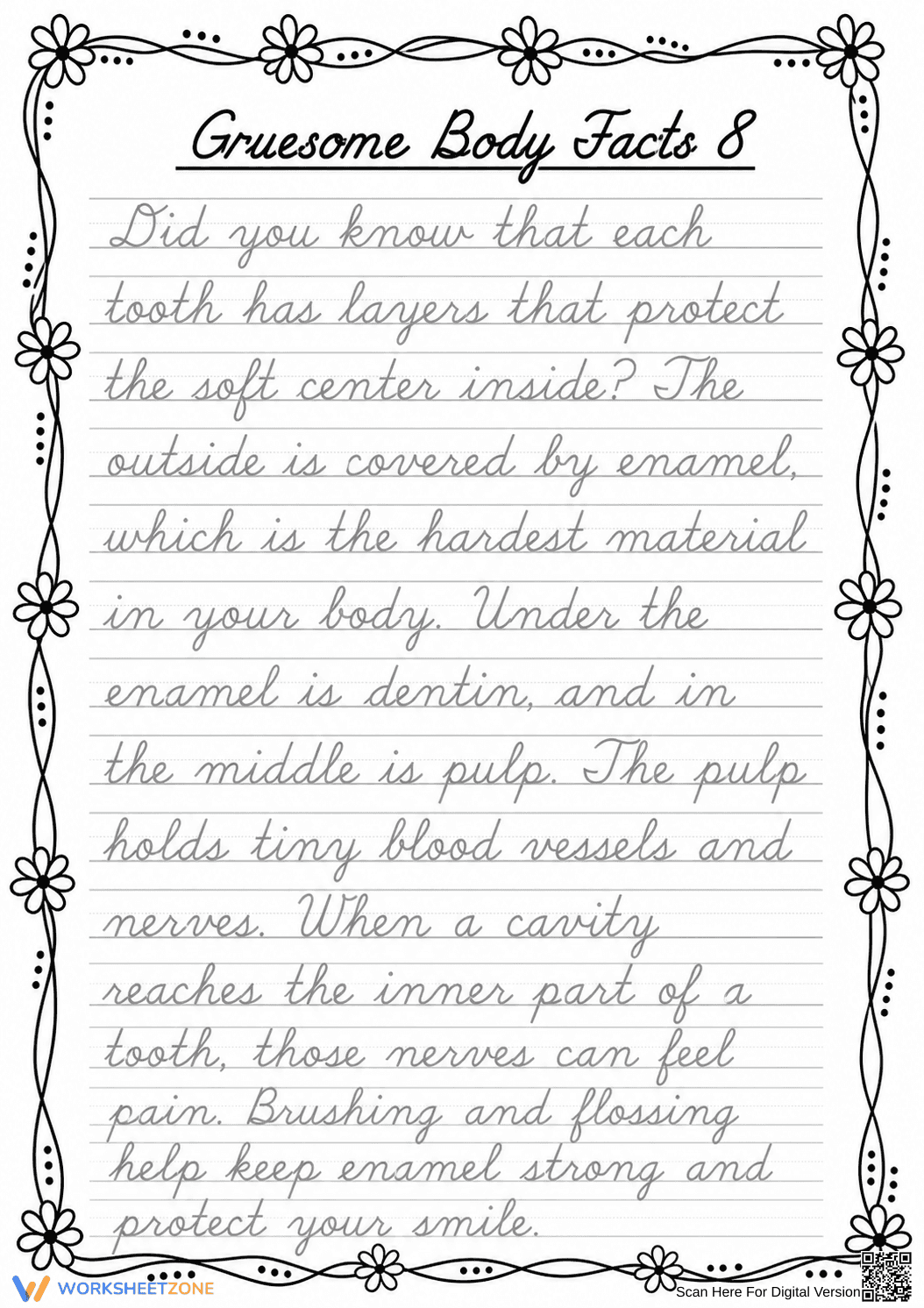

Grade 6 Cursive Teeth Facts — Printable No-Prep Worksheet
Paste this activity's link or code into your existing LMS (Google Classroom, Canvas, Teams, Schoology, Moodle, etc.).
Students can open and work on the activity right away, with no student login required.
You'll still be able to track student progress and results from your teacher account.
This Grade 6 cursive handwriting worksheet combines essential penmanship practice with engaging science content. Students read and write a fascinating paragraph about human teeth anatomy, focusing on enamel, pulp, and nerves. This resource helps middle schoolers refine their cursive fluency while reinforcing basic biology concepts in a single, focused activity.
At a Glance
- Grade: 6 · Subject: Science
- Standard:
CCSS.ELA-LITERACY.W.6.4— Produce clear and coherent writing appropriate to task- Skill Focus: Cursive handwriting and reading comprehension
- Format: 1 page · 1 task · No answer key needed · PDF
- Best For: Morning work or independent practice
- Time: 10–15 minutes
Inside this single-page resource, educators will find a formatted cursive passage titled "Gruesome Body Facts 8." The text features a high-interest paragraph explaining why cavities hurt, detailing the enamel exterior and sensitive pulp interior. The worksheet provides standard ruled lines to guide students as they practice cursive letter formation, spacing, and slant. No answer key is required.
This resource offers a zero-prep workflow, requiring under two minutes of teacher setup:
- Print (1 minute): Download the PDF and print copies for the class.
- Distribute (1 minute): Hand out during morning arrival or as a science extension.
- Review (0 minutes): Students self-monitor neatness and legibility, requiring no formal grading.
This streamlined process makes it an excellent addition to any sub plan.
This worksheet aligns with CCSS.ELA-LITERACY.W.6.4: "Produce clear and coherent writing in which the development, organization, and style are appropriate to task, purpose, and audience." By practicing cursive, students develop the physical fluency necessary to produce clear, legible text efficiently. It also lightly touches upon basic life science concepts regarding body systems. Both standard codes can be copied directly into lesson plans, IEP goals, or district curriculum mapping tools.
Use this worksheet as an engaging bell-ringer; students can settle in and begin handwriting practice while absorbing a science fact. Alternatively, it works well as a cool-down activity after a biology lesson. For formative assessment, observe students' grip and posture while writing, offering gentle corrections to ensure writing stamina. Expect completion within 10 to 15 minutes.
Designed for 6th-grade students needing cursive reinforcement, this resource benefits learners struggling with fine motor control. For differentiation, allow students who find cursive challenging to print the text instead, focusing purely on the science vocabulary. This worksheet pairs naturally with a broader unit on human anatomy or a direct instruction lesson on dental hygiene.
Maintaining legible handwriting remains a critical component of middle school literacy, even as digital typing becomes more prevalent in modern classrooms. This worksheet supports CCSS.ELA-LITERACY.W.6.4, requiring students to produce clear and coherent writing appropriate to task. According to an EdReports 2024 analysis, integrating content-area knowledge—such as biology and human anatomy—into foundational literacy practice significantly increases student engagement and long-term retention. When students practice cursive using high-interest science facts, they simultaneously build fine motor automaticity and essential background knowledge. This dual-purpose approach ensures that valuable instructional minutes are maximized across subjects. By focusing on writing mechanics through engaging topics like teeth anatomy, educators foster both physical writing stamina and scientific curiosity. This evidence-based strategy confirms that cross-curricular handwriting exercises are highly effective tools for developing well-rounded, literate students in the middle grades.


