


























Views
Downloads

Grade 1 Science Journal — Printable No-Prep Worksheet
Paste this activity's link or code into your existing LMS (Google Classroom, Canvas, Teams, Schoology, Moodle, etc.).
Students can open and work on the activity right away, with no student login required.
You'll still be able to track student progress and results from your teacher account.
This Grade 1 science journal provides a structured framework for students to document their observations during a nature trip or local habitat study. By combining visual sketching with written descriptions and inquiry-based questioning, students develop critical scientific thinking skills. It is designed to help young learners distinguish between living and non-living things while exploring diverse environments.
At a Glance
At a Glance
- Grade: 1 · Subject: Science
- Standard:
1-LS1-1— Use parts of plants and animals to help them survive and grow- Skill Focus: Scientific Observation & Inquiry
- Format: 1 page · 3 tasks · No answer key · PDF
- Best For: Field trips and nature walks
- Time: 15–30 minutes
What's Inside
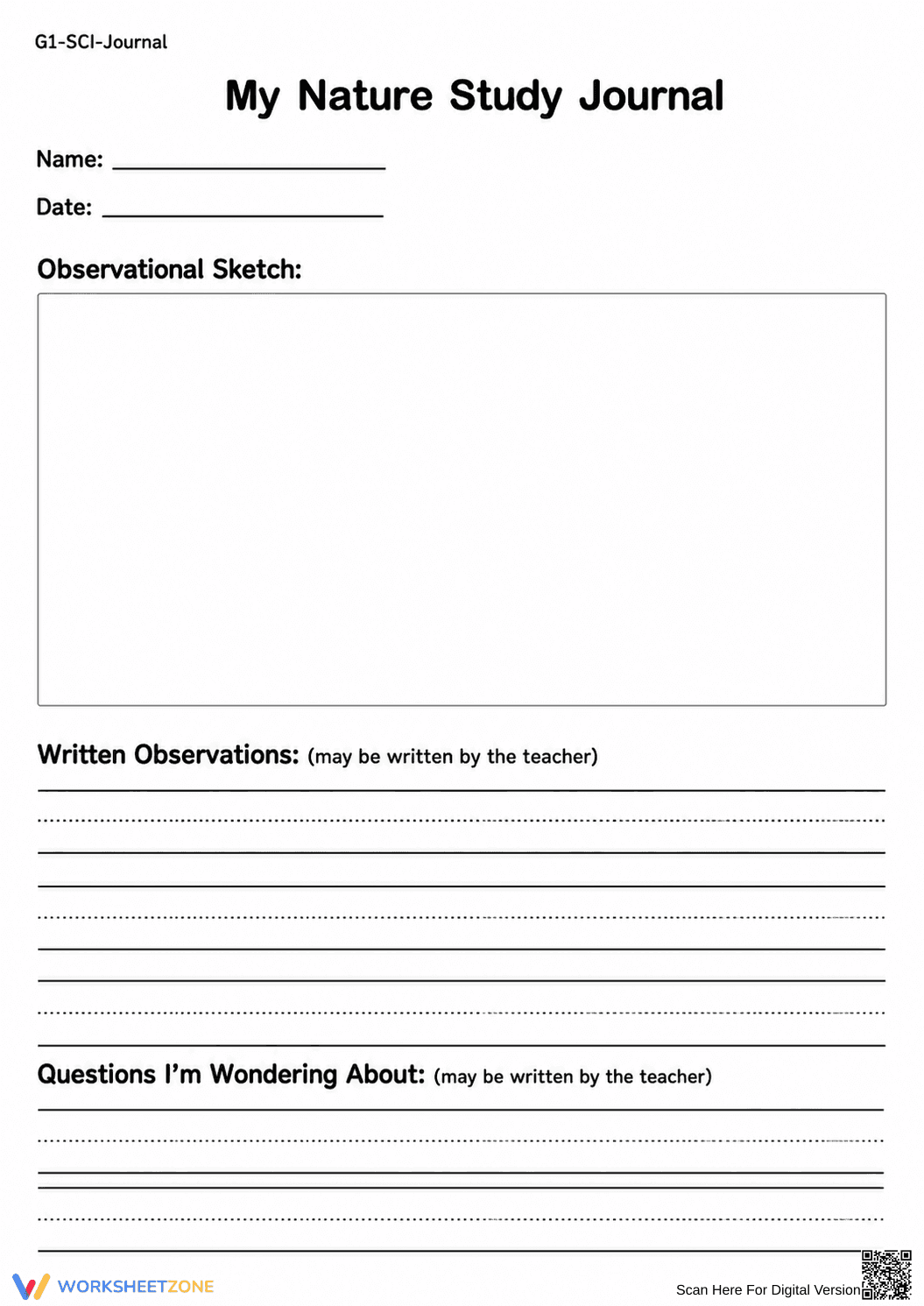
The worksheet features three distinct sections on a single page, titled "My Nature Study Journal." It includes a large "Observational Sketch" box for visual data collection, a "Written Observations" area with primary-ruled lines for descriptive text, and a "Questions I’m Wondering About" section to encourage curiosity. The layout includes teacher-support prompts, allowing educators to scribe for students who are still developing fine motor skills.
Zero-Prep Workflow
The zero-prep workflow is designed for immediate classroom or field use. First, print the single-page PDF (30 seconds). Second, distribute the journals to students as they begin their observation period (1 minute). Third, review the sketches and questions as a whole group to identify common themes or misconceptions (5 minutes). This resource is an ideal sub-plan component or spontaneous outdoor learning activity.
Standards Alignment
This resource aligns with `1-LS1-1`, focusing on how organisms interact with their environment. By recording observations of living things, students gather the raw data necessary to understand survival traits. It also supports `K-2-ETS1-1` by asking students to define a simple problem based on their "wondering" questions. Both standard codes can be copied directly into lesson plans, IEP goals, or district curriculum mapping tools.
How to Use It
Use this journal during a schoolyard nature walk or a formal field trip to a local habitat. Before the activity, model how to create a detailed sketch rather than a simple drawing. During the observation, circulate and help students articulate their "wondering" questions. This serves as a formative assessment to gauge student understanding of biological characteristics and environmental interactions.
Who It's For
This worksheet is tailored for first-grade students but is adaptable for Kindergarten or Grade 2 learners. It is particularly effective for English Language Learners (ELLs) who can use the sketching section to demonstrate understanding before mastering the written English components. Pair this with a habitat anchor chart or a read-aloud about local wildlife and ecosystems.
Scientific journaling in early childhood is a foundational practice for developing literacy and empirical reasoning. Fisher & Frey (2014) note that integrating visual representation with written reflection accelerates the acquisition of domain-specific vocabulary and conceptual understanding. This Grade 1 science journal facilitates that integration by providing a scaffolded space for `1-LS1-1` observations. Research from the NAEP indicates that students who engage in frequent hands-on data collection and recording perform significantly better on long-term science assessments. By documenting "Questions I'm Wondering About," students engage in the first step of the scientific method, moving from passive observation to active inquiry. This 1-page resource ensures that even the youngest learners can participate in authentic scientific practices without the cognitive load of complex formatting. It serves as a vital bridge between sensory experience and academic documentation in the primary science classroom.


