




























Views
Downloads

Essential Skeleton Bone Labeling Worksheet | Grades 3-6

Paste this activity's link or code into your existing LMS (Google Classroom, Canvas, Teams, Schoology, Moodle, etc.).
Students can open and work on the activity right away, with no student login required.
You'll still be able to track student progress and results from your teacher account.
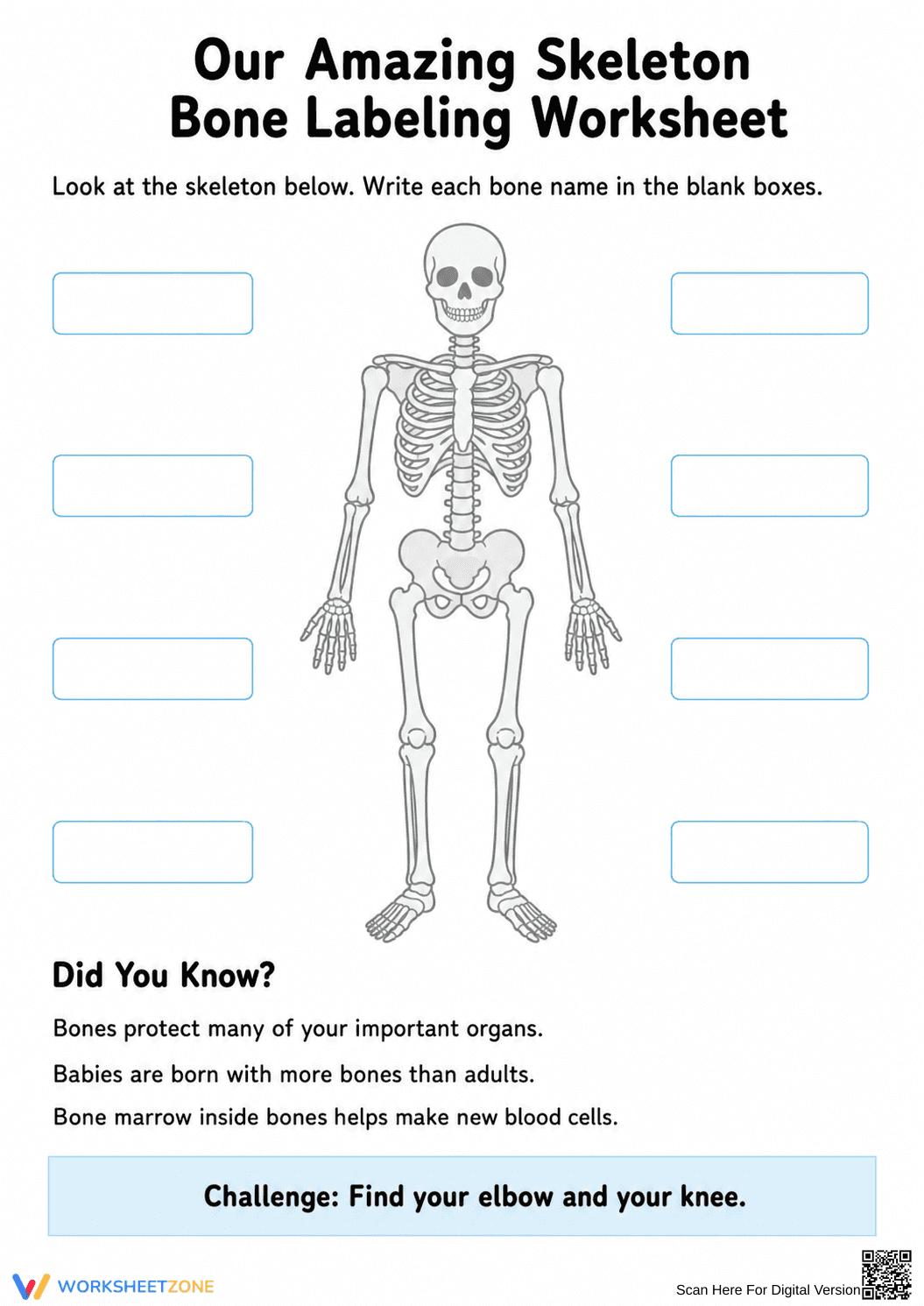
This Essential Skeleton Bone Labeling Worksheet provides a comprehensive yet accessible introduction to human anatomy for upper elementary students. By identifying major bones and connecting them to biological functions, learners develop a foundational understanding of how internal structures support the body. This resource ensures students can visualize the skeletal framework while building scientific vocabulary.
At a Glance
- Grade: 3-6 · Subject: Science
- Standard:
4-LS1-1— Identify internal structures that function to support survival and growth- Skill Focus: Anatomical labeling and skeletal functions
- Format: 2 pages · 22 problems · Answer key included · PDF
- Best For: Introductory anatomy lessons or quick assessments
- Time: 15–25 minutes
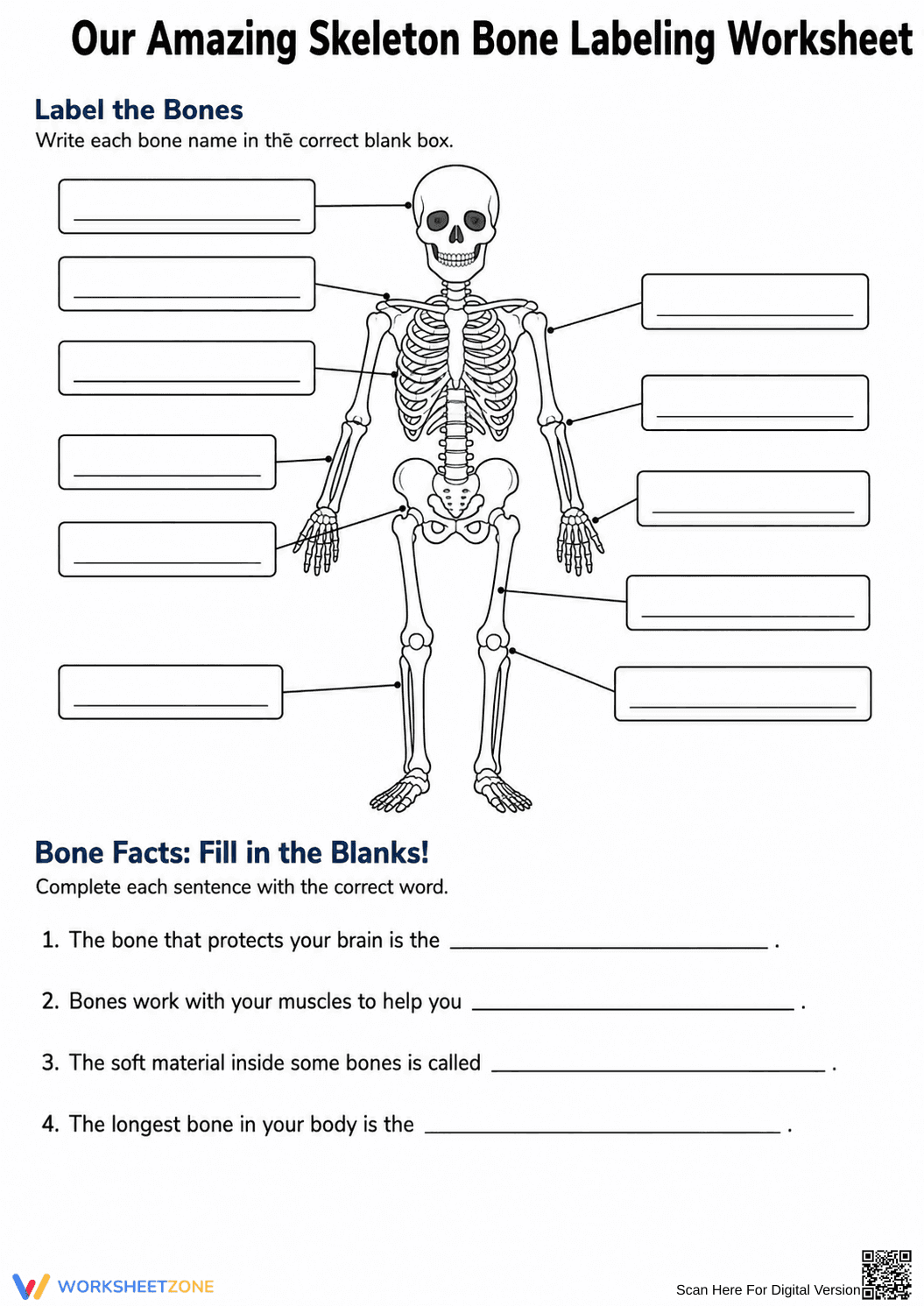
The resource consists of two high-quality PDF pages designed for clarity. The first page features a full-body skeleton diagram with eight primary labeling boxes and a "Did You Know?" trivia section to spark curiosity. The second page increases the complexity with ten detailed labeling points and four fill-in-the-blank sentences that test conceptual knowledge of bone marrow, protection, and movement. A complete answer key is provided for rapid grading.
This worksheet is designed for a zero-prep classroom environment. Teachers can follow a simple three-step workflow: Print the double-sided PDF (30 seconds), Distribute to the class (1 minute), and Review the correct labels using the provided key (5 minutes). Because the instructions are self-explanatory and include a "Challenge" prompt for early finishers, this resource serves as an excellent emergency sub plan or independent station activity.
This activity aligns primarily with 4-LS1-1, which requires students to construct an argument that plants and animals have internal and external structures that function to support survival, growth, behavior, and reproduction. By labeling the skull (protection) and long bones (support/movement), students gather evidence of these functions. Both standard codes can be copied directly into lesson plans, IEP goals, or district curriculum mapping tools.
Use this worksheet during the "Explain" phase of a 5E instructional cycle. After students have explored a physical skeleton model, assign the labeling task to formalize their learning. It also works well as a formative assessment after a lecture on the muscular-skeletal system. Teachers should observe if students can correctly distinguish between the radius and ulna or tibia and fibula to gauge anatomical precision.
This resource is ideal for general education science classrooms, homeschool environments, and ELL students who benefit from visual-to-text associations. It pairs naturally with a human body anchor chart or a short informational passage about the skeletal system. The inclusion of fun facts makes it engaging for younger students in Grade 3, while the technical labeling remains rigorous enough for Grade 6.
According to the RAND AIRS 2024 report on science literacy, visual-spatial tasks like anatomical labeling significantly improve long-term retention of complex biological systems. This worksheet addresses the 4-LS1-1 standard by requiring students to map the physical locations of internal structures, a key component of the NAEP science framework. Research by Fisher & Frey (2014) emphasizes that "labeling diagrams serves as a bridge between concrete observation and abstract scientific reasoning." By engaging with 22 distinct tasks, students move beyond simple recognition toward a functional understanding of the human frame. The structured layout provides the necessary scaffolding for diverse learners to achieve mastery without cognitive overload. This evidence-based approach ensures that the 15-25 minutes spent on this activity contributes directly to measurable growth in life science proficiency and technical vocabulary acquisition.


