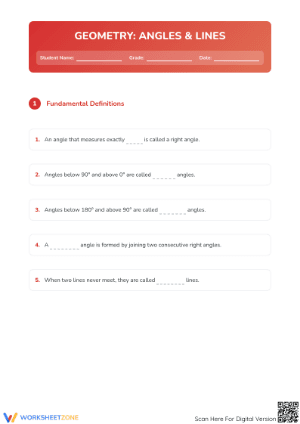
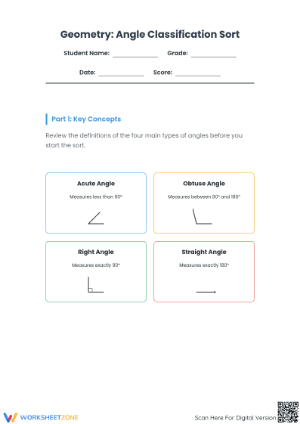
These classifying angles printable worksheets give fourth and fifth-grade teachers ready-to-use practice pages that move students from rough visual recognition — "that one looks like a corner" — toward confident, precise identification backed by measurement. Each page targets a specific step in that progression, so teachers can slot them into instruction at the right moment rather than treating angle classification as a single lesson event.
What Each Worksheets Asks Students to Do
The set covers the four angle types students encounter in 4th-grade geometry: acute (greater than 0°, less than 90°), right (exactly 90°), obtuse (greater than 90°, less than 180°), and straight (exactly 180°). Pages in the earlier portion of the set focus on identification — students look at a drawn angle, compare it mentally to a right-angle benchmark, and label it. Later pages ask students to measure with a protractor, record the degree value, and then classify based on that measurement. A handful of extension pages introduce reflex angles for classrooms that are ready to push past the 180° boundary.
Sorting tasks appear throughout the set. Students cut out angle cards and place them in labeled columns, or they mark each angle in a figure with its classification before answering questions about what they notice. The sorting format matters because it forces a decision: a student who would guess "obtuse" on a multiple-choice item and move on has to commit that angle to a physical column, which catches vague thinking that multiple-choice format masks.
Standards Alignment
CCSS 4.G.A.1 requires students to draw and identify points, lines, line segments, rays, and angles — including right, acute, and obtuse — within two-dimensional figures. That standard is the direct target here. What teachers sometimes miss is that 4.MD.C.5 is equally in play: it defines an angle as a fraction of a circular arc, which is the conceptual foundation students need before protractor use makes any sense. Worksheets that jump straight to "measure this with your protractor" skip the 4.MD.C.5 groundwork, and that's exactly where students start reading the wrong scale. The pages in this set build 4.MD.C.5 understanding first — using benchmark comparisons and rotation language — before asking for precise degree readings.
The Mistakes You Will See in Student Work
The most consistent mistake in 4th-grade angle work is protractor misalignment. Students place the protractor's center point near the vertex rather than on it, or they align one ray with the nearest labeled tick mark rather than with the 0° baseline. The result is a measurement that's off by 5–15 degrees — just enough to push an acute angle into an obtuse classification or vice versa. These worksheets include a short alignment checklist printed at the bottom of each protractor page so students self-check before they record.
A second pattern: students who correctly classify isolated angles will misclassify the same angle when it appears inside a polygon. A 120° interior angle in a hexagon gets called acute because it looks "small" relative to the shape around it. Context strips their benchmark. The later pages in this set embed angles inside triangles, quadrilaterals, and intersecting lines specifically to surface this confusion — because if it only shows up on a test, you've lost the instructional moment.
How Teachers Actually Use These Pages
The most natural fit is the 10–12 minutes after direct instruction wraps up but before students move to independent problem sets. That window is long enough for a focused identification task but short enough that a single worksheet page — rather than a multi-page packet — keeps the pace. Teachers running math workshop rotations pull from the protractor pages during small-group time, where they can watch alignment in real time and correct grip or placement before it becomes a habit.
Several teachers have used the visual-identification pages as Monday warm-ups across two weeks during the geometry unit, projecting a page on the board and having students write their classifications on whiteboards before the page goes home for individual practice. The exit-ticket pages — two or three angles, no more — work well in the last five minutes before a transition. You get immediate information about which students are still guessing at obtuse versus acute without investing the time of a full assessment.
Adjusting the Pages for Different Learners' Levels
Students who struggle with spatial reasoning do better when they have a physical right-angle reference to hold against the page. An index card corner works, but a small printed "angle gauge" cut from cardstock — showing 90° and 180° benchmarks side by side — lets students make the comparison without hunting for a card. Adding that tool to struggling students' materials, without calling attention to it, removes a processing bottleneck that has nothing to do with whether they understand angle classification.
For students who classify accurately and quickly, the extension moves worth making are angle-sum tasks: classify all angles in this triangle, then explain why a triangle can't contain two obtuse angles. That question is answerable with 4th-grade knowledge, but it requires students to apply classification as a tool for reasoning rather than as a labeling exercise. It also previews the interior-angle-sum work they'll encounter formally in later grades without overreaching the current standard.
Frequently Asked Questions
Do students need a protractor for every page?
No. The first portion of the set is intentionally protractor-free. Students classify by comparing angles to a 90° benchmark — larger, smaller, or equal. Protractor pages come after that foundation is solid. Handing students a protractor before they can estimate reliably tends to make them measurement-dependent: they'll reach for the tool even when a glance would tell them the answer, and they lose the self-checking instinct that catches gross measurement errors.
Are reflex angles included?
A small number of extension pages cover reflex angles for classrooms that address them. Reflex angles don't appear in the 4th-grade Common Core standards, but some state standards and some 5th-grade curricula introduce them. Those pages are clearly marked so teachers can include or skip them without disrupting the sequence.
What if a student consistently confuses acute and obtuse?
The confusion is almost always a benchmark problem, not a vocabulary problem. Students say "acute" and "obtuse" correctly on flash cards and then reverse them on diagrams because they're not comparing the angle to anything — they're just pattern-matching to a memorized word. The fix is to make the 90° benchmark explicit every single time: is this angle smaller than a right angle, or larger? Classification follows from that comparison. The mnemonic tricks ("a-cute little angle") can help with recall, but they don't substitute for the comparison habit.
















 Interactive Worksheet Maker
 Quiz Maker
 Word Search Maker
 Crossword Puzzle Maker
 Word Scramble Generator
 Sentence Scramble Generator
 Handwriting Worksheet Generator
 Name Tracing Generator
 Fill In The Blank Generator