What Exterior Angle Theorem Worksheets Cover
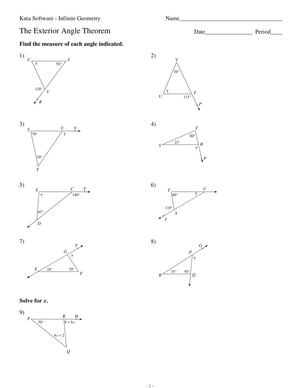
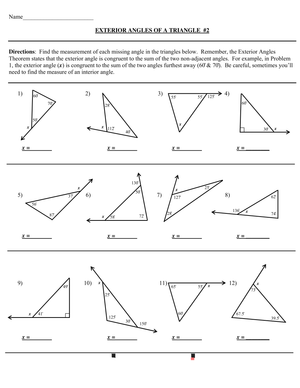
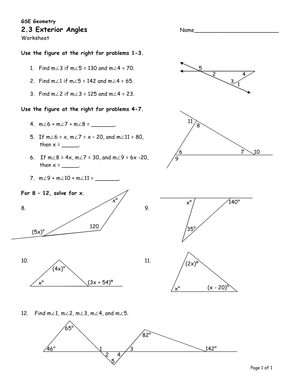
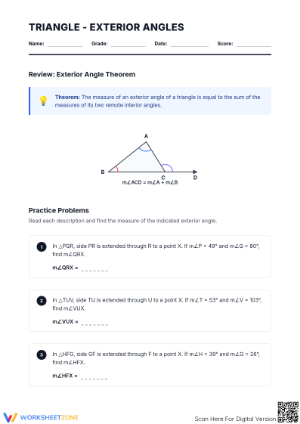
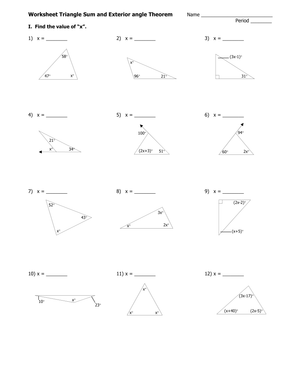
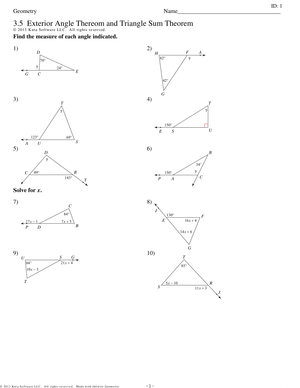
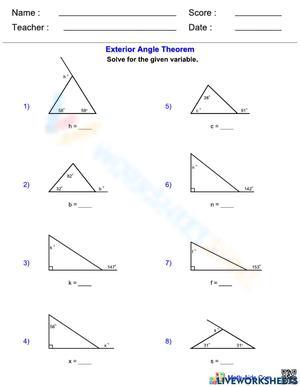
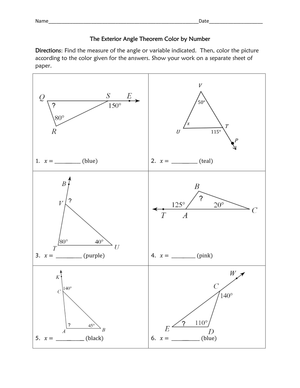
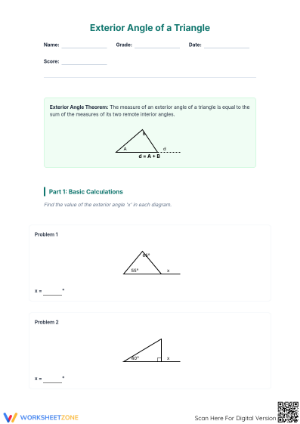
When you search for exterior angle theorem worksheets, you're usually planning one specific lesson: helping students see that the exterior angle of a triangle equals the sum of the two remote interior angles. A strong set makes that relationship visible before it asks for any calculation. It should open with clearly labeled triangle diagrams, move into numeric angle problems, and finish with solve-for-x tasks that push students to write and solve a short equation.
The best worksheets also keep one related fact in view: an exterior angle and its adjacent interior angle are supplementary, so they add to 180 degrees. Students who hold both ideas at once stop guessing and start reasoning. For a grade 8 class, that pairing is often the difference between a page students rush through and one that actually builds understanding.
Format matters as much as difficulty. Look for worksheets that keep each triangle large enough to label, group similar problems together, and leave room for students to show the sum they computed rather than just a final answer.
Where the Exterior Angle Theorem Fits in the Standards
Most teachers meet this topic in grade 8, and the placement is deliberate. The exterior angle relationship is one of several angle facts eighth graders are expected to reason about informally before they ever write a formal proof.
According to the Common Core State Standards Initiative, standard CCSS.Math.Content.8.G.A.5 asks grade 8 students to use informal arguments to establish facts about the angle sum and exterior angle of triangles. That single standard covers three angle relationships, which is why exterior angle practice rarely stands alone in a well-planned unit.
Because the standard names both the angle sum and the exterior angle together, worksheets that treat them as separate topics can leave gaps. Look for sets that let students move between the two, since the sum of the interior angles is what makes the exterior angle rule work in the first place.
Sequencing Worksheets From Informal Reasoning to Proof
Grade 8 expects informal, visual reasoning rather than two-column proofs. High school geometry then revisits the same theorem and rebuilds it formally, often using rigid transformations and the triangle angle sum theorem. Your worksheet sequence should mirror that arc.
Start with pages where students measure or read angles from a diagram and notice the pattern on their own. Follow with problems that state two remote interior angles and ask for the exterior angle, then reverse it: give the exterior angle and one remote interior angle and ask for the other. Only after that fluency is steady should you introduce algebraic problems that set an exterior angle expression equal to the sum of two interior expressions.
For high school geometry, choose worksheets that ask students to justify each step. The numbers stay simple, but the expectation shifts from getting an answer to explaining why the answer must be true.
The Remote Interior Angle Misconception
The single most common error on these worksheets is mixing up the remote interior angles with the adjacent interior angle. Students see three interior angles, spot the one nearest the exterior angle, and add the wrong pair.
In practice, this misconception is almost always a labeling problem, not a reasoning problem. When students shade the two remote angles in one color and the adjacent interior angle in another before they compute anything, error rates on the follow-up problems drop sharply, because the visual sorting happens before the arithmetic. A worksheet that builds in a quick color-code step for the first two or three problems does more for accuracy than another full page of numeric practice.
Small-group intervention is the natural place to catch this. Pull the four or five students who added the adjacent angle, hand them a diagram, and have them point to the two angles that are farthest from the exterior angle before writing a single number.
Using These Worksheets In Geometry Lessons
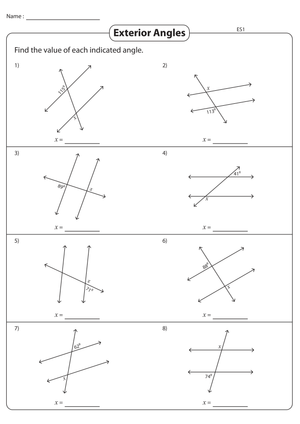
To fit exterior angle theorem worksheets into a real unit, treat them as one strand inside your triangle angle work rather than a stand-alone day. Pair them with triangle angle sum practice and with transversal-angle pages, since all three show up together in the same standard and reinforce one another.
A workable four-day flow looks like this. Day one, students discover the pattern from measured diagrams. Day two, numeric practice with a supplementary-angle check built in. Day three, algebraic solve-for-x problems for students who are ready, with a parallel numeric set for those who need it. Day four, a short exit-ticket assessment and targeted small-group work for anyone still confusing remote and adjacent angles.
Keep an answer key visible during practice, not just at grading time. When students can self-check a numeric answer against the 180-degree supplementary relationship, they catch their own errors and you spend less of the period confirming arithmetic.
Frequently Asked Questions
1. What grade level is the exterior angle theorem taught in US classrooms?
It's introduced in grade 8, where students reason about it informally, and revisited in high school geometry, where they build a formal proof. The same relationship appears in both, so the worksheets you use should match the level of reasoning your standard expects.
2. How is the exterior angle theorem different from the triangle angle sum theorem?
The triangle angle sum theorem says the three interior angles add to 180 degrees. The exterior angle theorem says one exterior angle equals the sum of the two remote interior angles. They're closely linked, and understanding the sum rule is what makes the exterior angle rule make sense.
3. Can these worksheets support both informal reasoning and formal proof?
Yes. Grade 8 sets should ask students to notice and describe the pattern, while high school sets should ask them to justify each step. Choosing worksheets by the type of thinking required, not just the diagrams, keeps them aligned to the right standard.
4. What misconception should teachers watch for with remote interior angles?
Students often add the adjacent interior angle instead of the two remote ones. A quick color-coding step, shading the two far angles before computing, prevents most of these errors and is worth building into the first few problems on any worksheet.
5. Do exterior angle theorem worksheets align with grade 8 and high school standards?
They can support both. At grade 8 the focus is informal argument about the angle sum and exterior angle of triangles; in high school geometry the same theorem is proved formally. Well-designed sets scale the reasoning up without changing the underlying relationship.













 Interactive Worksheet Maker
 Quiz Maker
 Word Search Maker
 Crossword Puzzle Maker
 Word Scramble Generator
 Sentence Scramble Generator
 Handwriting Worksheet Generator
 Name Tracing Generator
 Fill In The Blank Generator