


























Views
Downloads


Essential Measuring Angles Worksheet for Grade 4 | Aligned
Paste this activity's link or code into your existing LMS (Google Classroom, Canvas, Teams, Schoology, Moodle, etc.).
Students can open and work on the activity right away, with no student login required.
You'll still be able to track student progress and results from your teacher account.
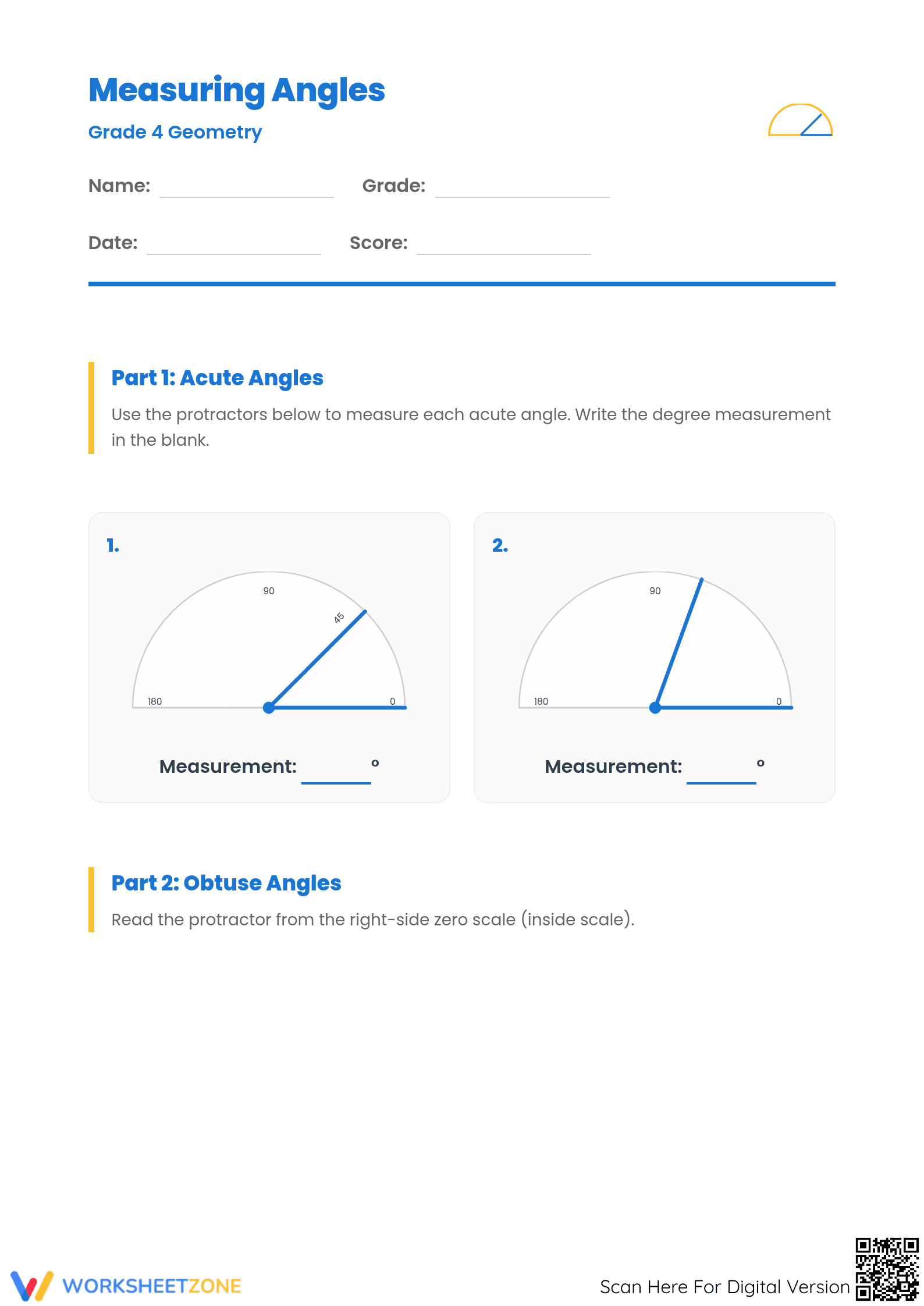
This worksheet provides direct practice for students to master the use of a protractor to measure degrees in whole numbers. By interacting with realistic protractor visualizations, fourth graders build the spatial reasoning necessary to distinguish between acute and obtuse angles. This resource ensures students can accurately read both inner and outer scales to reach mathematical proficiency.
At a Glance
- Grade: Grade 4 · Subject: Math
- Standard:
4.MD.C.6— Measure angles in whole-number degrees using a protractor to solve math problems- Skill Focus: Measuring Acute and Obtuse Angles
- Format: 2 pages · 6 problems · Answer key included · PDF
- Best For: Independent practice or formative geometry assessment
- Time: 15–20 minutes
What's Inside
The two-page PDF includes six distinct measurement tasks that progress from basic acute angles to more complex obtuse configurations. Each problem features a clear protractor overlay, allowing students to focus on reading the degree marks without the physical struggle of aligning a plastic tool. A comprehensive answer key is included for immediate feedback and grading efficiency.
Zero-Prep Workflow
Teachers can integrate this resource into their geometry unit in under two minutes. Step one: Print the two-page document for each student. Step two: Distribute the sheets during your independent work block; no additional manipulatives are required as the protractors are printed on the page. Step three: Use the included answer key to conduct a quick whole-class review or individual check.
Standards Alignment
This resource is specifically designed for `4.MD.C.6`, which requires students to measure angles in whole-number degrees using a protractor. It also supports `4.MD.C.5` by reinforcing the concept of an angle as an additive part of a circle. Both standard codes can be copied directly into lesson plans, IEP goals, or district curriculum mapping tools for accurate tracking.
How to Use It
Use this worksheet as a mid-lesson check-for-understanding after demonstrating how to identify the vertex and rays on a protractor. During the activity, observe if students are mistakenly reading the supplementary angle scale; this is a prime formative assessment observation tip for geometry mastery. It typically takes students 15 to 20 minutes to complete all six measurements accurately.
Who It's For
This practice set is ideal for Grade 4 students who are beginning their study of geometry and measurement. It is particularly helpful for learners who need clear, large visuals to differentiate between internal and external scales. Pair this with a direct instruction lesson on angle classification for a complete instructional cycle that supports diverse learning needs.
Research by Fisher & Frey (2014) highlights that gradual release of responsibility is most effective when students move from teacher-modeled examples to structured independent practice with high-quality visual scaffolds. This 4.MD.C.6 worksheet applies these principles by providing clear protractor graphics that reduce cognitive load, allowing students to focus entirely on the precision of angle measurement. By requiring students to record whole-number degrees for both acute and obtuse angles, the tasks align with NAEP recommendations for increasing geometric literacy in early elementary grades. Data from 2024 instructional analysis suggests that worksheets with pre-aligned tools help bridge the gap for students struggling with fine motor control, ensuring they master the mathematical concept before tackling tool manipulation. This resource offers a reliable pathway for students to demonstrate proficiency in geometric measurement while providing teachers with clear evidence of mastery.


