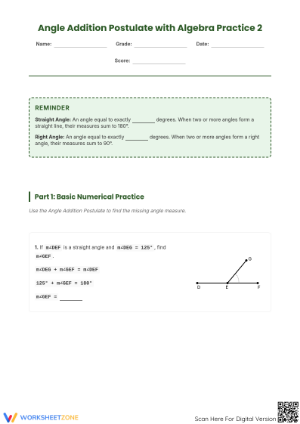
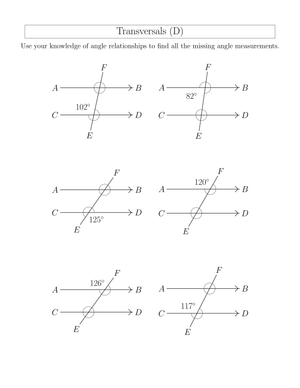
Start Angle Relationships Where Students Actually Struggle
By the time your students reach a geometry unit on angle pairs, most of them can name a right angle and measure with a protractor. The harder jump is reasoning: looking at two intersecting lines and knowing, without measuring, that the vertical angles match. Angle relationships worksheets give you a structured way to build that reasoning, moving students from memorized angle facts toward writing and solving equations for an unknown angle in a figure.
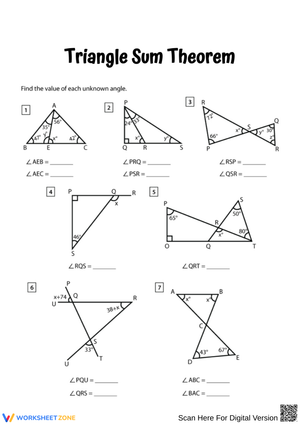
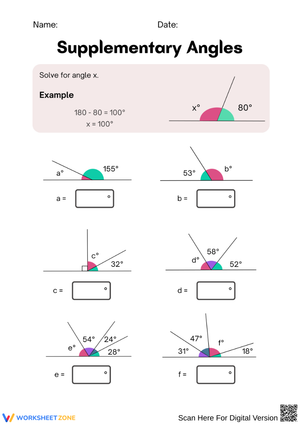
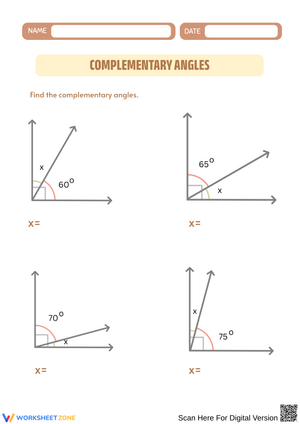
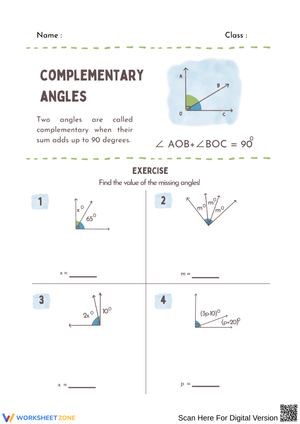
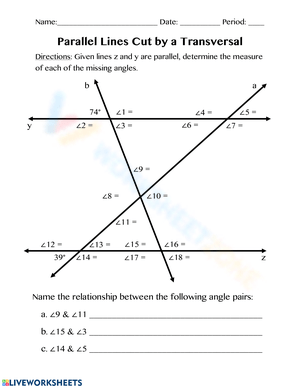
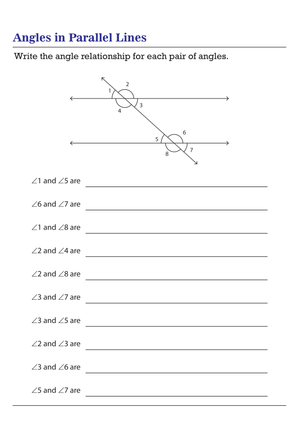
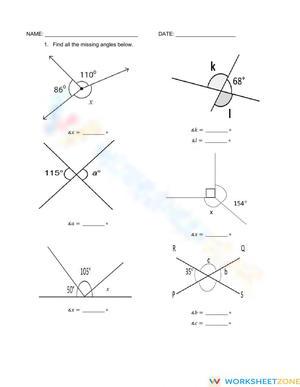
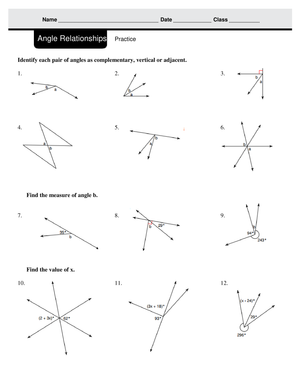
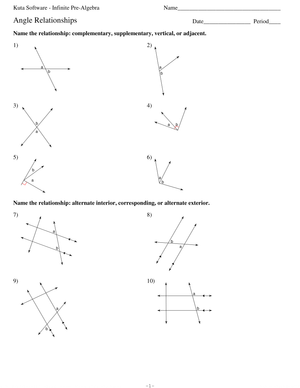
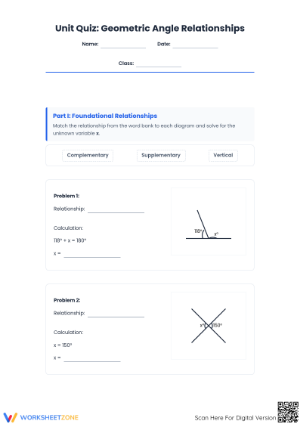
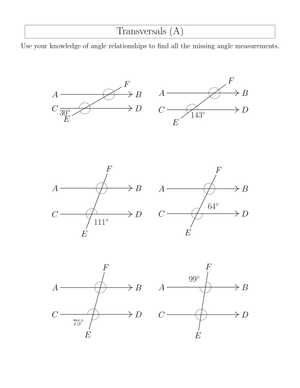
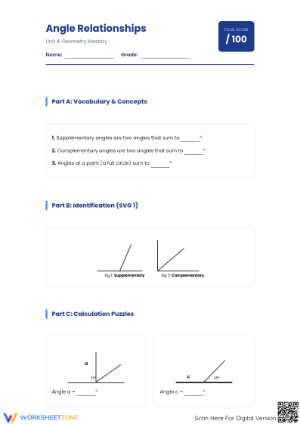
This page pulls together practice sets for complementary, supplementary, vertical, and adjacent angles so you can introduce the concepts, drill them, and check for mastery without building materials from scratch. Each set is designed for a grade 7-8 classroom and flexes between whole-group instruction, small-group intervention, and independent review, so you can drop it into almost any point in your geometry unit.
The Four Angle Relationships Your Worksheets Should Cover
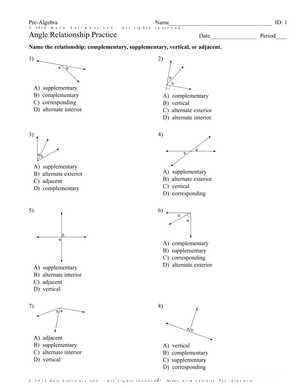
Strong practice materials keep the four core relationships visible and connected rather than teaching them in isolation. Students need to recognize each pair by sight and then apply its rule inside a multi-step problem.
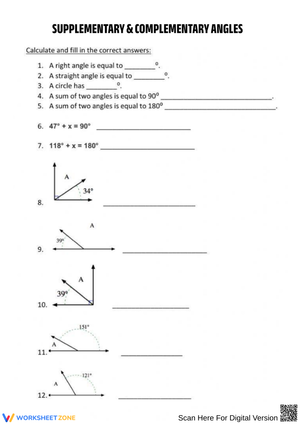
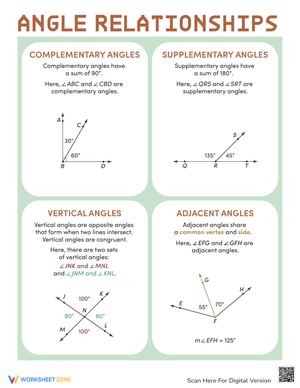
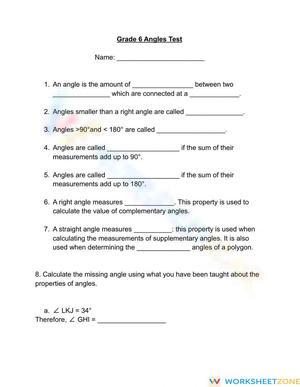
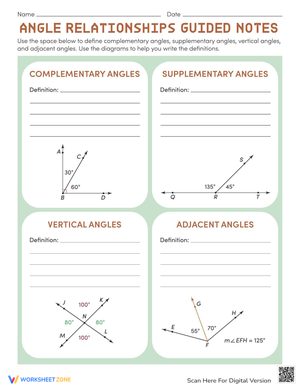
- Complementary angles sum to 90 degrees, so a problem might give one angle as 34 degrees and ask students to find its complement.
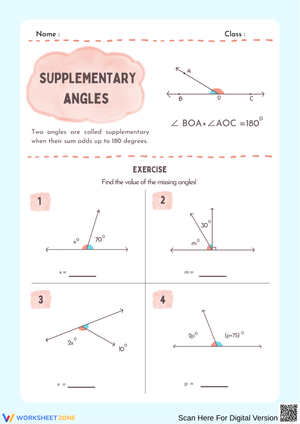
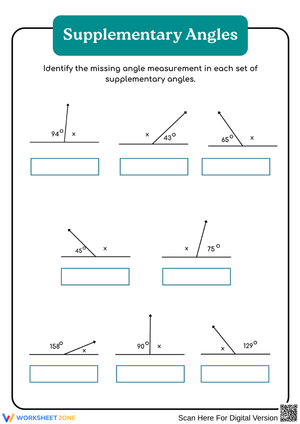
- Supplementary angles sum to 180 degrees, which shows up constantly along straight lines and inside triangles.
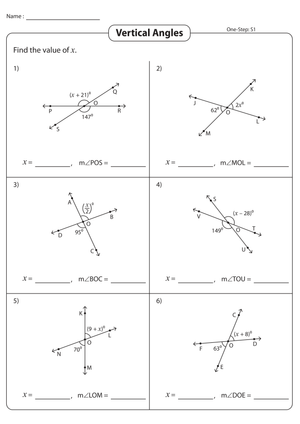
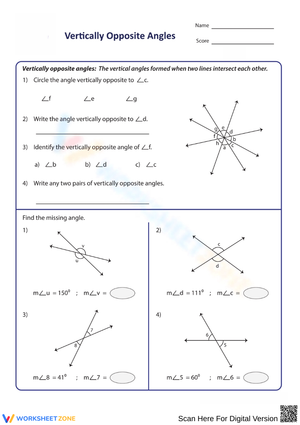
- Vertical angles are formed by two intersecting lines and are always congruent, a fact students can use to set two expressions equal.
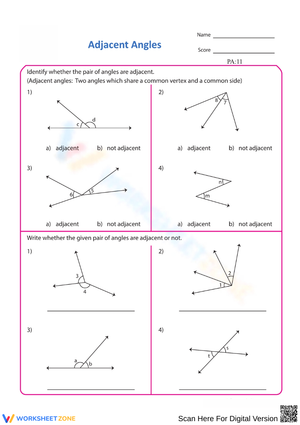
- Adjacent angles share a vertex and a side without overlapping, and they set up most of the "angles on a line" equation problems.
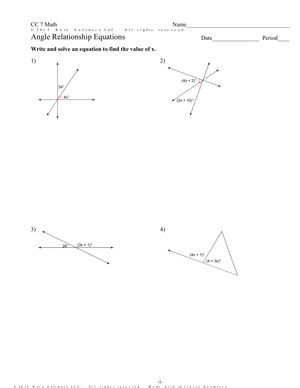
Once students can label these pairs, the worksheet problems shift from identification to algebra: writing something like 2x + 10 = 90 or (3x - 5) + 2x = 180 and solving for the unknown angle.
How These Worksheets Align to CCSS 7.G.B.5
The seventh-grade geometry standard is specific about what students should do with angle pairs, and well-built worksheets mirror that language directly instead of stopping at simple measurement.
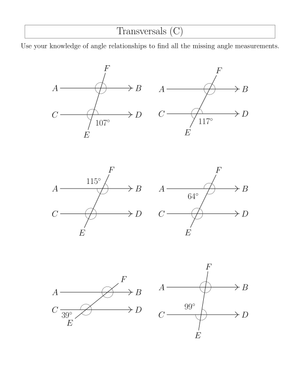
According to the Common Core State Standards, CCSS.MATH.CONTENT.7.G.B.5 asks students to use facts about supplementary, complementary, vertical, and adjacent angles in a multi-step problem to write and solve simple equations for an unknown angle in a figure. That single standard names all four relationships and ties them directly to equation writing, which is exactly why a good worksheet set includes diagram-to-equation tasks, not just fill-in-the-degree items.
Here is the piece teachers often underestimate: angle relationships are one of the earliest places students are asked to translate a picture into an algebraic equation. That translation, not the arithmetic, is where most errors live. When a student writes (3x - 5) + 2x = 180 from a straight-line diagram, they are practicing the modeling skill that later drives success in systems, functions, and proof. Framing the unit as an algebra on-ramp, rather than a measurement review, changes how you sequence the practice.
Differentiate Practice for Every Group
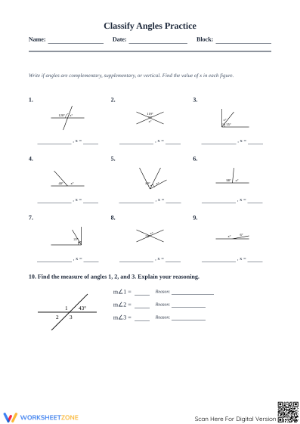
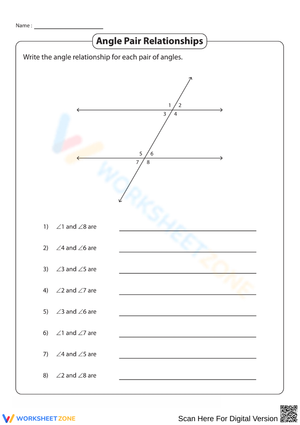
One reason teachers reach for worksheet sets on this topic is the range of readiness in a single class. Angle relationships lend themselves to layered practice. For students who are still shaky, start with visual identification pages: circle the vertical pair, shade the supplementary angles, match the term to the picture. For on-level students, move to one-step equations built from a single relationship. For students ready to stretch, use multi-step figures that combine two or three relationships, so finding one angle unlocks the next.
Because the underlying standard is fixed, you can differentiate the scaffolding without lowering the expectation. Every group still writes and solves an equation for an unknown angle; the difference is how much of the diagram-to-equation work is done for them. This lets you run a single topic across the whole room while meeting students where they are.
Classroom Implementation
A predictable routine helps this topic stick. Open with a short warm-up that asks students to name a relationship from a diagram, then teach one relationship at a time before combining them. Keep protractors nearby early on so students can verify that vertical angles really are congruent and that a linear pair really does total 180 degrees; that physical check builds the trust they need to reason without measuring later.
Use worksheets as exit tickets to catch misconceptions before they harden. A three-problem slip at the end of class tells you who confused complementary with supplementary and who is ready to move on. Pull a small group the next day using a targeted reteach page while the rest of the class practices multi-step problems independently. Keep completed pages in a folder so students can revisit worked examples before a quiz or unit test.
Target Common Misconceptions in Small-Group Reteaching
Two mix-ups show up in nearly every class. The first is swapping complementary and supplementary; a quick anchor, C comes before S just as 90 comes before 180, helps but needs repeated practice to stick. The second is assuming adjacent angles are always equal, which students overgeneralize from vertical angles. Reteach pages that place non-congruent adjacent angles right next to a vertical pair force students to look at the actual relationship instead of guessing. Short, focused sets like these are ideal for small-group intervention because they isolate one error at a time.
Frequently Asked Questions
1. What are the four main types of angle relationships covered in a 7th grade worksheet?
The four are complementary angles (summing to 90 degrees), supplementary angles (summing to 180 degrees), vertical angles (congruent pairs formed by two intersecting lines), and adjacent angles (which share a vertex and a side without overlapping). Grade 7-8 worksheets typically ask students to identify each pair and then use it to solve for an unknown angle.
2. How do angle relationships worksheets align with CCSS 7.G.B.5?
The standard asks students to use supplementary, complementary, vertical, and adjacent angle facts in multi-step problems to write and solve simple equations for an unknown angle. Worksheets aligned to it include diagram-based problems where students set up an equation, such as 2x + 40 = 180, rather than only measuring or recalling angle totals.
3. How can teachers use these worksheets for small-group intervention or reteaching?
Use short, single-focus pages to isolate one misconception at a time. For example, give a reteach set that only distinguishes complementary from supplementary angles, or one that contrasts adjacent and vertical pairs. Because each page targets a narrow skill, you can pull a small group, work three or four problems together, and check understanding before returning students to independent practice.
4. What is the difference between complementary, supplementary, vertical, and adjacent angles?
Complementary and supplementary describe angle sums (90 and 180 degrees). Vertical describes position, the opposite pairs formed when two lines cross, and those are always congruent. Adjacent describes angles that sit side by side sharing a vertex and a side. An angle pair can be both adjacent and supplementary at the same time, which is a useful point to raise in discussion.
5. How should teachers assess mastery beyond a single worksheet?
Combine formative checks with a cumulative task. Use exit tickets during the unit to track specific relationships, then finish with a multi-step figure that requires two or more relationships to solve, since that mirrors the standard's intent. Adding a short explanation prompt, asking students to justify which relationship they used, reveals whether they truly understand the reasoning or are guessing from the diagram.













 Interactive Worksheet Maker
 Quiz Maker
 Word Search Maker
 Crossword Puzzle Maker
 Word Scramble Generator
 Sentence Scramble Generator
 Handwriting Worksheet Generator
 Name Tracing Generator
 Fill In The Blank Generator