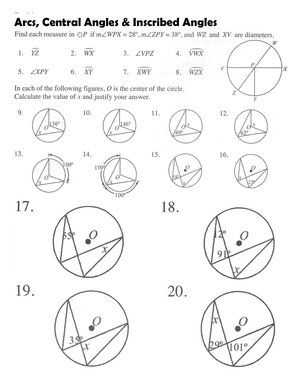
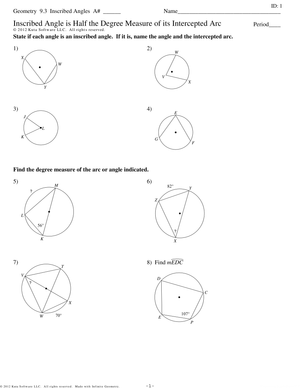
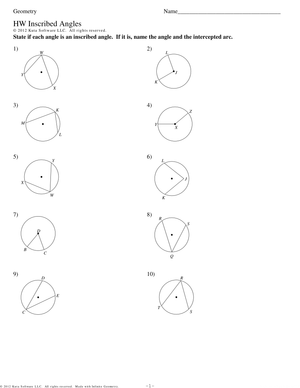
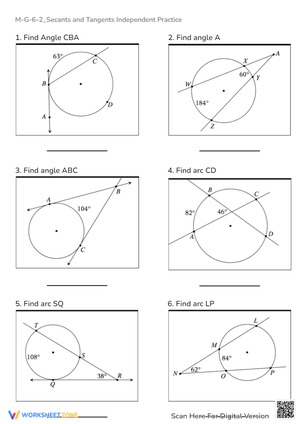
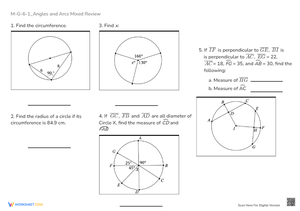
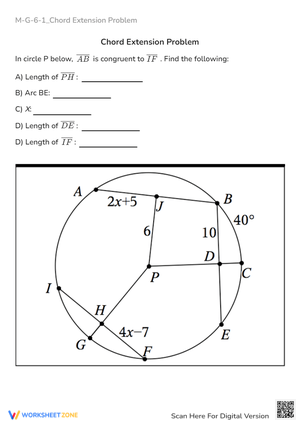
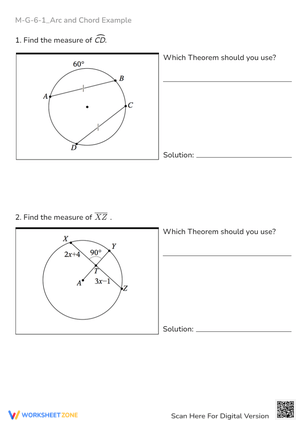
Once students can name a central angle and measure an arc, the next stop in a circles unit is the inscribed angle theorem. This is the relationship that unlocks almost everything else in the unit, from cyclic quadrilaterals to tangent-chord angles, so it deserves more than a single worksheet squeezed between other topics. An inscribed angle is formed by two chords that share an endpoint on the circle, with its vertex sitting on the circle itself rather than at the center. That single distinction, vertex on the circle versus vertex at the center, is the root of most of the confusion you will see in student work.
Worksheets built around inscribed angles give students repeated, low-stakes reps at identifying the vertex, naming the intercepted arc, and applying the theorem before they are asked to combine it with other circle relationships. For a circles unit that spans two to three weeks, a dedicated inscribed angle set is a natural bridge between central angle basics and the more layered problems that show up on unit assessments.
The Core Relationship Students Need to Internalize
The inscribed angle theorem states that an inscribed angle measures half the measure of its intercepted arc. Because a central angle equals its intercepted arc in degrees, this also means an inscribed angle is half of the central angle subtending the same arc. Worksheets should introduce this as a single, memorable rule before layering in variations.
In practice, the fastest way to expose a shaky grasp of this rule is a worksheet item that gives the arc measure and asks for the inscribed angle, immediately followed by an item that gives the inscribed angle and asks for the arc. Students who only memorized halve the arc without understanding the relationship will stall on the reverse question, which makes this pairing a quick diagnostic you can build into any practice set.
Scaffolding From Identification to Multi-Step Problems
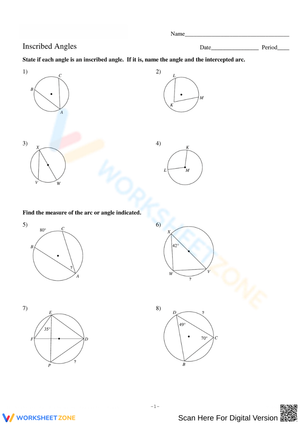
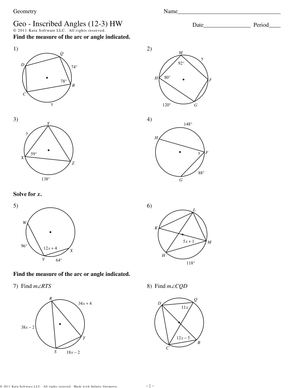
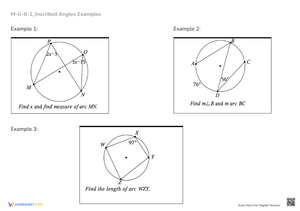
Good inscribed angle worksheets move through a clear progression rather than jumping straight to complex diagrams. A four-tier structure works well for most geometry classes: first, identification items where students label the vertex, the two chords, and the intercepted arc on a given circle; second, direct application items where one value is given and students solve for the other using the half-arc rule; third, problems with an unknown variable expressed algebraically, where students set up and solve an equation; and fourth, multi-angle diagrams where two or more inscribed angles share the same circle and students must combine relationships to find missing measures.
This progression matters because inscribed angle problems compound quickly. A diagram with three chords and four labeled angles can be solved with the same core theorem used in the first tier, but only if students have practiced isolating one relationship at a time before combining them. Worksheets that skip straight to tier four tend to produce guessing rather than reasoning.
The Semicircle Special Case and Why It Matters Later
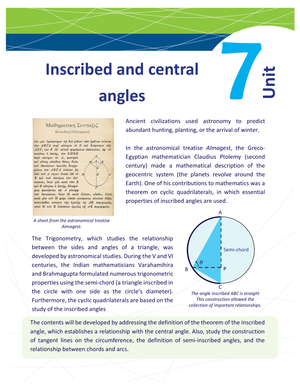
One of the most useful special cases to build into a worksheet set is the inscribed angle in a semicircle. When the intercepted arc is a semicircle, measuring 180 degrees, the inscribed angle must measure 90 degrees, making it a right angle. This case is worth its own dedicated section on a worksheet rather than being folded into general practice, because it previews right triangle relationships and Thales theorem that students will meet again in later units.
Framing a few problems around a diameter drawn into a circle, with students asked to prove or justify why the resulting inscribed angle is a right angle, also gives you a natural formative assessment moment. Students who can explain the reasoning, not just recall the 90-degree answer, are demonstrating the kind of understanding CCSS.HSG-C.A.2 is aiming for when it calls for students to identify and describe relationships among inscribed angles, radii, and chords.
Common Misconceptions Worth Targeting Directly
Two errors show up consistently in inscribed angle work, and worksheets can be designed to surface both. The first is confusing an inscribed angle with a central angle, particularly when a diagram includes both types and students apply the wrong rule to the wrong vertex. The second is identifying the wrong arc, using the near arc or the far arc incorrectly when the diagram is drawn with the angle opening toward one side.
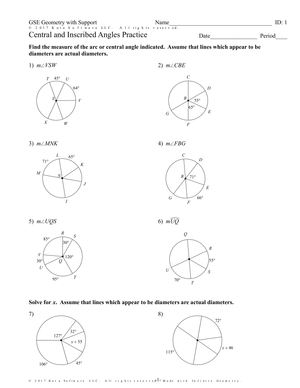
Building a short set of diagrams where a central angle and an inscribed angle intercept the same arc, side by side, helps students see the halving relationship directly rather than memorizing it as an abstract rule. Similarly, including at least one item where the intercepted arc is not the arc closest to the angle forces students to trace the chords carefully rather than guessing based on proximity.
Extending Practice to Cyclic Quadrilaterals
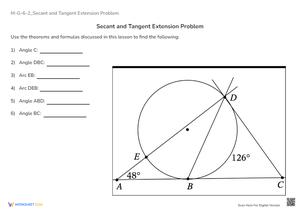
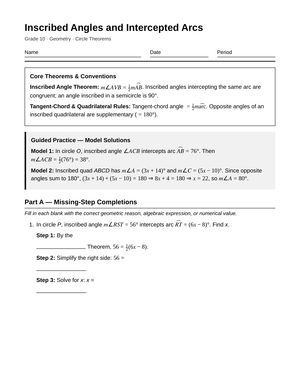
For classes ready to go beyond single inscribed angles, worksheets can extend into cyclic quadrilateral problems as an enrichment layer. Two properties are useful here: inscribed angles that intercept the same arc are congruent, and opposite angles of a quadrilateral inscribed in a circle are supplementary, summing to 180 degrees. These properties turn a four-sided figure inside a circle into a system of equations, which is a strong stretch task for students who have already mastered the basic inscribed angle relationship.
A worksheet built around one cyclic quadrilateral problem, with several sub-questions asking students to find each angle in sequence, works well as a challenge station or homework extension without requiring an entirely separate lesson.
Teacher Tips for Using These Worksheets in Class
Pace the four-tier progression across two class periods rather than one if your students are new to circle theorems; rushing identification and direct application in a single day tends to produce weak transfer to the algebraic and multi-angle tiers. Use the identification tier as a warm-up on day one and the multi-angle tier as an exit ticket or quiz on day two.
For small-group intervention, pull students who struggle specifically with the reverse question, given the angle, find the arc, and give them a short stack of paired problems rather than a full worksheet. This keeps the intervention focused on the exact misconception rather than re-teaching the whole topic. For enrichment groups, skip straight to the cyclic quadrilateral extension and let students work in pairs to justify each step, which pushes them toward the kind of written reasoning that CCSS.HSG-C.A.2 expects.
When grading, look specifically at whether students labeled the intercepted arc before calculating. Students who write the arc measure directly on the diagram before solving are far less likely to make the near-arc versus far-arc error, so this habit is worth modeling explicitly and checking for in student work.
Frequently Asked Questions
1. What is the difference between an inscribed angle and a central angle?
A central angle has its vertex at the center of the circle, and its measure equals the measure of its intercepted arc. An inscribed angle has its vertex on the circle itself, formed by two chords, and its measure is half the intercepted arc.
2. How do you find the measure of an inscribed angle from its intercepted arc?
Divide the measure of the intercepted arc by two. If the arc measures 100 degrees, the inscribed angle that intercepts it measures 50 degrees.
3. Why is an inscribed angle in a semicircle always a right angle?
A semicircle is an arc of 180 degrees. Since an inscribed angle is half its intercepted arc, an inscribed angle intercepting a semicircle is always 90 degrees, making it a right angle.
4. What grade level or course typically covers inscribed angles under CCSS?
Inscribed angle relationships fall under CCSS.HSG-C.A.2, part of the high school Geometry circles cluster, which asks students to identify and describe relationships among inscribed angles, radii, and chords.
5. How can teachers check for understanding before moving to cyclic quadrilateral problems?
Use a short quiz that pairs a forward question, arc given, find the angle, with a reverse question, angle given, find the arc. Students who answer both correctly and can explain the semicircle right angle case are typically ready for cyclic quadrilateral extensions.













 Interactive Worksheet Maker
 Quiz Maker
 Word Search Maker
 Crossword Puzzle Maker
 Word Scramble Generator
 Sentence Scramble Generator
 Handwriting Worksheet Generator
 Name Tracing Generator
 Fill In The Blank Generator