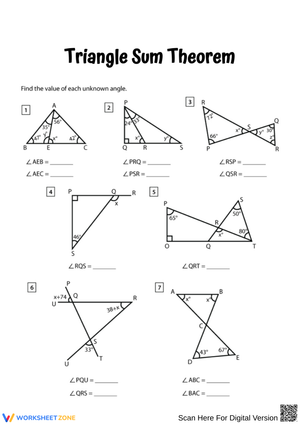
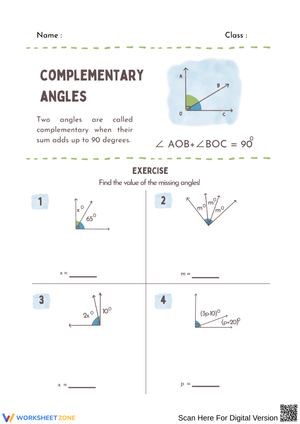
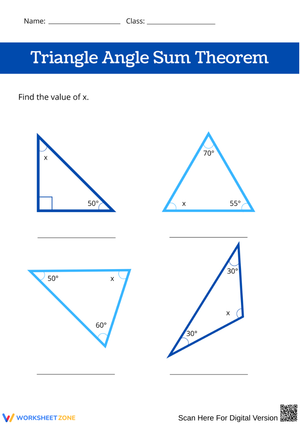
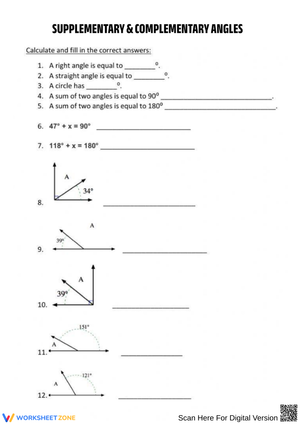
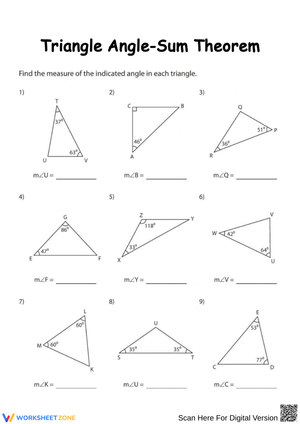
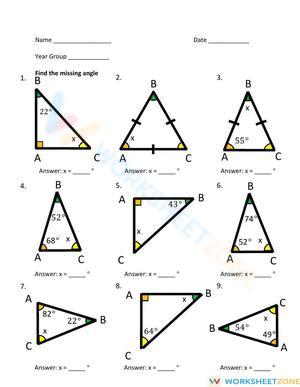
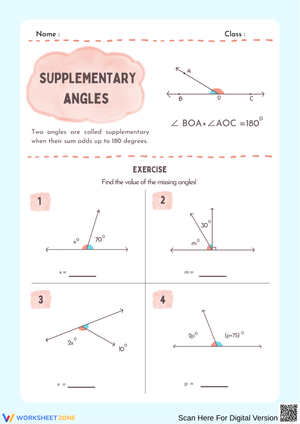
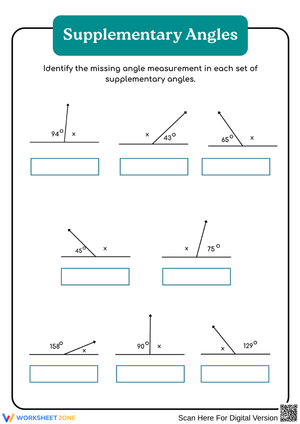
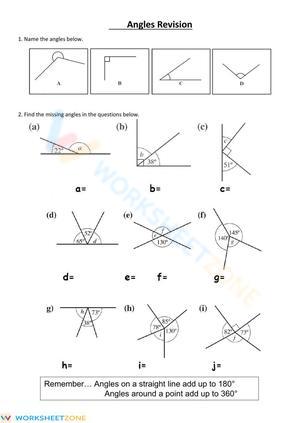
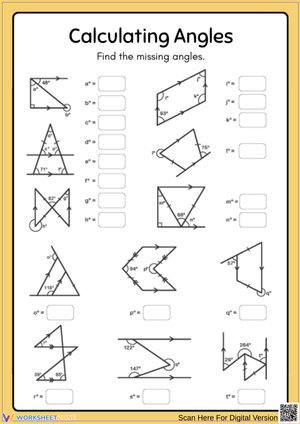
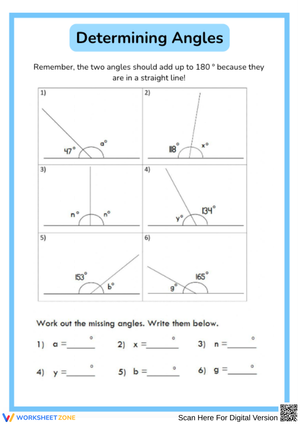
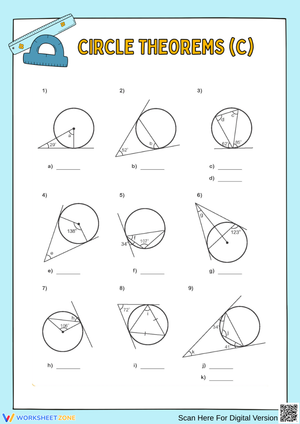
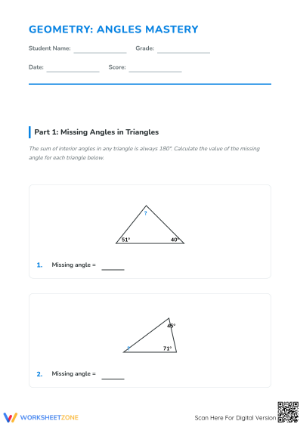
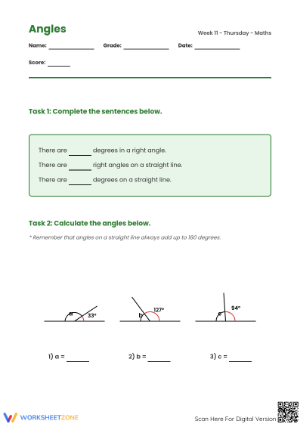
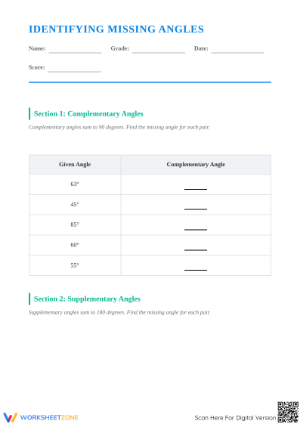
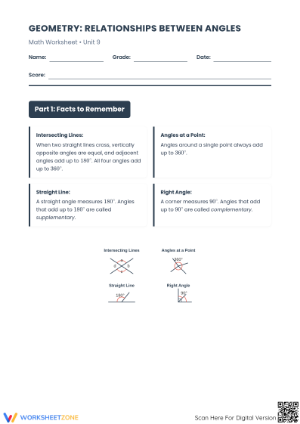
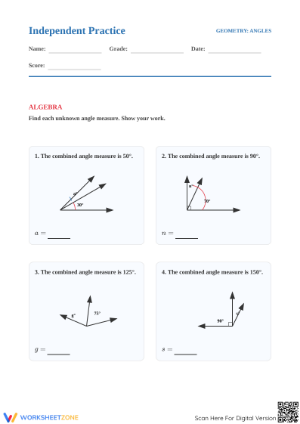
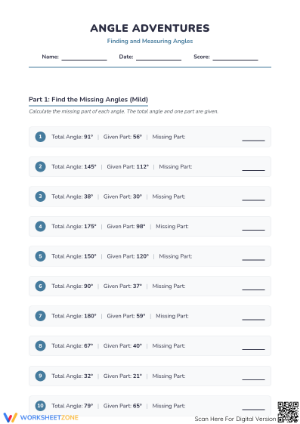
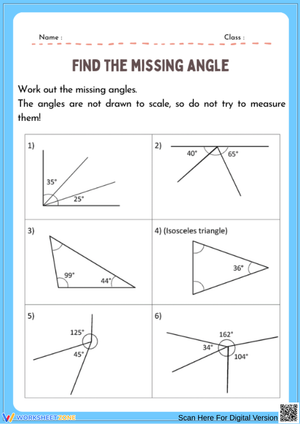
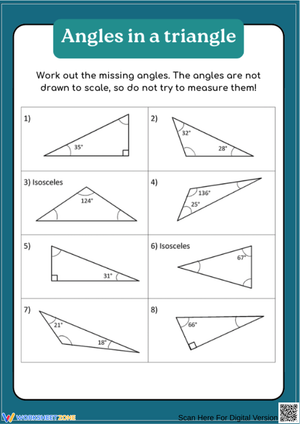
These missing angles worksheets give middle school teachers a structured sequence of practice pages that moves from basic angle identification through multi-step algebraic equations — the full arc of what 7th and 8th graders need to work through before geometry gets formally assessed. Each page targets a specific angle relationship so students aren't jumping between concepts before any one of them is solid.
Concepts Covered Across the Set
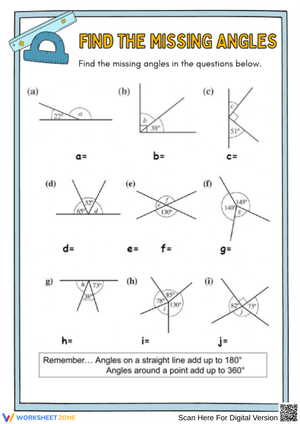
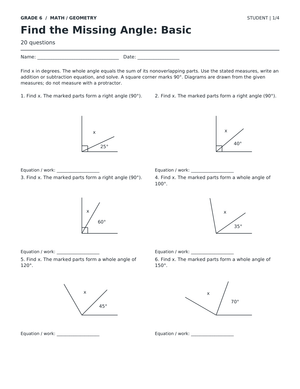
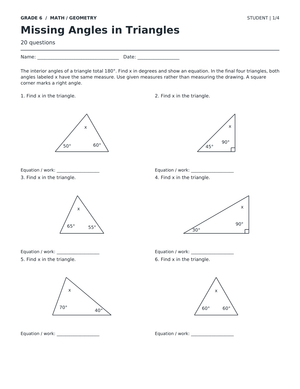
The pages address the core angle relationships students encounter from late elementary through middle school. Early pages focus on complementary and supplementary pairs, where students identify which relationship applies and calculate the missing measure. Later pages shift to intersecting lines, asking students to distinguish vertical angles from adjacent ones and apply each rule correctly. Triangle and quadrilateral interiors get their own pages, using the angle sum theorems as the basis for every calculation. The most demanding pages introduce algebraic expressions — two supplementary angles labeled as 3x + 15 and 2x − 5, for instance — requiring students to write an equation, solve for the variable, then substitute back to find the actual angle measures. That last step trips up a lot of students who stop at x = 33 and never compute the angle itself.
Where Student Thinking Breaks Down
There are a few errors that appear so reliably they're almost predictable. The most common: students assume any two angles that look adjacent in a figure must be supplementary. When intersecting lines aren't drawn perpendicular to each other, the visual cue fails them, and they reach for 180 when the relationship doesn't call for it. A second pattern shows up specifically with vertical angles — students who can correctly identify them in a clean two-line intersection lose track of which angles are vertical when a third line enters the figure. The figures in this set are designed to surface both of those errors. Some include non-perpendicular intersections; others add a transversal to force careful identification rather than visual guessing.
The algebra-integrated pages expose a third issue: students conflate solving for the variable with answering the question. After finding x, they write the value in the answer blank and move on. Building in a "check your angle" step — where students substitute back and verify the relationship holds — catches this before it becomes a habit.
How These Pages Fit into Classroom Routines
The single-concept pages work well as Monday warm-ups after a weekend away from the material — four or five problems, enough to reactivate the rule without eating into instruction time. The algebraic pages are better suited to independent practice blocks or small-group work, where students have time to show full equation setup. In small groups, ask students to announce which angle relationship they're using before they calculate anything. That narration step exposes whether the reasoning is sound or whether they arrived at a correct answer through a flawed process.
For bell ringers, one page projected on a whiteboard and worked collectively takes about eight minutes and gives you a clean look at where the class stands before you decide how to open a lesson. If three or four students can't correctly identify why two angles are vertical rather than supplementary, that's a signal to back up before pushing into algebra. These pages function as informal formative checkpoints as much as they function as practice.
Why Angle Relationships Are Hard to Hold in Working Memory
Part of what makes missing angle problems cognitively demanding at the 7th-grade level is that students are managing several things at once: reading a geometric figure, recalling the correct relationship, setting up arithmetic or algebra, and executing the calculation. Cognitive load theory is useful here. When students are still retrieving angle rules effortfully, there's little working memory left for the equation-solving. One approach that reduces this: have students trace each angle pair in a different color before writing anything. Marking vertical angles in one color and supplementary pairs in another forces classification to happen visually and explicitly, before the arithmetic starts. It's a small move, but it keeps students from trying to classify and calculate simultaneously.
Standards Alignment
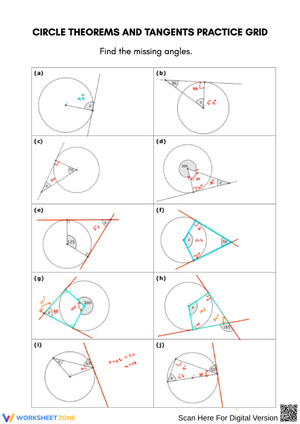
The core of this set aligns to CCSS.MATH.CONTENT.7.G.B.5, which asks students to use facts about supplementary, complementary, vertical, and adjacent angles to write and solve simple equations for unknown angle measures. That standard is placed at grade 7 because students at that level have enough algebraic fluency — from the 7.EE standards — to set up one-variable equations without the equation-writing itself becoming the obstacle. The earlier, arithmetic-only pages anticipate students who are approaching that standard from below, and the multi-line figures extend the work for students moving toward 8th-grade geometry content involving parallel lines and transversals.
Frequently Asked Questions
At what point should I introduce the algebraic versions?
When students can consistently identify the correct angle relationship and calculate the missing measure arithmetically without prompting, they're ready for algebraic problems. If they're still misclassifying vertical and adjacent angles, introducing expressions as unknowns adds a second layer of difficulty that buries the first. Arithmetic fluency with the relationships is the prerequisite, not a grade level or a calendar date.
Can these pages be used for test prep?
Angle relationships appear consistently on state assessments at grades 7 and 8, usually in two forms: straightforward missing-measure problems and embedded problems where finding an angle is one step inside a larger multi-part question. The single-concept pages address the first format directly. For the second, use the algebraic pages and ask students to explain each step in writing — that's closer to what constructed-response items require.













 Interactive Worksheet Maker
 Quiz Maker
 Word Search Maker
 Crossword Puzzle Maker
 Word Scramble Generator
 Sentence Scramble Generator
 Handwriting Worksheet Generator
 Name Tracing Generator
 Fill In The Blank Generator