


























Views
Downloads



Essential Grade 4-6 Angles on Clock Face Worksheet
Paste this activity's link or code into your existing LMS (Google Classroom, Canvas, Teams, Schoology, Moodle, etc.).
Students can open and work on the activity right away, with no student login required.
You'll still be able to track student progress and results from your teacher account.
This Essential Angles on the Clock Face worksheet helps students master the relationship between time and geometry. Students identify, draw, and calculate acute, obtuse, and right angles using clock hands as rays. Learners will understand how the circular movement of a clock creates specific angular measurements across seventeen structured problems.
At a Glance
- Grade: 4-6 · Subject: Math
- Standard:
CCSS.MATH.CONTENT.4.MD.C.5— Recognize angles as geometric shapes that are formed wherever two rays share a common endpoint- Skill Focus: Angle identification and clock-based geometry
- Format: 3 pages · 17 problems · Answer key included · PDF
- Best For: Independent practice or math center activity
- Time: 25–35 minutes
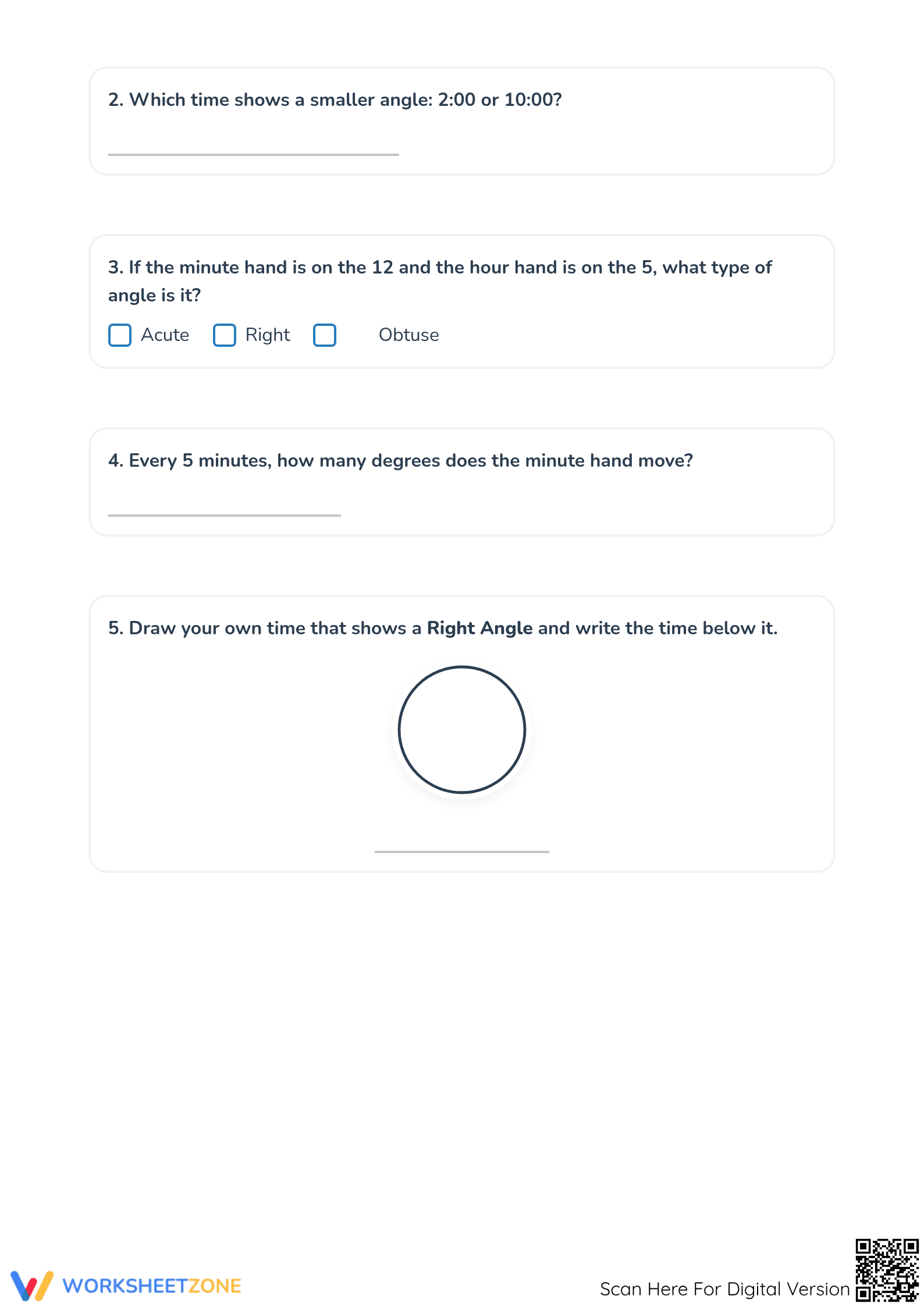
This 3-page PDF provides a structured progression. Part 1 features nine clocks where students classify the shown angle. Part 2 challenges students to draw hands for specific times to create right, acute, and obtuse angles. Part 3 includes five thinking questions on degree calculations and comparative reasoning. A full answer key is included.
Zero-Prep Workflow
The zero-prep design is ideal for busy classrooms or sub plans. Simply print the PDF, distribute to students, and review using the key. Total teacher preparation time is under two minutes. This workflow ensures students engage with standards-aligned content without complex setup, making it perfect for independent practice or quick assessments.
Standards Alignment
The primary focus is CCSS.MATH.CONTENT.4.MD.C.5, which requires recognizing angles as geometric shapes formed by rays. The worksheet also supports CCSS.MATH.CONTENT.4.MD.C.6 as students sketch angles on the clock. These standard codes can be copied directly into lesson plans or IEP goals to ensure compliance with curriculum mapping and grade-level requirements.
How to Use It
Use this as a mid-unit assessment during geometry to gauge understanding of angle classification. It works well as a formative assessment; observe student approaches to the thinking questions to identify those struggling with degrees. Most learners complete the set in 30 minutes. It serves as an excellent bridge between concrete clock reading and abstract geometry.
Who It's For
This is for students in grades 4, 5, and 6 developing spatial reasoning. It provides scaffolding for visual learners through the familiar analog clock. Pair this with a physical teaching clock for optimal results. This resource bridges the gap between everyday observations and formal mathematical definitions for acute, obtuse, and right angles.
Integrating geometry into time-based contexts reinforces mathematical fluency. According to the RAND AIRS 2024 report, contextualized problems increase engagement by grounding abstract concepts in real-world objects. This worksheet addresses CCSS.MATH.CONTENT.4.MD.C.5 by treating clock hands as rays, facilitating understanding of circular measurement. Fisher & Frey (2014) emphasize that such visual representations are critical for students moving from concrete to abstract reasoning. By identifying, drawing, and analyzing angles through 17 tasks, students build skills for complex trigonometry. This resource provides evidence of mastery for identification and construction of geometric figures, making it a valuable addition to standards-based curricula. Learners gain confidence in calculating degrees and recognizing angle types, ensuring they are prepared for advanced middle school geometry, spatial reasoning, and standardized testing requirements. This alignment provides educators with a reliable tool for both assessment and instruction in foundational geometric principles.


