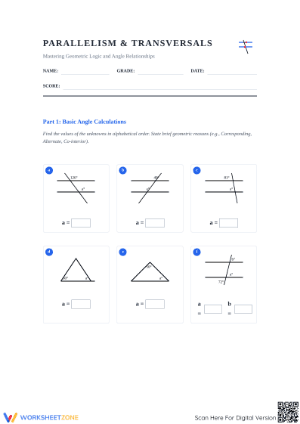
Parallel lines cut by a transversal worksheets give geometry practice a clear routine
When students reach angle relationships in geometry, they often need more than one exposure before the vocabulary and patterns stick. Parallel lines cut by a transversal worksheets give teachers a practical way to organize that repetition. Instead of treating corresponding angles, alternate interior angles, alternate exterior angles, and same-side interior angles as isolated facts, these pages let students see the full structure again and again in a consistent visual format. That matters in middle school and early high school units, where students are expected to move from naming angle pairs to justifying why measures are equal or supplementary.
For teachers, the value is in how flexible the practice can be. The same worksheet set can support a short bell ringer, a guided practice block, homework, a review packet, or small-group intervention. Students who need visual reinforcement can focus on identifying relationships in a diagram, while students who are ready for more challenge can solve for missing angles with variables. A strong set of worksheets helps you keep the content focused on theorem application instead of losing time to constantly re-explaining the diagram setup.
Students need to recognize the four angle relationships quickly and accurately
The best parallel lines cut by a transversal worksheets start with recognition. A transversal is a line that intersects two lines at distinct points, and when those two lines are parallel, several dependable angle relationships appear. Corresponding angles are congruent. Alternate interior angles are congruent. Alternate exterior angles are congruent. Same-side interior angles are supplementary, so their measures add to 180 degrees. Those are the core ideas students need before they can solve multi-step problems confidently.
Worksheets are especially useful here because they slow the task down into visible decisions. Students can label, compare, and sort angle pairs before they calculate anything. That sequence keeps the lesson grounded in reasoning instead of guessing. If a student says two angles are equal, the worksheet format makes it easier to ask, Which relationship proves it? If another student adds two angles to 180, the page gives you a concrete place to discuss why same-side interior angles behave differently from alternate interior angles.
Good worksheet sets move from naming angles to solving for unknowns
A strong progression matters more than the number of problems on the page. Early items should ask students to identify or name angle pairs formed by a transversal crossing parallel lines. From there, the work should shift into finding missing angle measures, then into algebraic problems where students solve for a variable before determining actual angle values. That laddered structure supports both review and new instruction because it builds from recognition to application.
Teachers often need materials that can serve multiple readiness levels in the same class period. In that situation, worksheets are useful because they can be assigned selectively. One group may still be matching angle names to positions, while another is solving equations based on congruent corresponding angles or supplementary same-side interior angles. Keeping those tasks within the same visual family reduces confusion and helps students transfer what they already know from one problem type to the next.
One reliable planning move is to separate error analysis by relationship type rather than by overall score. If a student misses mostly same-side interior questions, the issue is usually not arithmetic. It is often that the student treats every angle pair around parallel lines as congruent. A worksheet sequence that isolates supplementary relationships for even 6 to 8 items can correct that misconception faster than a mixed page of 20 problems.
What classroom-ready practice should include
Not every worksheet labeled for this topic supports classroom instruction equally well. The most useful sets make the diagrams easy to parse and vary the task demand without changing the visual logic too abruptly. Teachers usually benefit from materials that include straightforward angle naming, direct measure finding, and at least a few algebra-based items. That mix allows the same resource to work in a mini-lesson, independent practice, and later review.
- Clear diagrams with enough spacing for students to track interior and exterior regions.
- Problems that cover corresponding, alternate interior, alternate exterior, and same-side interior angles.
- A progression from basic identification to missing-angle equations.
- Answer-friendly layouts for quick checking during circulation or intervention groups.
- Enough variation that students must reason from position, not memorize one diagram.
Classroom Implementation
In real classrooms, these worksheets work best when they are attached to a narrow instructional goal. If your goal is vocabulary accuracy, use a short set focused only on identifying angle relationships. If your goal is procedural fluency, move to missing-angle measures and variable equations. If your goal is intervention, choose a page with repeated diagram structures so students can focus on the relationship instead of re-decoding a new layout every time.
A simple implementation pattern is to open with two projected examples, assign one worksheet section independently, and close with a comparison discussion about which angles are equal and which sum to 180 degrees. That keeps the practice efficient and makes misconceptions visible. It also fits several common use cases: bell ringers, station work, homework, exit-ticket review, and reteach groups before an assessment.
Differentiation works best when the worksheet task stays visible
Because the diagrams are so central to this topic, differentiation should simplify the thinking path, not remove the geometry. For students who need support, that might mean highlighting one intersection at a time, using fewer total items, or assigning only one relationship family in a short practice set. For students who are ready to extend, the better move is usually to increase the reasoning demand with algebra or mixed relationship identification rather than simply adding more of the same problem.
Small-group intervention can be especially effective with this topic because teacher feedback is immediate. You can watch a student point to the wrong angle region, correct the visual misunderstanding in the moment, and then have the student apply the same rule on the next item. In contrast, a whole-class lecture may hide those small but important errors until a quiz exposes them.
How teachers can choose the right worksheet for the lesson
The right worksheet depends on what students need to do by the end of the lesson. If the target is identification, choose pages with many short items and consistent diagrams. If the target is application, choose fewer problems with more reasoning and equation solving. If the target is intervention, choose a page that repeats the same structure often enough for a pattern to emerge. Matching the worksheet to the exact lesson purpose is what turns practice from busy work into usable instruction.
It is also worth checking whether the worksheet supports teacher talk. Can students explain why two angles are corresponding? Can they defend why another pair is supplementary? Can they trace the effect of the transversal across both parallel lines? The best materials make those conversations easier because the layout supports comparison and the problem set exposes common misconceptions before they become habits.
Frequently Asked Questions
1. What angle pairs are formed when parallel lines are cut by a transversal?
The main pairs teachers usually emphasize are corresponding angles, alternate interior angles, alternate exterior angles, and same-side interior angles. Worksheets help students identify each pair by position before they move into solving for unknown measures.
2. Which angles are equal and which are supplementary?
When the lines are parallel, corresponding angles are equal, alternate interior angles are equal, and alternate exterior angles are equal. Same-side interior angles are supplementary, so they add to 180 degrees.
3. How do students solve for x in transversal angle problems?
Students first identify the angle relationship shown in the diagram. Then they write an equation based on that relationship, such as setting congruent angles equal or making supplementary angles sum to 180, and solve for the variable before finding any requested angle measures.
4. What grade level usually covers parallel lines and transversals?
This topic is commonly taught in middle school and early high school geometry units. Teachers often revisit it during review because it blends vocabulary, diagram interpretation, and algebraic reasoning in one skill set.
















 Interactive Worksheet Maker
 Quiz Maker
 Word Search Maker
 Crossword Puzzle Maker
 Word Scramble Generator
 Sentence Scramble Generator
 Handwriting Worksheet Generator
 Name Tracing Generator
 Fill In The Blank Generator