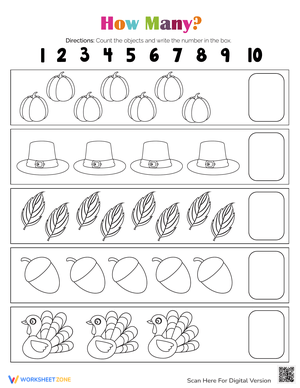
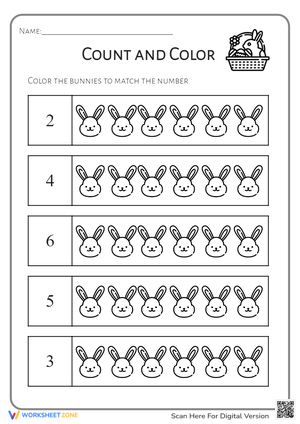
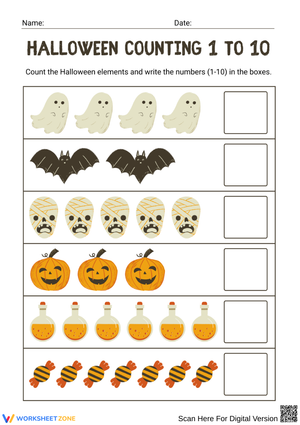
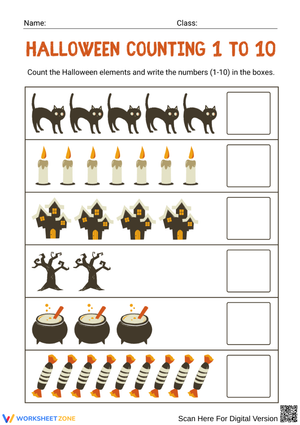
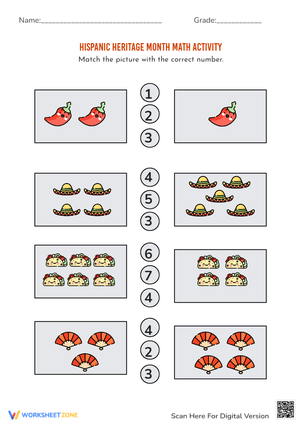
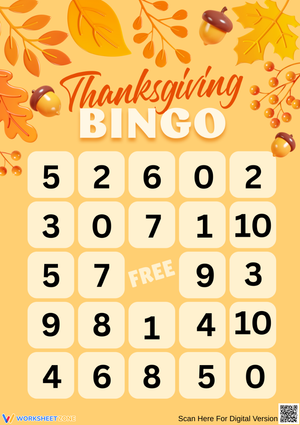
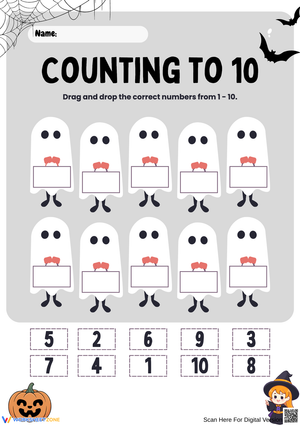
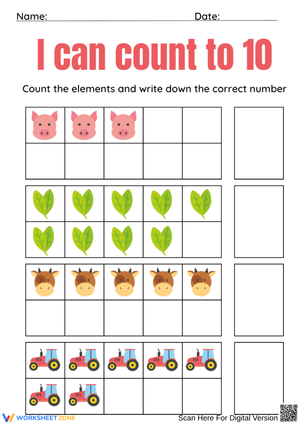
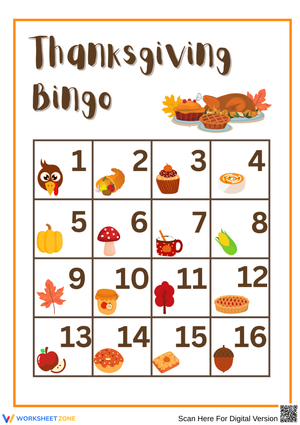
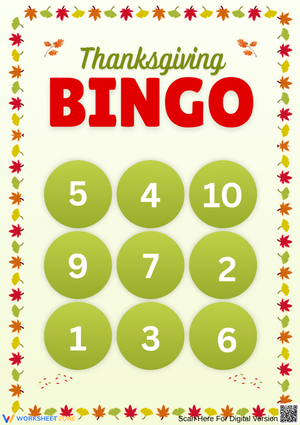
These counting to 10 worksheets give PreK and Kindergarten teachers a set of printable pages that target the specific sub-skills hiding inside what looks like a simple task — touching each object once, connecting a written numeral to a quantity, and holding onto that final count when someone asks "how many?" Each of those moves is its own teachable moment, and the pages are built to make each one visible.
The Specific Skills Each Page Targets
Counting to ten involves at least four distinct competencies that develop on different timelines and require different practice structures. One-to-one correspondence — tagging each object with exactly one number name — is the first to appear and the first to break down under pressure. Students who count aloud fluently will still drag a finger across a row of drawn apples and say "seven" when there are six, skipping the pause between objects. Worksheets where students mark or cross out each item as they count build the habit of slowing down that physical gesture.
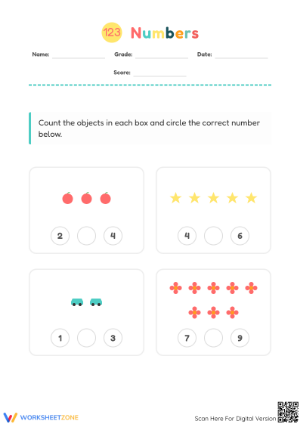
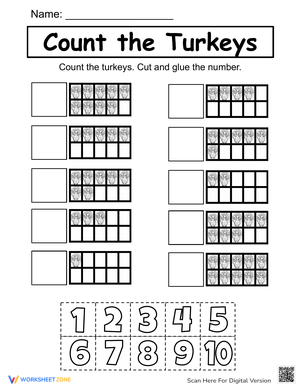
Number recognition and cardinality develop alongside correspondence but are not the same skill. A child can recognize the numeral 7 on a calendar and still recount a pile of seven blocks from scratch when asked "how many?" because they haven't yet internalized that the last count word names the whole set. Pages that ask students to count a group and then circle the matching numeral — without recounting — push directly on cardinality. Subitizing, the instant recognition of small quantities without counting, is supported through ten-frame formats: once students see five filled dots on the top row and three on the bottom, they stop counting and start seeing eight as a shape.
What's Inside the Set
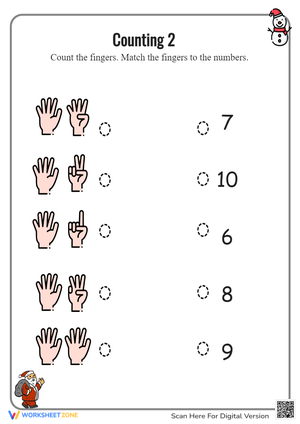
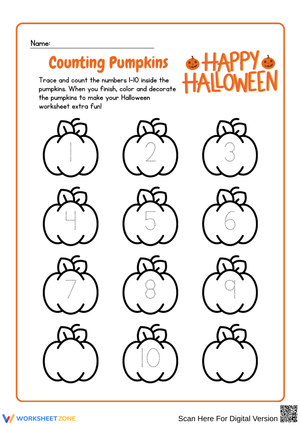
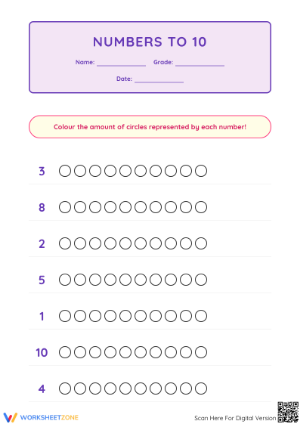
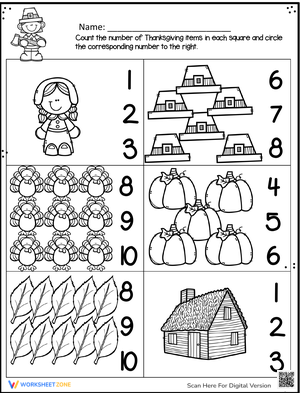
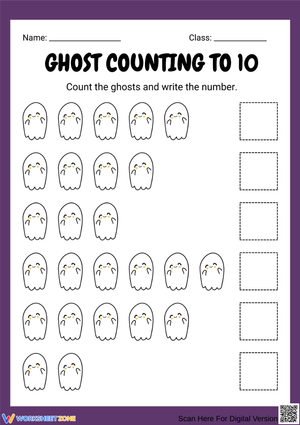
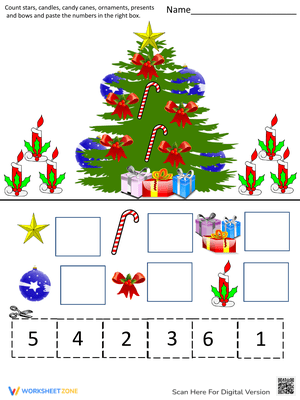
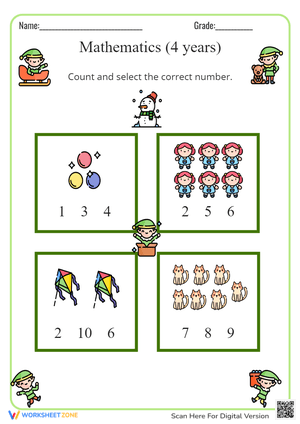
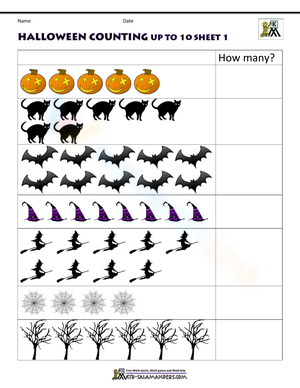
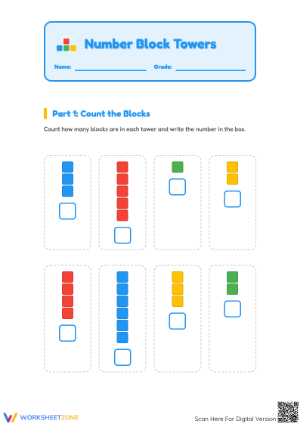
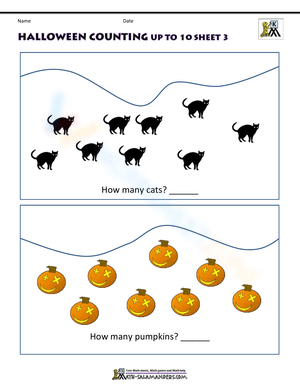
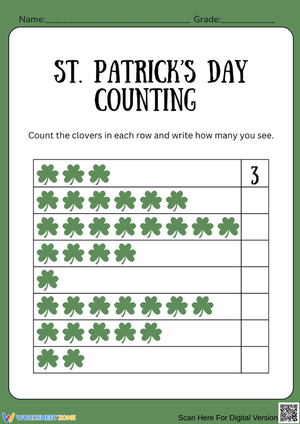
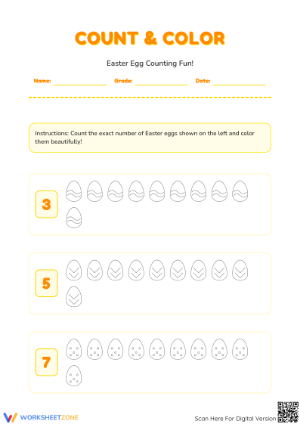
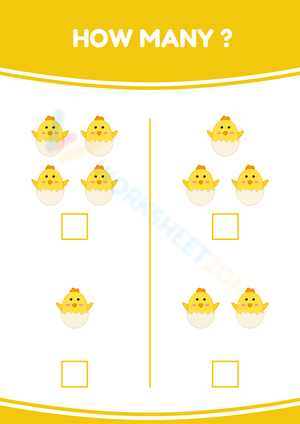
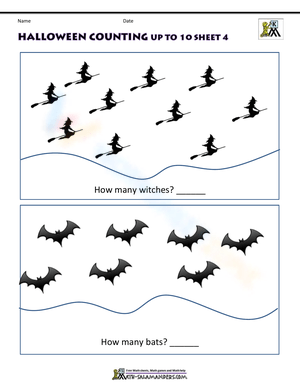
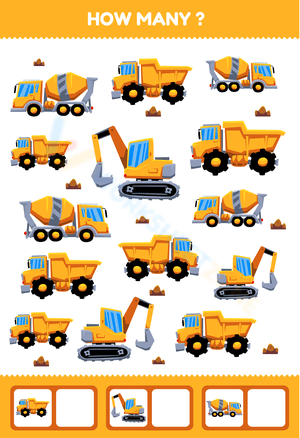
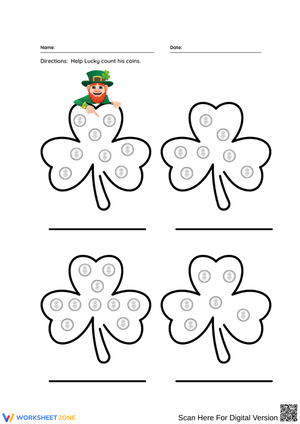
The collection includes several distinct formats, each suited to a different point in instruction. Ten-frame pages ask students to fill in the grid for a given number, building the visual anchor between a numeral and its position relative to five and ten. Object-counting scenes — illustrated pages with animals, shapes, or classroom items — have students count and write the total. Cut-and-paste pages pair fine motor practice with numeral matching. Tracing pages address number formation alongside quantity, so students practice writing 6 while also counting six objects. A smaller set of pages works on sequencing: fill in the missing number in a short run like 4, ___, 6.
Where These Fit in the Day
The most reliable use is morning arrival work. A single counting page gives students something purposeful to do in the eight minutes between sitting down and morning meeting — low stakes, no instructions needed once the routine is established, and it surfaces who came in distracted or who is still shaky on numerals above seven. That last point matters: a student who breezes through counting to five but stalls at eight or nine is telling you something about where consolidation stopped.
Math centers are another natural home. Laminate a handful of pages or slide them into dry-erase sleeves, and the same sheet serves six rotations in a week. Students use a dry-erase marker, wipe it clean, and the next group starts fresh. Pairing the laminated page with a small cup of counters — buttons, mini-erasers, anything countable — lets students place one chip on each drawn object before they write the numeral, keeping the concrete-to-representational sequence intact rather than jumping straight to pencil and symbol.
During small-group instruction, these pages function as a formative lens. Watching a student work through a counting page in real time shows you whether the error is in the count sequence, in tagging, or in cardinality — three different instructional responses. A child who miscounts because they skip "fourteen" doesn't need the same follow-up as one who counts nine objects correctly and then writes 8.
Patterns You'll Recognize in Student Work
The most common error isn't losing the count sequence — most Kindergarteners can recite to ten before they can count ten objects reliably. The breakdown is physical: students move to the next object before the number word has fully landed, producing a count that's one or two off in either direction. This shows up consistently on pages with objects arranged in a scattered layout rather than a line. A row of six ducks is easier to count correctly than six ducks arranged in a loose cluster, because the line provides an external structure that the child's hand can follow. Scattered-layout pages are worth saving for late in the unit when that physical coordination has steadied.
A second pattern appears specifically on numeral-writing pages: students who correctly count seven objects and say "seven" out loud will write a reversed 7 or substitute a 1. The count is right; the symbol retrieval is where it falls apart. That's a different problem than a counting problem, and it's worth separating the two in your notes. Marking those pages differently — or keeping them in a portfolio alongside earlier samples — makes that developmental arc visible to families and to yourself.
Why This Format Works at This Age
Cognitive load is the practical reason worksheet format matters in PreK and Kindergarten. Young children are simultaneously managing the count sequence, physical coordination, numeral recognition, and in many cases fine motor demands. A cluttered page with small objects, decorative borders, and dense text asks them to filter irrelevant visual information while doing all of that — some students simply can't. Pages with clean white space, large objects, and a single clear task reduce that filter burden so the counting itself gets the child's full attention. This is also why gradual release matters here: the first exposure to a new format should be guided, with the teacher modeling aloud, before students attempt it independently.
Standards Context
These pages address CCSS.MATH.CONTENT.K.CC.A.1 (counting to 100 by ones, with the early classroom emphasis on 1–10), K.CC.B.4 (understanding the relationship between numbers and quantities, including one-to-one correspondence and cardinality), and K.CC.B.5 (counting to answer "how many?" for up to 20 objects, beginning with sets to 10). In most Kindergarten pacing guides, counting and cardinality occupies the first six to eight weeks of the year before addition and subtraction are introduced. These worksheets sit in that foundational window. PreK teachers working toward NAEYC or state early learning standards will find the same skills addressed under counting and cardinality domains, typically with a ceiling of five to seven for the fall semester.
Frequently Asked Questions
1. Are these appropriate for PreK, or are they sized for Kindergarten?
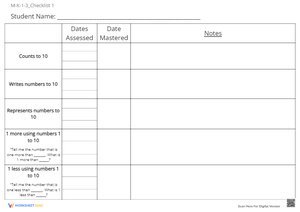
Both, with some adjustment. PreK teachers typically work the pages in the 1–5 range through late winter, using them for guided practice and as a fine motor activity rather than independent assessment. Kindergarten teachers use the full 1–10 range and can shift to the sequencing and missing-number pages once one-to-one correspondence and cardinality are secure, usually by late October or November in a typical pacing calendar.
2. What's the difference between rote counting and one-to-one correspondence, and do these worksheets address both?
Rote counting is reciting the number sequence from memory — a child can chant "one, two, three, four, five" without any objects present. One-to-one correspondence is the physical and cognitive act of assigning exactly one number name to exactly one object while counting a real set. A child can rote count to ten and still double-count or skip objects in a group of six. The worksheets address correspondence directly through formats that require marking, crossing out, or placing a counter on each object before writing the total.
3. How do ten-frame pages prepare students for addition later in the year?
Ten-frames build the visual anchors that mental addition relies on. Once a student sees 7 as "five and two more" rather than as a count-from-one sequence, they have the spatial structure they'll need when a teacher asks "what's 7 plus 3?" — the answer is visible in the frame without recounting. That perceptual shortcut is exactly what early addition instruction builds on, which is why the ten-frame is one of the few worksheet structures that earns its place across multiple units.













 Interactive Worksheet Maker
 Quiz Maker
 Word Search Maker
 Crossword Puzzle Maker
 Word Scramble Generator
 Sentence Scramble Generator
 Handwriting Worksheet Generator
 Name Tracing Generator
 Fill In The Blank Generator