


























Views
Downloads
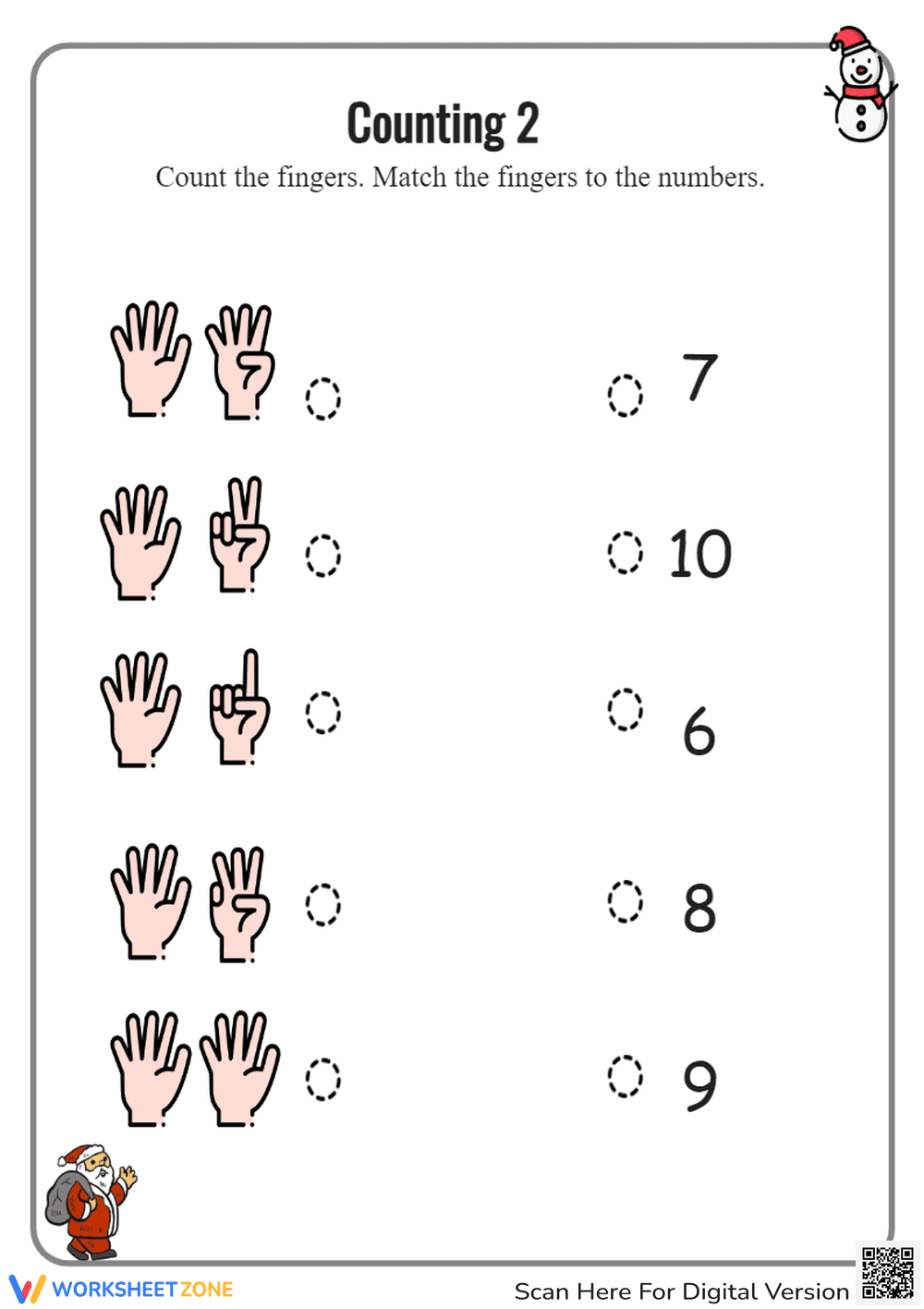

Kindergarten Finger Counting — Printable No-Prep Worksheet
Paste this activity's link or code into your existing LMS (Google Classroom, Canvas, Teams, Schoology, Moodle, etc.).
Students can open and work on the activity right away, with no student login required.
You'll still be able to track student progress and results from your teacher account.
This printable math worksheet helps kindergarten students master counting from 6 to 10 using visual finger representations. By matching hand illustrations to corresponding numerals, early learners build subitizing skills and strengthen one-to-one correspondence. This resource provides immediate, structured practice to reinforce foundational number sense and prepare children for basic addition.
At a Glance
- Grade: Kindergarten · Subject: Math
- Standard:
CCSS.MATH.CONTENT.K.CC.B.4— Understand the relationship between numbers and quantities- Skill Focus: Finger counting and matching 6 to 10
- Format: 1 page · 5 problems · Answer key included · PDF
- Best For: Morning work or independent math centers
- Time: 10–15 minutes
This single-page PDF features five distinct matching tasks designed for young learners. Each task displays a combination of two hands showing a specific number of fingers alongside a dashed circle for drawing matching lines. On the right side, clear, large numerals from 6 to 10 are arranged in a scrambled order to challenge students. The clean layout minimizes visual distractions, making it highly accessible for early childhood classrooms.
This resource streamlines classroom management with a three-step workflow. First, print the single-page PDF in under one minute. Second, distribute the sheets to students during transition periods, requiring zero explanation due to the intuitive matching format. Third, review student work in under two minutes using the straightforward layout. This efficient design makes the worksheet an excellent choice for emergency sub plans, quick warm-ups, or homework assignments.
This activity aligns directly with `CCSS.MATH.CONTENT.K.CC.B.4`, which requires students to understand the relationship between numbers and quantities. By linking visual representations of fingers to written numerals, students practice cardinality and one-to-one correspondence. Additionally, it supports the development of subitizing skills essential for future operations. Both standard codes can be copied directly into lesson plans, IEP goals, or district curriculum mapping tools.
Use this worksheet during independent practice after a direct instruction lesson on counting past five. Introduce the activity by demonstrating how to count fingers on both hands together, then model drawing a line to the correct number. Alternatively, use it as a quick formative assessment exit ticket at the end of a math block to gauge individual student mastery. The expected completion time ranges from 10 to 15 minutes.
This worksheet is tailored for kindergarten students learning to count beyond five, as well as preschool students ready for advancement or first-grade students needing targeted intervention. It pairs naturally with physical manipulative counters, ten-frames, or a direct instruction lesson on number lines. The visual hand cues provide built-in scaffolding for English language learners and students receiving special education services.
According to the Fisher & Frey (2014) framework for gradual release of responsibility, structured visual scaffolds like finger models bridge the gap between concrete counting and abstract numerical representation. Research indicates that using fingers as a natural mathematical tool supports cognitive development and working memory in early childhood. This worksheet applies these findings by providing clear, uncluttered visual prompts that help students transition from physical counting to symbolic number recognition. By aligning with standard CCSS.MATH.CONTENT.K.CC.B.4, the resource ensures that students practice essential cardinality skills in a structured format. Educators can confidently integrate this tool into their daily math routines, knowing it supports evidence-based practices for early numeracy acquisition. The simple matching format allows teachers to quickly assess student understanding and identify individuals who may need additional concrete intervention with physical manipulatives.


