


























Views
Downloads


Printable Number Block Towers Counting Worksheet | Grade K
Paste this activity's link or code into your existing LMS (Google Classroom, Canvas, Teams, Schoology, Moodle, etc.).
Students can open and work on the activity right away, with no student login required.
You'll still be able to track student progress and results from your teacher account.
This Kindergarten Number Block Towers worksheet helps students master counting objects up to 10. Through visual representations of block stacks, learners strengthen their understanding of cardinality and the relationship between numbers and quantities, developing early math fluency and confidence.
At a Glance
- Grade: K · Subject: Math
- Standard:
K.CC.B.4— Understand the relationship between numbers and quantities and connect counting to cardinality- Skill Focus: Counting and cardinality to 10
- Format: 3 pages · 16 problems · Answer key included · PDF
- Best For: Independent practice and small group instruction
- Time: 15–20 minutes
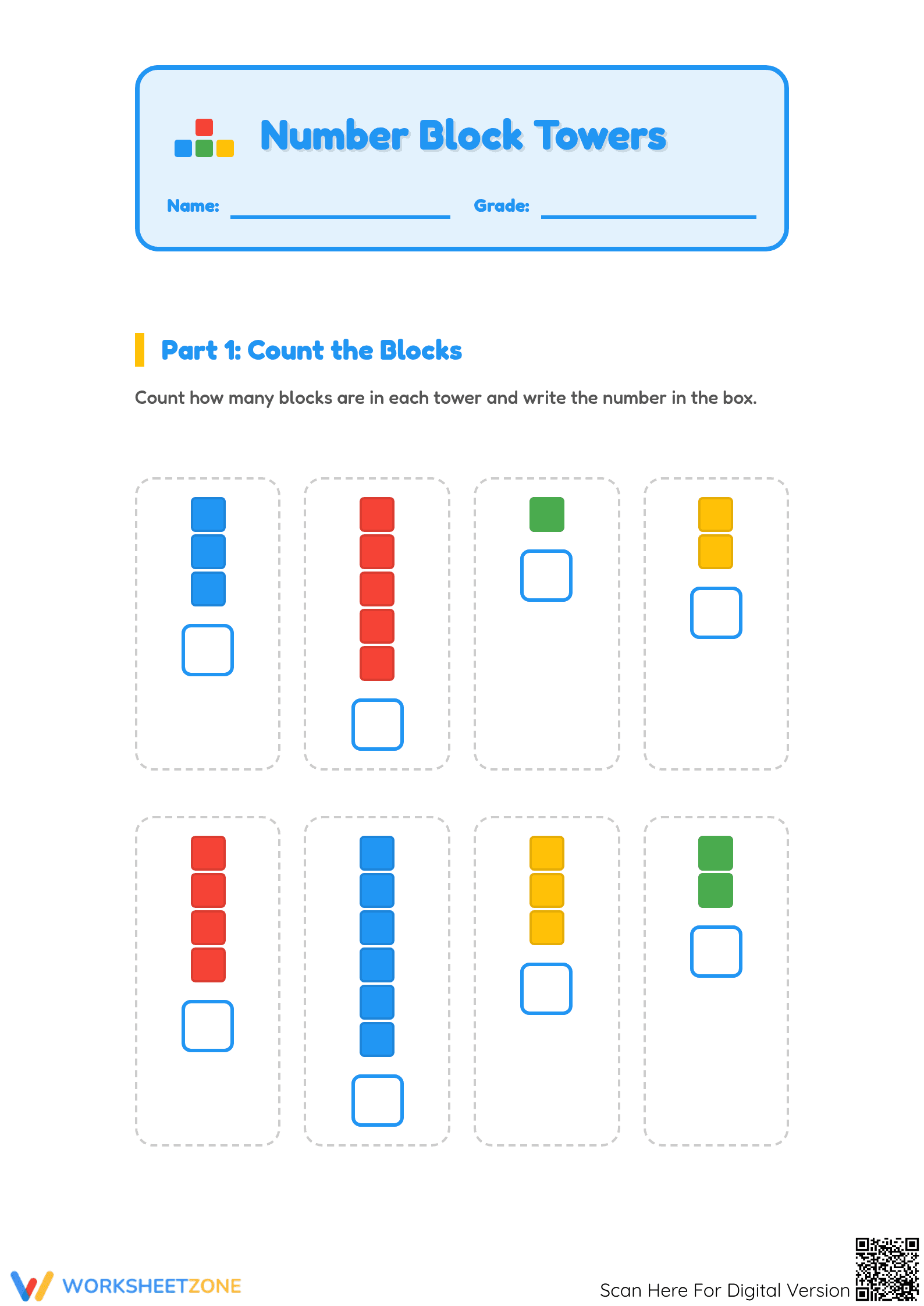
Inside this resource, you will find three distinct parts designed to build counting skills progressively. Part 1 features eight individual towers of varying heights, Part 2 introduces four taller towers reaching up to ten blocks, and Part 3 provides four mixed-color towers to challenge visual tracking. Each task includes a dedicated box for recording the final count, and a comprehensive answer key is provided for quick grading.
Skill Progression
- Guided Practice: Students begin with Part 1, counting eight smaller towers (1-6 blocks) to establish the basic one-to-one correspondence between the block and the number name.
- Supported Practice: Learners move to Part 2, tackling four tall towers up to ten blocks, requiring more sustained attention and consistent counting patterns.
- Independent Practice: Part 3 uses four multi-colored towers to ensure students can count accurately even when visual stimuli vary, reinforcing the concept that the count remains the same regardless of color.
This "I Do, We Do, You Do" structure ensures students move from simple recognition to independent mastery of cardinality and number representation.
Standards Alignment
The primary standard addressed is CCSS.MATH.CONTENT.K.CC.B.4, which requires students to understand that the last number name said tells the number of objects counted. This worksheet also supports CCSS.MATH.CONTENT.K.CC.B.5 by asking students to count to answer "how many?" questions about objects arranged in a line. Both standard codes can be copied directly into lesson plans, IEP goals, or district curriculum mapping tools.
How to Use It
Use this worksheet during the practice phase of direct instruction to check for understanding after introducing counting manipulatives. For a formative assessment, observe students as they count: notice if they touch each block or use their eyes only, as this reveals their level of abstraction. The activity typically takes 15 to 20 minutes to complete depending on individual student pace and previous experience with cardinality.
Who It's For
This resource is tailored for Kindergarten students but also serves as an excellent intervention tool for first graders who need to solidify their number sense. It pairs naturally with physical counting blocks or an anchor chart displaying numbers 1-10 to provide additional scaffolding for learners who are still developing one-to-one correspondence or tracking skills.
This worksheet meticulously aligns with CCSS.MATH.CONTENT.K.CC.B.4, bridging rote counting and true cardinality. Students count 16 distinct block sets, reinforcing that quantity is independent of order or arrangement. Frequent engagement with structured visual-spatial counting tasks, as provided here, is crucial for early arithmetic success, moving students toward a deep conceptual understanding of numbers. Varying tower heights and mixed colors prevent memorization, encouraging active engagement. Educators can use this evidence-based practice to support long-term numeracy goals in any Grade K classroom.


