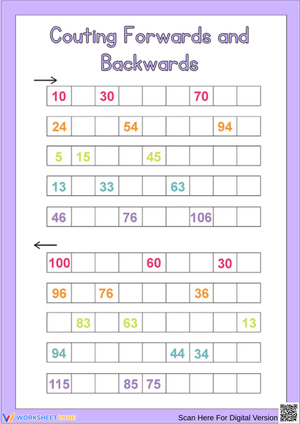
These counting backwards worksheets give kindergarten and first-grade teachers ready-to-use practice pages for one of the most misunderstood skills in early number work — the ability to move left on a number line with the same fluency students eventually develop moving right. The set spans simple countdowns from 10 to more demanding sequences across decades, with enough variation in format that teachers can match the page to the lesson rather than shoehorn the lesson around a single layout.
The Specific Skills Targeted
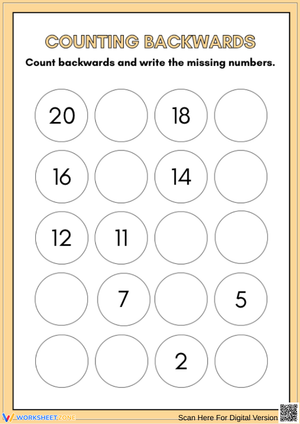
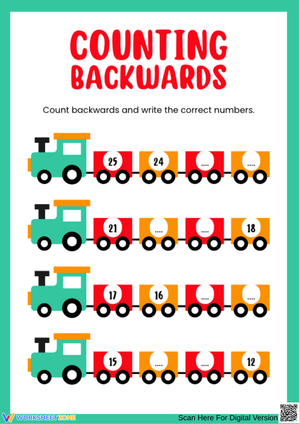
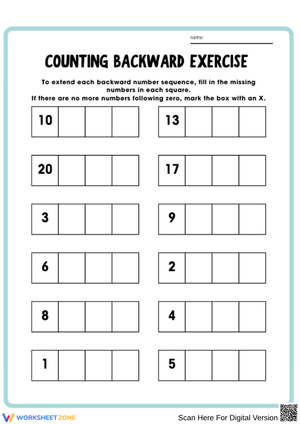
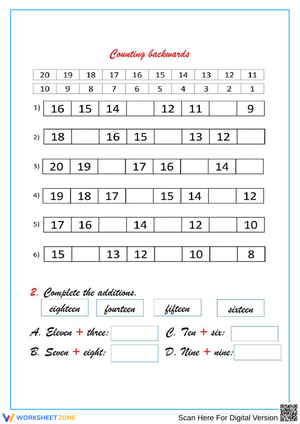
Each worksheet targets a defined slice of the backward-counting progression rather than treating the skill as a monolith. Pages in the lower range ask students to fill in missing numerals in a counting-back sequence from 10, trace and complete number paths, and mark the "one less" position on a partial number line. Mid-range pages shift to sequences starting from numbers in the teens and twenties, where students cross decade boundaries — the transition from 20 to 19, or 30 to 29 — without a visual scaffold beneath every step. The upper pages require students to count backwards from numbers as large as 100, including skip-count sequences by twos, fives, and tens, which builds the same mental flexibility they'll need for subtraction with larger numbers.
Several pages use a deliberately incomplete sequence — three numbers given, two missing — rather than fill-every-blank formats. That structure forces students to locate themselves in the sequence rather than rely on the momentum of writing one number after another.
Where Students Struggle Most
The decade crossings are the most reliable sticking point, and the errors have a consistent shape. A student counts back smoothly: 24, 23, 22, 21, 20 — then writes 10. They're not careless; they're pattern-matching to what "20" looks like as a starting point, mentally restarting the sequence rather than continuing through it. This shows up even in students who can recite the sequence correctly during oral practice, because oral rhythm provides momentum that written work strips away.
Teen numbers produce a different error pattern. Eleven and twelve don't follow the suffix logic of thirteen through nineteen, so students who have decoded the "-teen" pattern will sometimes write 20, 19, 18, 17, 16, 15, 14, 13, 12, 11, and then stall or write 10 next when they should continue. They know something is different about those numbers; they're just not sure what to do with that instinct. Worksheets that include a number-line reference alongside these sequences help students self-correct without waiting for teacher confirmation on every line.
How These Pages Fit Into the Daily Schedule
The most consistent use pattern is the first five to eight minutes of the math block — after students have settled but before direct instruction begins. A single counting backwards worksheet used as a warm-up gives teachers a quick formative read before they decide how much guided practice the lesson needs. If most students sail through a sequence from 20, the teacher can move quickly to the decade-crossing content. If papers show the 20-to-19 error clustered across four or five students, that's the anchor for the whole-group lesson that day.
A second common use is the independent practice slot during guided math rotations. Because the pages are self-contained and don't require setup or materials beyond a pencil, they run cleanly as a center task while the teacher pulls a small group. Pages with a built-in number line work well here for students who are still building confidence; pages without any reference strip are better suited to students consolidating what they already know.
Friday review is a third natural slot. A counting-back page at the end of the week, matched to whatever range the class worked on Monday through Thursday, functions as informal spaced retrieval — low stakes, no timer, but enough structure to surface retention gaps before the following week's instruction builds on them.
Why This Format Works for This Skill at This Grade
Counting backward is one of those skills where oral fluency and written fluency diverge sharply. A kindergartner who can chant "10, 9, 8, 7..." with the class during a countdown may not be able to write the same sequence independently, because the group chant carries them. Paper practice isolates the individual student's mental number line from the chorus. That's not a limitation of worksheets — it's precisely why worksheets earn their place here alongside manipulative and oral work.
Cognitive load matters in format selection, too. Pages with heavy illustration, multiple colors, or complex framing pull working memory toward decoding the page itself. For students who are still building automaticity with the backward sequence, a clean layout — number path, blanks, maybe a simple pictorial cue — keeps attention on the mathematics. The more elaborate themed pages are better held for moments when the skill is mostly secured and engagement is the actual goal.
Scaling the Pages for the Whole Class
The range built into the set supports differentiation without requiring teachers to prepare separate lessons. Students who are still working to consolidate the 10-to-0 sequence get pages with a printed number line running along the bottom — they can finger-track across it to check each step. Students working in the 20-to-0 range get pages where the number line is partial or absent, requiring more internal retrieval. Students ready for cross-decade and large-number work get the 50-to-0 or 100-to-0 sequences and the skip-count-backward pages, which can run without any reference support.
One honest tradeoff: the fill-in-blank format can frustrate students who freeze when they encounter an unfamiliar starting number mid-sequence. For those students, pairing the worksheet with a bead string or physical counters — removing one bead for each number they write — gives them a concrete anchor until the written sequence feels less arbitrary. That pairing also prevents the error of writing numbers mechanically without tracking the underlying quantity, which is the more dangerous habit to let calcify early.
Frequently Asked Questions
1. My students can count backward orally but fall apart on paper. What's happening?
That gap is normal and developmentally expected. Oral counting is supported by rhythm, social modeling, and the momentum of the group. Written counting requires each student to independently hold their place in the sequence, retrieve the next number, and produce it without external support. Starting with shorter sequences on paper — from 5 to 0, then 10 to 0 — before moving to longer runs helps students build written fluency without overwhelming working memory all at once.
2. At what point should students stop needing the number-line reference?
Most first-grade students should be counting backward from 20 without a printed reference by mid-year, and from larger numbers by year's end. If a student is still tracking a number line for every step well into spring of first grade, that's worth noting — it may indicate the sequence hasn't moved to automatic retrieval and subtraction strategies that depend on counting back (like solving 8 − 3 by starting at 8 and counting back three steps) will be slow and effortful.
3. How does this practice connect to what students do with subtraction later?
The "counting back" strategy — starting at the larger number and counting back the amount being subtracted — is the most common bridging strategy between concrete subtraction and fact fluency. A student who doesn't own the backward sequence can't use that strategy efficiently. They'll reach for tally marks or fingers for every problem instead of reasoning numerically. Solid backward counting from the early grades makes that transition substantially smoother.













 Interactive Worksheet Maker
 Quiz Maker
 Word Search Maker
 Crossword Puzzle Maker
 Word Scramble Generator
 Sentence Scramble Generator
 Handwriting Worksheet Generator
 Name Tracing Generator
 Fill In The Blank Generator