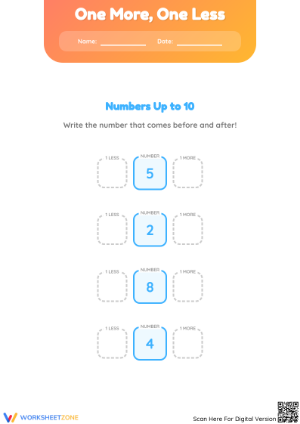
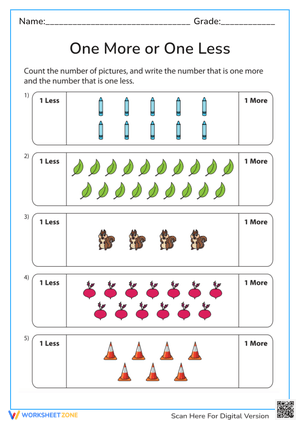
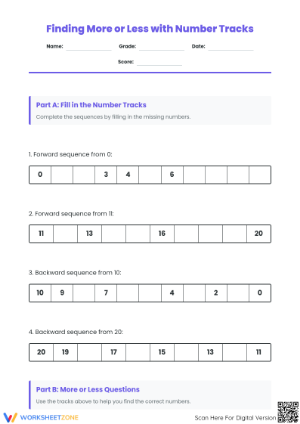
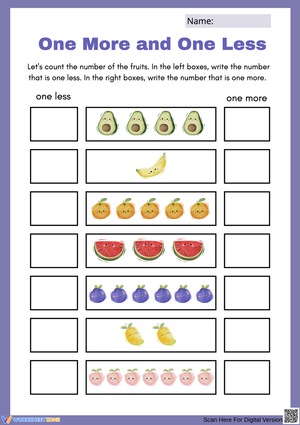
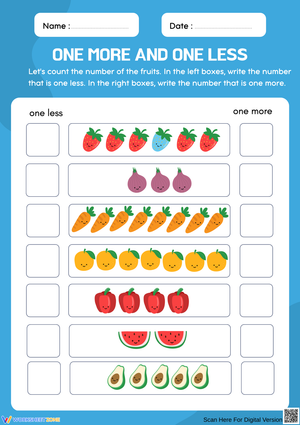
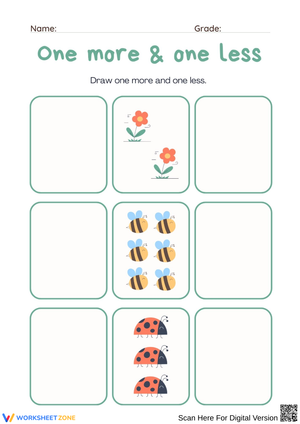
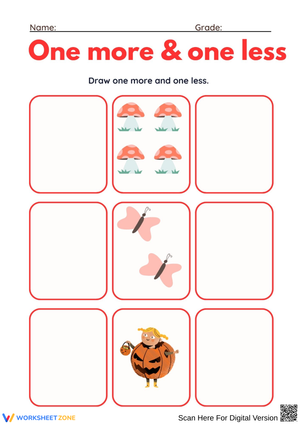
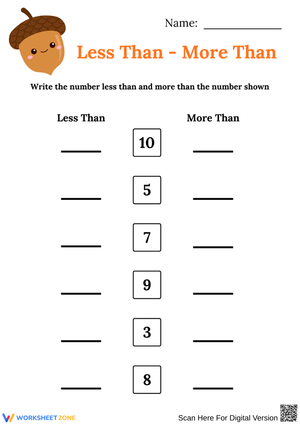
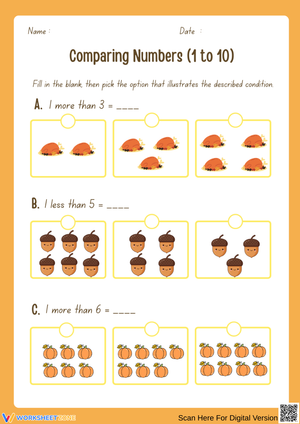
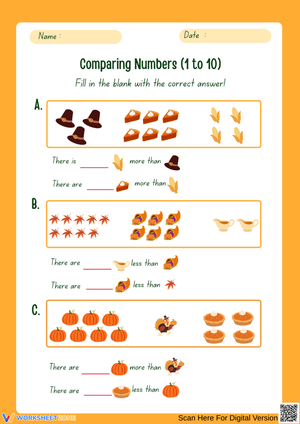
These one more one less worksheets give kindergarten and first-grade teachers a focused set of pages for building the number-relationship fluency that early addition and subtraction depend on. Each page targets a specific range — numbers within 10, teen numbers, or two-digit numbers up to 100 — so teachers can match the work directly to where a student is, not where the calendar says they should be.
The Specific Skills These Pages Build
Students practice identifying one more and one less across three distinct number ranges. Within 10, the work centers on number sequences students can check against their fingers — concrete enough that most kindergartners can self-correct. The teen numbers introduce the first real cognitive hurdle: a student who fluently knows that six comes after five will still pause at 19, because one more means crossing into a new decade. Two-digit work extends that same challenge to transitions like 29–30, 49–50, and 99–100, where place value patterns become visible and students start to notice that the tens digit changes while the ones digit resets.
Beyond filling in blanks, students on these pages underline, circle, or rewrite numbers in sequence — actions that slow down the automatic "just count up one" impulse and require students to reason about the number rather than recite past it. Some pages use ten frames as scaffolds; others strip those supports away. That variation is deliberate, because the goal is fluency without the scaffold, not fluency with it.
Where Student Thinking Breaks Down
The errors in student work on this concept fall into a short, predictable list, and seeing them clearly helps teachers know what to address.
- Students working in the teens will write "one more than 13 is 14" correctly, then write "one more than 19 is 110." They are applying a pattern — append a digit — without understanding that 20 is a new two-digit number. This is the most common stumbling block and the reason teen-number pages deserve their own tier rather than being lumped in with within-10 practice.
- Students who have memorized the counting sequence forward often stall on "one less" because they have not practiced the backward sequence with the same intensity. A child who can count to 20 without hesitation may need several seconds to produce "one less than 14." These worksheets surface that gap by requiring both directions on the same page.
- Students who rely on rote counting frequently land on the right answer but cannot explain why. When asked "how do you know seven is one more than six?" they say "I counted." Worksheets alone will not fix this, but they create the practice context in which a teacher circulating during independent work can ask that question and catch the gap early.
How This Fits into a Daily Routine
Most teachers reach for these pages in three places. The first is the morning warm-up — a single row of "one more, one less" problems takes about four minutes and activates number-sense thinking before the formal math block begins. The second is math centers, where a laminated page with dry-erase markers turns one printable into a reusable station that a small group can cycle through three or four times a week without burning through paper. The third is small-group intervention: when a teacher pulls three students who are still counting from one to find one less than eight, a structured page with a built-in number line gives them a reference to wean off gradually.
These pages also work as exit tickets. A four-problem strip cut from the bottom of a page takes less than two minutes to complete at the end of a lesson and tells the teacher immediately which students need the ten-frame scaffold tomorrow and which ones are ready to work with two-digit numbers.
Why This Concept Appears at Kindergarten, Not Earlier or Later
Kindergartners arrive with a wide range of counting experience, but most have not yet built the mental number line that allows them to move forward and backward with intention. The cognitive load of holding a number in mind, shifting it by one, and producing the result — without physically counting objects — is genuinely new at this age. Research on number sense development places this skill at the boundary between cardinal understanding (knowing that a group of five objects is "five") and ordinal understanding (knowing that five sits between four and six in a fixed sequence). That boundary is exactly where kindergarten math instruction is designed to work.
By the end of first grade, the same skill extends to numbers up to 120, and students are expected to compute rather than count. The worksheets at the two-digit level build toward that expectation by making the place-value structure of the number system visible — students who notice the pattern at 39/40 and 49/50 are beginning to see how tens and ones interact, which is the conceptual groundwork for regrouping in addition and subtraction.
Scaling the Pages for Different Learners
Students who are not yet secure with the counting sequence within 10 need pages that include a number line or ten-frame at the top of the sheet. The visual reference reduces the memory demand enough that students can focus on the relationship rather than the sequence. Removing that reference is the progression, not a different worksheet.
For students ready for a challenge, two-digit pages that include decade transitions (asking for one more than 30, one less than 70, one more than 99) push thinking beyond pattern-matching into genuine place-value reasoning. These are not harder by virtue of larger numbers alone — they are harder because the predictable digit pattern breaks at decade boundaries, and students who have been coasting on pattern recognition have to stop and think.
Standards Aligned
Within the Common Core framework, this work sits under K.CC.C.7 (comparing two numbers between 1 and 10) and connects directly to K.OA.A.1, which asks students to represent addition and subtraction with objects and drawings before introducing formal notation. The reason one more and one less belong in kindergarten rather than being treated as a first-grade review skill is precisely that bridge: students who understand one more as a relationship — not a computation — arrive at first-grade addition with a mental structure already in place. Teachers who spend time on this concept in the fall are not doing pre-math; they are doing the most important math of the year.
Frequently Asked Questions
1. Can these pages be used before students know how to write numerals?
Yes, with modification. A student who cannot yet write a legible 9 can still point to the correct answer on a number line or select from two choices. Some teachers use the pages orally during small-group time, asking students to say the answer aloud while the teacher or a partner marks the sheet. The reasoning practice is the same; the recording format is adjusted.
2. At what point should students stop needing the number-line scaffold?
Most kindergartners working within 10 should be able to drop the number line by mid-year if instruction has included regular practice. A student still relying on a visual reference for numbers below 10 in late spring is signaling that the underlying counting sequence is not yet automatic — that gap is worth addressing directly rather than simply providing the scaffold indefinitely.
3. Do these worksheets work for first graders who are behind?
The within-10 and teen-number pages are appropriate intervention material for first graders who did not consolidate this skill in kindergarten. The format is simple enough that it does not feel punitive, and the tiered levels mean a teacher can assign the within-10 pages without signaling to the student that they are doing "baby work" — especially if the same pages are used with multiple groups at different levels.













 Interactive Worksheet Maker
 Quiz Maker
 Word Search Maker
 Crossword Puzzle Maker
 Word Scramble Generator
 Sentence Scramble Generator
 Handwriting Worksheet Generator
 Name Tracing Generator
 Fill In The Blank Generator