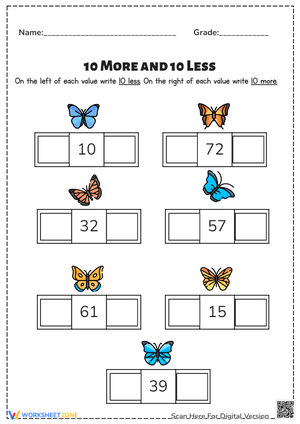
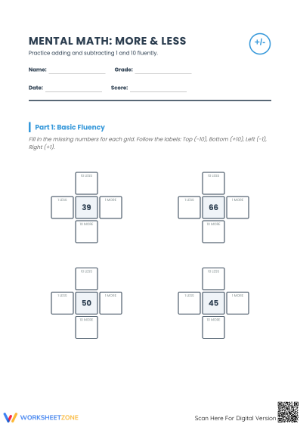
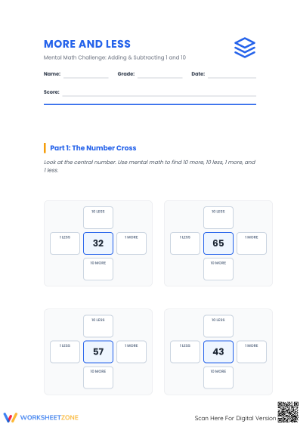
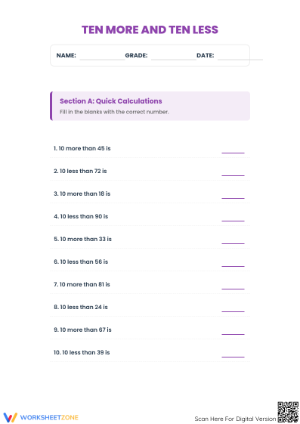
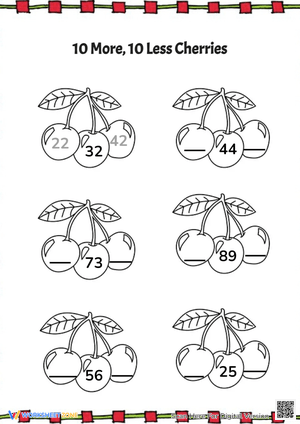
Why 10 More and 10 Less Matters in Grade 1
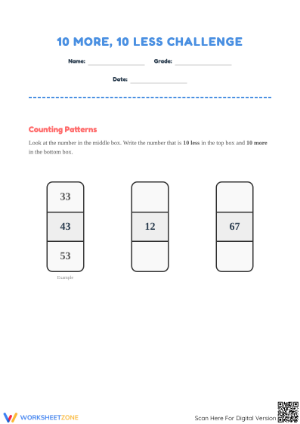
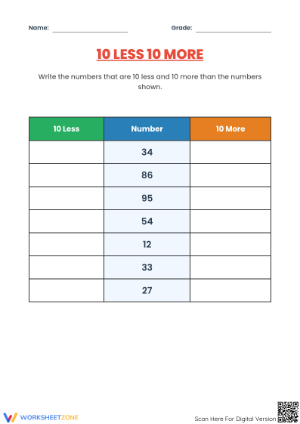
The skill of mentally finding 10 more or 10 less than a two-digit number sits inside the Number and Operations in Base Ten domain for Grade 1. Students are expected to do this without counting by ones and to explain the reasoning behind their answer, not just produce a correct number.
That distinction matters for how you use worksheets in your classroom. A page of correct answers does not tell you whether a student reasoned through place value or simply memorized a chart. Build in a reasoning prompt, even an informal one like turn-and-talk or a written sentence starter, so the worksheet becomes evidence of understanding rather than just computation practice.
The Place-Value Pattern Behind the Skill
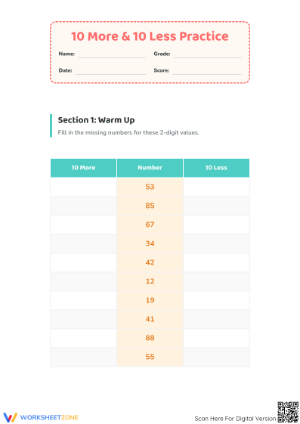
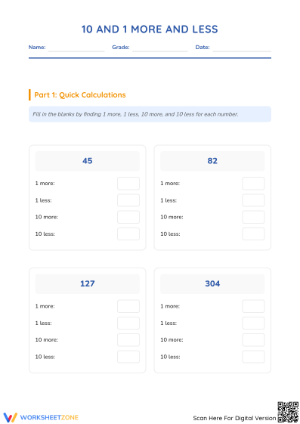
The entire skill rests on one idea: when you add or subtract 10 from a two-digit number, only the tens digit changes. The ones digit stays exactly the same. For a student who has internalized this, 63 plus 10 is not a counting problem, it is a quick glance at the tens place.
This is worth naming explicitly during instruction, because many students arrive at this standard still treating two-digit numbers as a string of ones rather than as a bundle of tens and ones. Worksheets that isolate the tens-digit change, for example by bolding or highlighting the tens digit in a shift, make the pattern visible instead of leaving students to infer it from scattered practice problems.
Hundred Charts and Number Lines as Visual Anchors
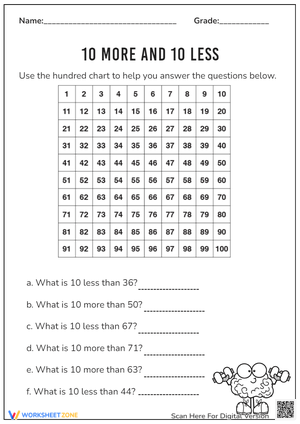
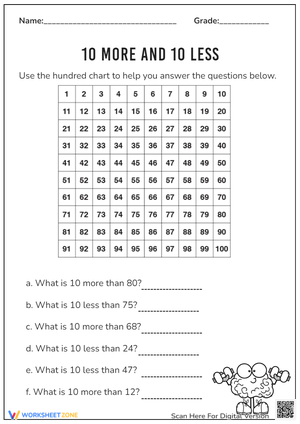
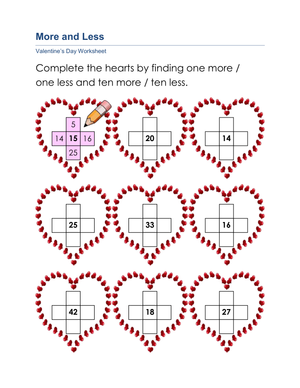
Hundred charts and number lines are the most common instructional tools for this skill, and worksheets that lean on them tend to transfer better than abstract number-only pages. On a hundred chart, moving 10 more is a vertical shift straight down one row, and 10 less is a shift straight up. That spatial pattern gives students something concrete to picture even after the chart is taken away.
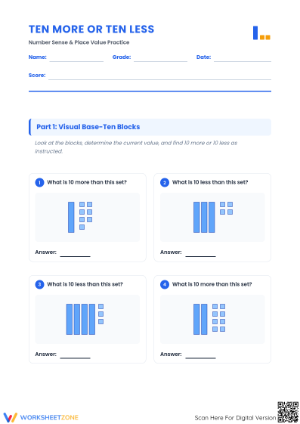
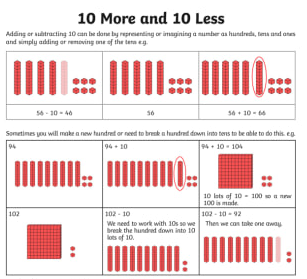
Base-ten blocks serve a similar purpose for students who need a hands-on step before moving to a printed chart. If a worksheet includes a small blocks diagram alongside the numeral, students can check their answer against a physical model rather than guessing, which is especially useful for interventionists working with small groups who are still counting by ones.
Classroom Implementation
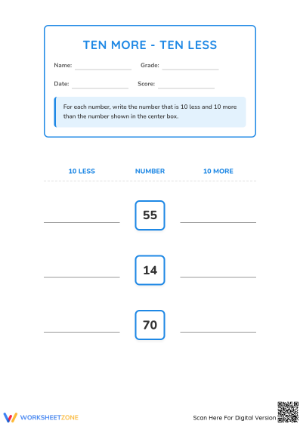
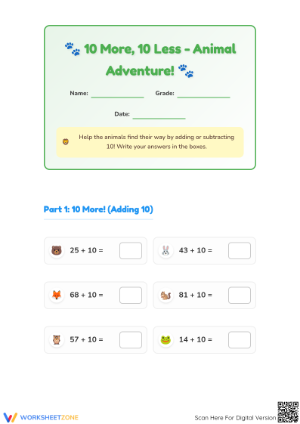
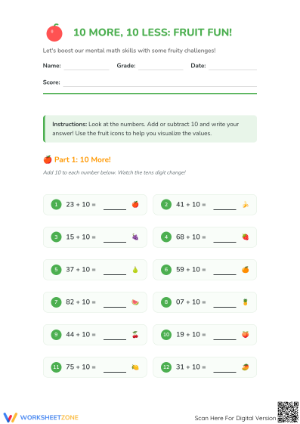
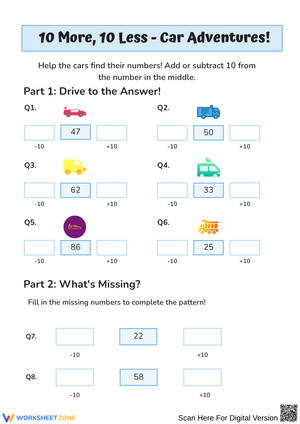
Start each week with a quick diagnostic: a handful of mixed 10-more/10-less problems with no visual support. Students who answer quickly and correctly are ready for independent, chart-free practice. Students who hesitate or revert to counting should get chart-supported worksheets and small-group time with base-ten blocks before moving to abstract problems.
Keep an eye on the explain-your-reasoning piece, since it is explicitly part of the standard. A simple worksheet addition, a single line that says explain how you know, or a sentence frame like the tens digit changed from blank to blank, gives you a quick formative check without adding significant grading time. Over a two to three week unit, gradually reduce the visual scaffolds on the worksheets as students demonstrate they no longer need the hundred chart to answer correctly.
Connecting to Later Two-Digit Strategies
This skill is not an isolated worksheet topic, it is a foundational building block for later two-digit addition and subtraction strategies. Students who can mentally jump by 10 have an easier time later decomposing numbers like 34 plus 27 into tens and ones parts, because they already trust that a tens-digit shift does not disturb the ones digit.
When you introduce more complex two-digit addition later in the year, it is worth referencing this earlier skill directly. Reminding students that they already know how to shift the tens digit gives them a concrete anchor point rather than treating multi-digit addition as an entirely new procedure.
Frequently Asked Questions
1. What grade level typically learns 10 more and 10 less?
This skill is most commonly taught in Grade 1, where mentally finding 10 more or 10 less than a two-digit number is a core expectation. Many Grade 2 teachers also revisit it early in the year as a review and intervention tool for students who need more practice before moving into larger two-digit computation.
2. How do 10 more/10 less worksheets align with Common Core standards?
Worksheets built around this skill support CCSS.MATH.CONTENT.1.NBT.C.5, which asks students to mentally find 10 more or 10 less than a given two-digit number without counting by ones and to explain the strategy they used to get their answer.
3. What manipulatives or visuals help students grasp this skill fastest?
Hundred charts, number lines, and base-ten blocks are the most widely used supports. Hundred charts are especially effective because the vertical shift between rows makes the tens-digit pattern visually obvious, while base-ten blocks give students a concrete model to check their answers against.
4. How can teachers tell if a student truly understands the pattern versus just memorizing answers?
Ask students to explain their reasoning, either verbally or in a short written response, rather than relying on the numeral answer alone. A student who understands the pattern can describe why only the tens digit changes, while a student who is guessing or pattern-matching typically cannot explain the shift in their own words.
5. How does this skill connect to future math concepts like two-digit addition?
Fluency with 10 more and 10 less gives students an early, trustworthy strategy for decomposing numbers into tens and ones, which becomes essential once they start adding and subtracting larger two-digit numbers using place-value based strategies later in the year.













 Interactive Worksheet Maker
 Quiz Maker
 Word Search Maker
 Crossword Puzzle Maker
 Word Scramble Generator
 Sentence Scramble Generator
 Handwriting Worksheet Generator
 Name Tracing Generator
 Fill In The Blank Generator