


























Views
Downloads
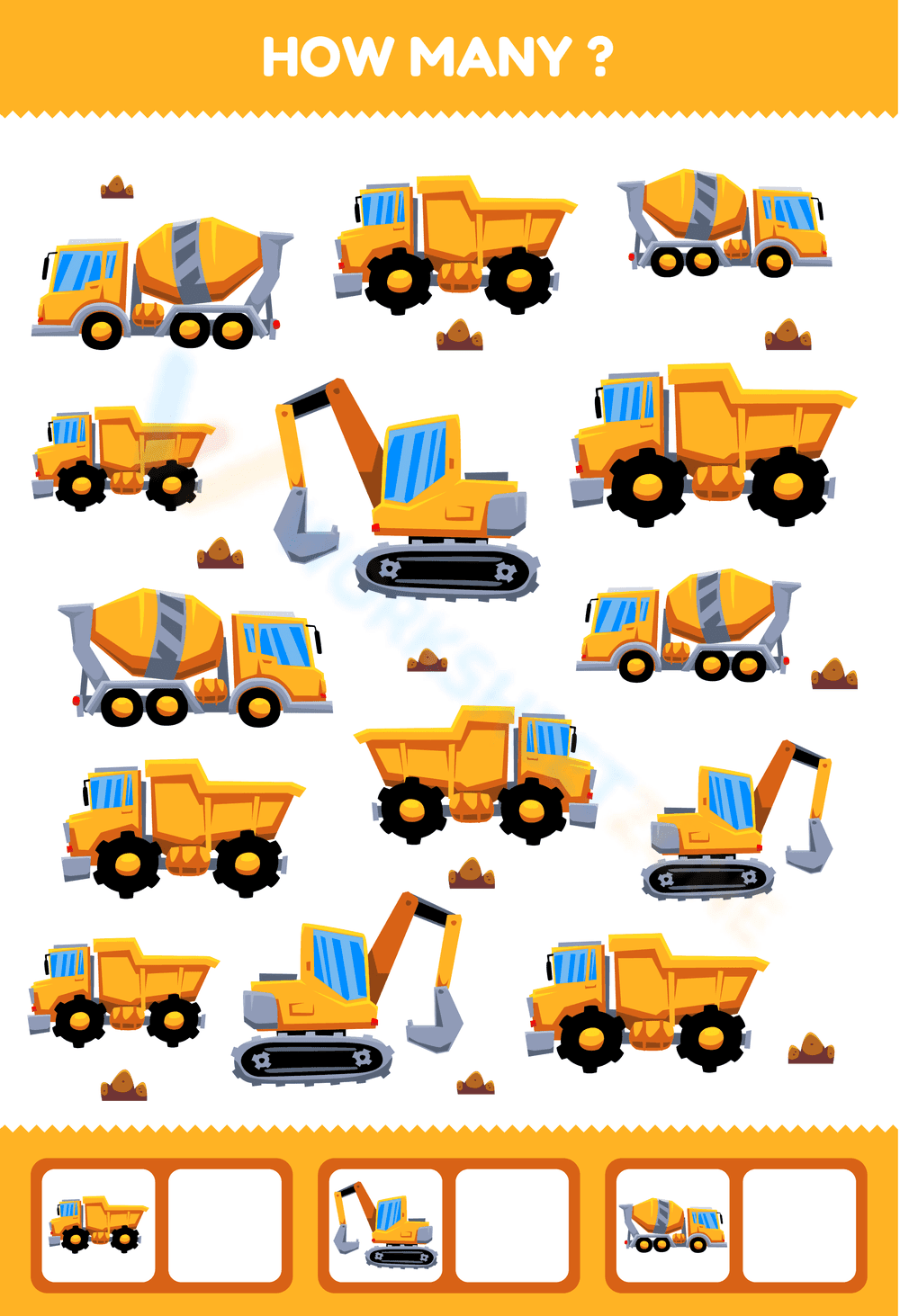

Grade K Counting — Printable No-Prep Worksheet
Paste this activity's link or code into your existing LMS (Google Classroom, Canvas, Teams, Schoology, Moodle, etc.).
Students can open and work on the activity right away, with no student login required.
You'll still be able to track student progress and results from your teacher account.
This Kindergarten math worksheet gives students focused practice counting objects in a scattered configuration. By identifying and tallying different construction vehicles, early learners develop foundational one-to-one correspondence and visual discrimination skills. The engaging theme keeps young students motivated while building essential number sense.
At a Glance
- Grade: K · Subject: Math
- Standard:
CCSS.MATH.CONTENT.K.CC.B.5— Count up to 10 objects in a scattered configuration- Skill Focus: Counting scattered objects
- Format: 1 page · 3 problems · Answer key included · PDF
- Best For: Independent practice or centers
- Time: 10–15 minutes
Inside this single-page resource, educators will find a vibrant counting activity. The page features a scattered assortment of dump trucks, excavators, and cement mixers. At the bottom, three recording boxes prompt students to isolate each vehicle type, count the total quantity, and write the corresponding numeral. A complete answer key is provided to ensure quick grading.
This resource is designed for a zero-prep workflow, making it ideal for busy mornings or unexpected schedule changes.
- Print (1 minute): Simply download the PDF and print a class set. The high-contrast images print clearly in both color and grayscale.
- Distribute (1 minute): Hand out the sheets along with pencils or crayons. The visual instructions are intuitive for non-readers.
- Review (3 minutes): Quickly check student work using the provided answer key or review together as a whole class.
Total teacher preparation time is under two minutes, making this an excellent addition to any emergency sub plan.
This activity is directly aligned to CCSS.MATH.CONTENT.K.CC.B.5: Count to answer "how many?" questions about as many as 20 things arranged in a line, or as many as 10 things in a scattered configuration. It also supports K.MD.B.3 by having students classify objects into categories. Both standard codes can be copied directly into lesson plans, IEP goals, or district curriculum mapping tools.
Teachers can utilize this worksheet during independent math centers after direct instruction on one-to-one correspondence. It also serves as an effective morning work activity to settle students into the daily routine. As a formative assessment observation tip, watch to see if students cross out or mark each vehicle as they count it; this indicates their developing strategy for tracking scattered objects. Expected completion time ranges from 10 to 15 minutes.
This resource is primarily designed for Kindergarten students mastering early counting skills. It is easily differentiated for students needing extra support by providing physical manipulatives to place over each vehicle before tallying. It pairs perfectly with a hands-on math center featuring toy construction vehicles or a read-aloud book about building sites.
Mastering the ability to count scattered objects is a critical milestone in early childhood mathematics. According to a recent EdReports 2024 analysis of foundational math curricula, explicit practice with visual discrimination and categorization significantly improves long-term numerical fluency. When students engage with CCSS.MATH.CONTENT.K.CC.B.5 to count up to 10 objects in a scattered configuration, they actively build the cognitive pathways required for more complex addition tasks. This specific skill forces the brain to organize visual information systematically, preventing the common error of double-counting. By integrating high-interest themes like construction vehicles, educators can easily sustain the attention necessary for young learners to practice this rigorous mental organization. Consistent exposure to these targeted counting exercises ensures that students develop robust one-to-one correspondence, laying a secure foundation for all subsequent mathematical reasoning in elementary school.


