


























Views
Downloads
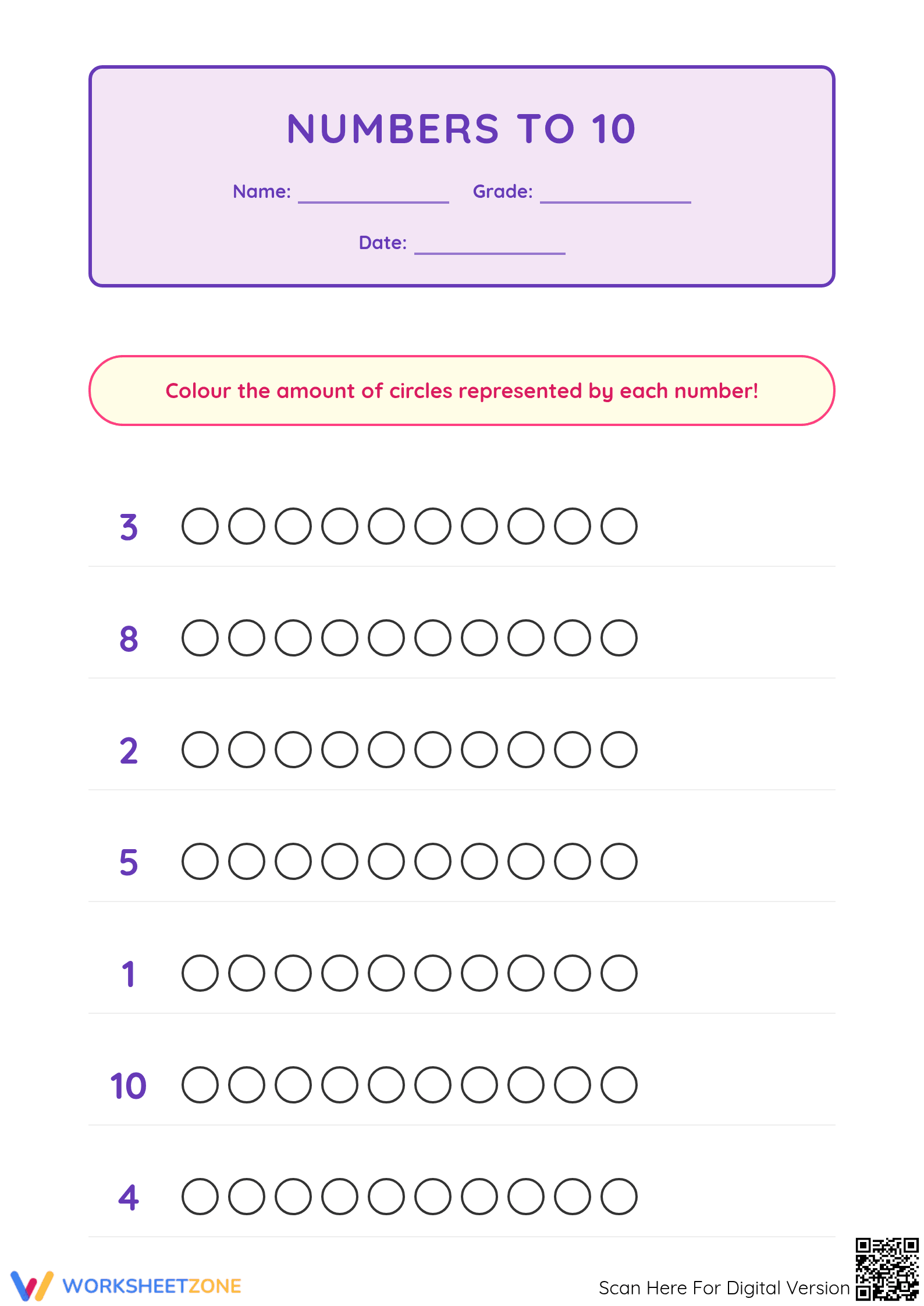


Printable Counting to 10 Worksheet | Kindergarten Math
Paste this activity's link or code into your existing LMS (Google Classroom, Canvas, Teams, Schoology, Moodle, etc.).
Students can open and work on the activity right away, with no student login required.
You'll still be able to track student progress and results from your teacher account.
This kindergarten math worksheet provides students with targeted practice in counting and cardinality for numbers 1 through 10. By coloring specific quantities of circles and stars, learners build a concrete understanding of the relationship between numbers and physical sets. It is a foundational tool for developing one-to-one correspondence and early number sense in young mathematicians.
At a Glance
- Grade: Kindergarten · Subject: Math
- Standard:
CCSS.MATH.CONTENT.K.CC.B.5— Count to answer how many questions about objects arranged in a line- Skill Focus: Counting to 10 and cardinality
- Format: 2 pages · 15 problems · Answer key included · PDF
- Best For: Kindergarten morning work or early finishers
- Time: 15–20 minutes
This two-page PDF includes 15 distinct counting and coloring exercises. The first section focuses on "Numbers to 10" with circle representations, while the second section, "Star Power," uses star shapes to maintain student engagement. Each row presents a numeral and 10 corresponding shapes for students to color. A complete answer key is included for rapid teacher review or student self-correction.
Zero-Prep Workflow
This resource is designed for an efficient, zero-prep classroom workflow. Teachers can print the document in 30 seconds and distribute it immediately without cutting or assembly. The self-explanatory instructions allow students to begin working independently in less than a minute. Total preparation time is minimal, making this an ideal solution for unexpected substitute plans or sudden transitions.
Standards Alignment
The primary focus is `CCSS.MATH.CONTENT.K.CC.B.5`, which requires students to count to answer "how many?" questions about objects arranged in a line or a rectangular array. The worksheet also supports `CCSS.MATH.CONTENT.K.CC.B.4` by reinforcing the concept that the last number name said tells the number of objects counted. Both standard codes can be copied directly into lesson plans, IEP goals, or district curriculum mapping tools.
How to Use It
Assign this worksheet during the independent practice portion of a lesson on counting and cardinality to reinforce direct instruction. It also serves as an effective formative assessment tool; teachers can observe students as they color to identify those struggling with one-to-one correspondence or numeral recognition. Students typically complete the 15 tasks within 20 minutes, depending on their fine motor coloring speed.
Who It's For
This worksheet is specifically tailored for kindergarten students who are building their initial number sense. It provides helpful scaffolding for students who need visual sets to understand abstract numerals. The resource pairs naturally with physical manipulatives, such as counting bears or blocks, allowing students to model the sets physically before coloring them on the page.
Early childhood math education research emphasizes the importance of visual and kinesthetic engagement when developing early number concepts. According to a RAND AIRS 2024 analysis of early numeracy interventions, students who engage in activities that require mapping numerals to physical or representational sets demonstrate significantly higher retention of cardinality concepts. This worksheet leverages that methodology by requiring students to physically color a specific quantity, reinforcing the connection between the symbol and the set. By limiting the scope to numbers 1 through 10, the resource ensures cognitive load remains manageable while focusing on the mastery of foundational skills. The inclusion of 15 structured tasks provides sufficient repetition to stabilize the "how many" concept as defined by CCSS.MATH.CONTENT.K.CC.B.5. This evidence-based approach to counting practice is essential for preparing young learners for addition and subtraction.


