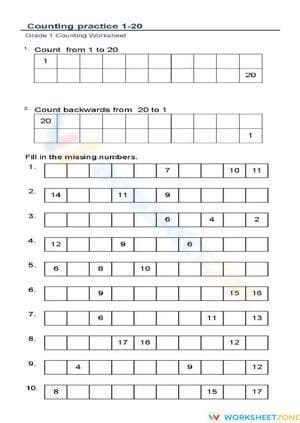
These counting to 20 worksheets give PreK and Kindergarten teachers a set of print-ready pages that move students through the full arc of early number sense — from tracing a numeral to recognizing it in sequence to understanding what quantity it actually represents. The formats vary enough that a single PDF set covers morning warm-ups, guided math groups, and end-of-unit checks without a teacher having to build anything from scratch.
What's on the Pages
The worksheet types in a solid set address genuinely different skills, not just the same task in different clothes. Number tracing pages use dotted stroke guides for 1 through 20 — useful not just for handwriting practice but because students who can't yet form a 4 or a 7 consistently tend to also confuse those numerals when reading them. Count-and-color sheets ask students to count a group of pictured objects and mark the matching numeral; this is where one-to-one correspondence actually gets tested, because a child who has memorized the count sequence can still recount objects or skip them without touching each one.
Fill-in-the-sequence pages present gaps like 14, 15, ___, 17 or ___, 11, 12 — formats that distinguish rote recitation from internalized number order. Ten-frame worksheets are particularly valuable in the 11–20 range because they make the structure of teen numbers visible: a full frame of ten plus additional dots. A student who looks at 13 dots scattered across a page and a student who sees a complete ten-frame plus three more dots are having two very different cognitive experiences. Cut-and-paste sequencing activities round out the set with a hands-on format that works well for students who disengage during seat work.
Where These Pages Fit in the Day
The most reliable use is as a morning transition task. A single tracing or missing-number sheet placed on desks before students arrive fills the 6–8 minutes between arrival and whole-group gathering without requiring teacher direction. Students know what to do with a worksheet; the low-stakes familiarity of the format keeps early-morning anxiety low while activating number sense before instruction begins.
During math centers, ten-frame sheets pair naturally with a small cup of counters. The physical act of placing objects on a printed ten-frame before writing the numeral preserves the concrete-to-representational-to-abstract progression that early numeracy research consistently supports — students aren't skipping straight to symbols before they've built the mental image of the quantity.
For small-group guided math, count-and-color and mixed-task pages are especially useful because they produce observable behavior. Watching a student touch each picture while counting, or skip the touch entirely, tells you something a completed worksheet alone won't. Three to five students at a table lets a teacher catch a recount error or a numeral reversal in real time rather than discovering it during stack grading.
A Two-Pass Assessment Strategy
One practical move worth building into any counting unit: use the same mixed-task sheet twice. Administer it at the start of the unit as an ungraded pre-assessment, date it, and file it. At the end of the unit, students complete the identical page again. Placing both pages side by side — even with Kindergartners — makes growth concrete and visible in a way that a score or sticker chart can't replicate. Students who wrote shaky 7s and left sequence gaps in week one can see their own improvement without needing an adult to narrate it for them. Teachers get before-and-after data without scheduling a separate testing event.
Where Students Struggle Most
The teen numbers — 13 through 19 specifically — are where counting to 20 instruction earns its difficulty. Students who handle 1–12 with confidence often stall here because the English number names give no structural clue. Thirteen does not sound like ten-three the way that Spanish trece doesn't either, and unlike the tidy decade words (twenty, thirty), the teens are phonetically irregular. On fill-in-the-sequence pages, expect gaps clustered in the 13–16 range, not distributed evenly across 1–20.
A separate, common error shows up on count-and-color sheets: students count correctly but then mark the wrong numeral because 6 and 9 look similar, or because 12 and 21 both use the same digits. These are recognition errors, not counting errors, and they call for different instruction — more numeral identification work, not more counting practice. Watching which wrong numerals students circle tells you which problem you're actually dealing with.
Standards Placement
Common Core Kindergarten standard K.CC.A.1 asks students to count to 100 by ones and tens, but K.CC.A.2 and K.CC.B.4 are where counting to 20 worksheets do their real work: counting forward from a given number other than one, and understanding that the last number said in a count tells the total quantity. The fill-in-the-sequence format directly addresses K.CC.A.2, because starting a sequence at 8 or 14 requires a student to call up number order from an internal structure rather than starting at 1 every time. K.CC.B.4c — understanding that each successive number refers to a quantity one larger — is what ten-frame worksheets build toward, since the visual accumulation of dots makes "one more" a pattern students can see before they can articulate it.
Scaling for the Range of Learners in the Room
PDF sets allow quiet differentiation. A student still consolidating 1–10 gets the tracing and sequencing pages that stop at 10; a student ready to move past 20 gets a mixed-task sheet that includes the number word alongside the numeral (writing seventeen next to the numeral 17 is a distinct challenge that connects to reading, not just counting). Neither student needs to know the other is working on a different page, which matters in Kindergarten where awareness of peer comparisons is already developing.
For students who freeze when they see an unfamiliar page layout, the cut-and-paste ordering format is often the entry point that works — the task is physical enough that it doesn't feel like "doing a worksheet," and arranging number cards in sequence gives a student who resists writing a way to demonstrate understanding without a pencil.
Frequently Asked Questions
1. At what point should students move from counting to 10 worksheets to counting to 20?
When a student can fill in a 1–10 sequence from a non-one starting point with consistency — asked to start at 6 and count to 10, they don't restart at 1 — they're ready for the 11–20 range. Accuracy on a single sheet isn't the signal; the signal is whether they can begin a count mid-sequence without scaffolding.
2. Do these work for students receiving intervention in Grade 1?
Yes, particularly the ten-frame and missing-number formats. A first grader who is struggling with place value often has an underlying gap in teen-number understanding, and going back to structured ten-frame work — even briefly — resolves confusions that addition drill alone won't fix.
3. What's the right frequency for using these pages?
Short and often beats long and infrequent. A single page three to four times per week, used for 5–10 minutes, builds more durable recall than a 30-minute worksheet block once a week. The research on spaced practice applies at this level just as it does higher up — distributed exposure across days outperforms massed practice on a single day.
















 Interactive Worksheet Maker
 Quiz Maker
 Word Search Maker
 Crossword Puzzle Maker
 Word Scramble Generator
 Sentence Scramble Generator
 Handwriting Worksheet Generator
 Name Tracing Generator
 Fill In The Blank Generator