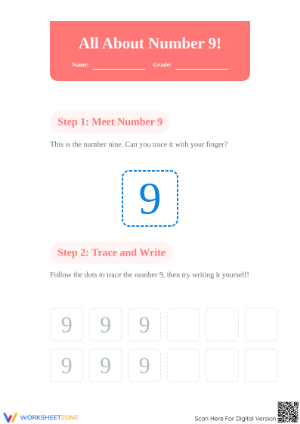
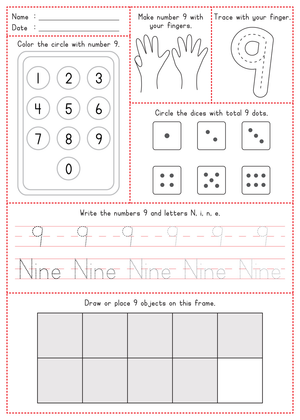
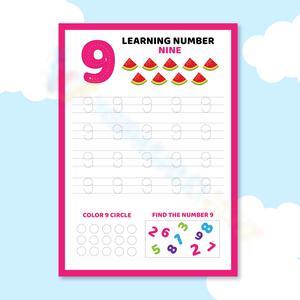
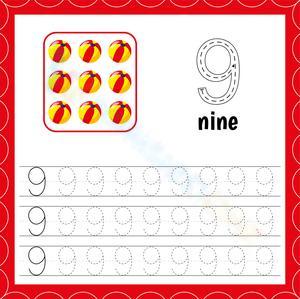
Number 9 printable worksheets for kindergarten address a specific moment in early math instruction — the point when students have worked through 1 through 8 and now need the same sustained, focused attention on the numeral that closes out the single-digit sequence. These worksheets combine numeral formation, counting picture sets of nine objects, and matching practice so students connect the written symbol to the quantity in more than one way.
Skills Covered Across the Set
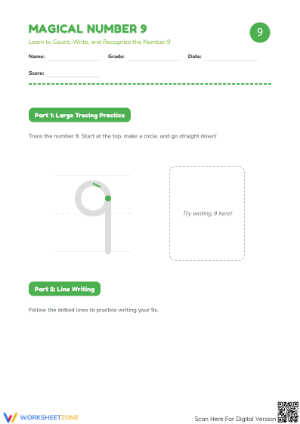
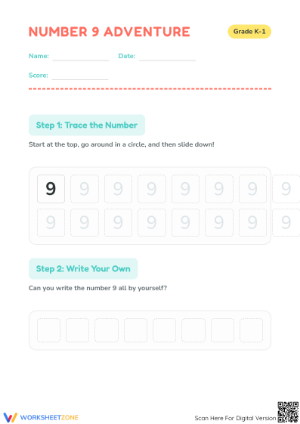
The work each worksheet asks of students stays narrow by design. Students trace the numeral 9 along large guided paths, count sets of nine objects, circle or mark the correct group when shown options with quantities near nine, and write 9 independently in open boxes. Some worksheets include a ten-frame showing nine filled squares — a setup that primes students to see nine relative to ten, which pays off when they start work with teen numbers and decomposition.
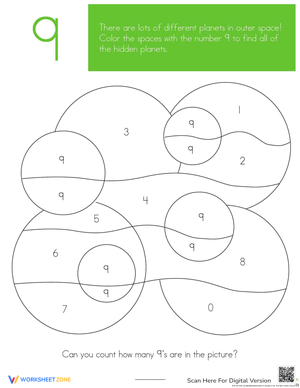
Visual discrimination tasks appear in the stronger worksheets as well. Students identify the numeral 9 from a mixed row that includes 6, 4, and other numerals that share similar features. That kind of task reveals quickly whether a child recognizes 9 by its form or is simply recalling its position from earlier practice.
Student Errors That Surface Consistently With the Number 9
Nine and six are the same shape rotated 180 degrees. This confuses kindergartners more reliably than almost any other single-digit numeral pair. A child who writes 6 correctly in September can still produce an upside-down 6 when asked to write 9 in November, especially when working quickly. The error reflects genuine visual ambiguity — not carelessness — and a worksheet that places 6 and 9 side by side in a circle-the-correct-numeral task is one of the few formats that forces students to attend to orientation rather than shape alone.
The second pattern worth watching is cardinality lag. A student counts nine pictures accurately, touching each one, then writes "8" in the answer box. The counting was correct; the problem is that the child has not yet internalized the final count as the name of the whole set. Asking the student to point to the numeral after counting — rather than selecting it first — helps distinguish students who understand cardinality from those who are still building it. This is a different problem from formation confusion, and no amount of tracing practice will address it.
Numeral formation errors are also predictable. Writing 9 requires closing a circle and then pulling a straight tail downward, and students frequently leave the circle open at the bottom or curl the tail sideways. A worksheet model that includes directional arrows addresses this more reliably than a repeated verbal reminder during whole-group time.
Fitting These Worksheets Into the Week
The most natural entry point is a number-of-the-week focus on 9. These worksheets give students a paper record of their practice after the morning meeting counting, the hands-on center work, and the small-group number building — they are the documentation, not the centerpiece. Two or three worksheets spread across Monday, Wednesday, and Friday during that instructional week builds retention without turning pencil-and-paper work into the primary mode of instruction.
Beyond a dedicated instructional week, these worksheets fit into several recurring classroom slots:
- Monday warm-up: a short tracing and counting task after a weekend gap, requiring almost no setup and giving teachers a quick look at retention
- Math center rotation: independent work after a brief teacher model, with counters or cubes nearby so students can build before recording
- Small-group intervention: a concrete shared task for three or four students who are still reversing 9 or miscounting picture sets
- Early finisher tray: review practice students can begin without additional directions
- Take-home review: directions visible on the worksheet itself, so families can support practice without needing any preparation
One constraint worth naming: number 9 printable worksheets for kindergarten are most effective when used after students have handled real objects. Counting nine printed pictures is a harder cognitive task than counting nine actual cubes, and introducing a worksheet before any concrete counting experience often produces low-quality work that masks what students actually understand about the quantity.
Adjusting the Work Across Ability Levels
For students still developing pencil control, the tracing task is the priority — not the counting or independent writing. A worksheet with a single large numeral model and two or three tracing paths gives those students useful fine-motor practice without multiple competing task types. Sliding a dry-erase sleeve over the worksheet lets them trace the numeral several times before committing anything in pencil.
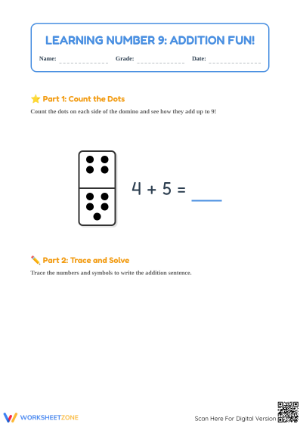
Students who already write 9 accurately and count nine objects reliably need something with more cognitive demand. Worksheets that ask them to produce sets — drawing nine objects from scratch, filling in a ten-frame to represent nine, or completing a simple number sentence — push toward relational thinking that becomes important in first grade. A standard tracing worksheet does little for these students once formation is stable.
Number 9 printable worksheets for kindergarten are not inherently language-dependent, but students receiving language support still benefit from a teacher or aide narrating each step aloud before independent work begins. Pairing every worksheet task with oral counting and a brief teacher model keeps the language load from blocking access to the math itself.
Standard Alignment
These worksheets address CCSS.MATH.CONTENT.K.CC.A.3, which requires students to write numbers from 0 to 20 and represent a number of objects with a written numeral, and K.CC.B.4, which covers the relationship between numbers and quantities — including the understanding that the last number said when counting names the total. In classroom terms, K.CC.A.3 is what students practice when they trace and write the numeral; K.CC.B.4 is what they practice when they count picture sets and record the total. A worksheet that includes both tasks in the same sitting lets teachers observe both standards in a single formative snapshot rather than needing two separate activities.
Frequently Asked Questions
Do these worksheets help with students who recognize 9 but consistently reverse it when writing?
Yes, and the most useful worksheets for this issue are the ones that show a directional arrow on the model numeral. The 9 starts at the top right of the circle, curves counterclockwise to close the ball, then pulls straight down into the tail. When a student reverses 9, the problem is usually the starting point — they begin with the tail first or enter the circle from the wrong side. A worksheet that marks the starting dot and arrow gives the child a visual anchor they can check without waiting for teacher feedback on every single attempt.
How many worksheets should I plan to use in one instructional week on the number 9?
Two or three is the right range. One early in the week after the introduction, one mid-week after center practice, and one at the end as a check covers the concept without turning every work period into paper tasks. Use the final worksheet as a quick formative tool: a student who correctly traces, counts, and identifies 9 across all the tasks on it has demonstrated enough stability to move forward.
Are these worksheets useful for students who are significantly behind the rest of the class in number sense?
Number 9 printable worksheets for kindergarten work best for students who already have some stability with quantities up through five. If a student is still unsure whether a group of four objects is three or four, counting nine pictures will produce guessing rather than learning. In those cases, keep those students working with smaller quantities and treat the number 9 worksheets as a goal to work toward — not a current starting point.
How do I tell whether a completed worksheet reflects real understanding or just task completion?
Watch the process, not just the product. A student who points to each picture exactly once while counting, says the number words in order, and then writes the matching numeral is demonstrating both counting accuracy and cardinality. A student who fills in every blank but skipped pictures while counting or wrote a numeral before finishing the count is completing the task without the underlying understanding. The worksheet looks the same in both cases — only observation during the work reveals the difference.













 Interactive Worksheet Maker
 Quiz Maker
 Word Search Maker
 Crossword Puzzle Maker
 Word Scramble Generator
 Sentence Scramble Generator
 Handwriting Worksheet Generator
 Name Tracing Generator
 Fill In The Blank Generator