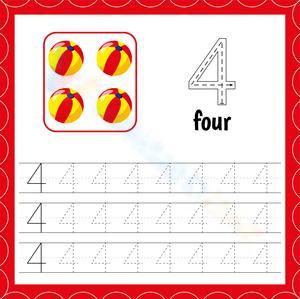
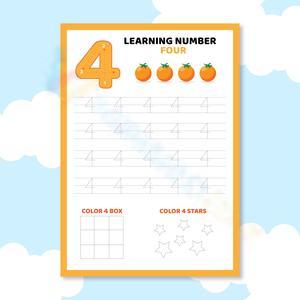
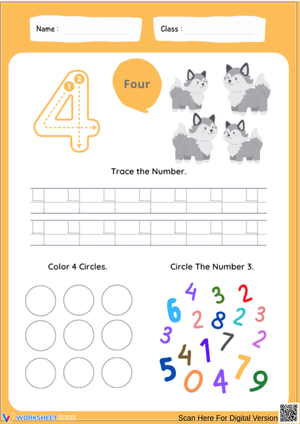
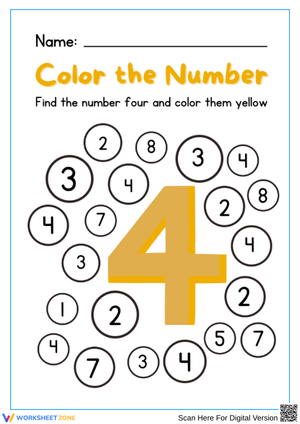
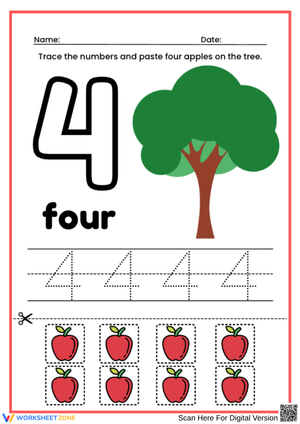
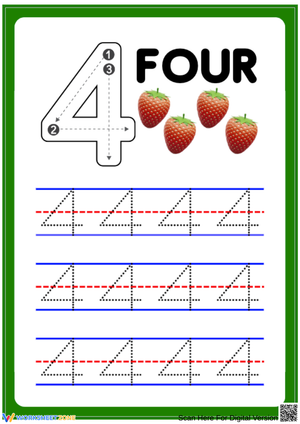
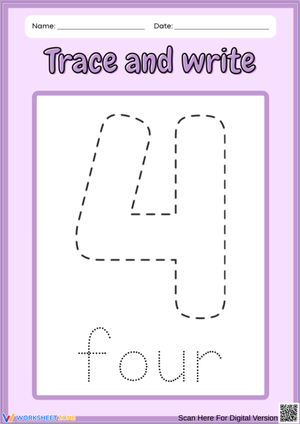
These number 4 printable worksheets for kindergarten give teachers targeted practice across three distinct skill areas: numeral formation, quantity recognition, and subitizing with visual models like ten frames and dot arrangements. The set takes seriously what teachers often learn by watching — the number 4 is genuinely harder to form than 1, 2, or 3, because it demands a deliberate pencil lift mid-stroke that five-year-olds are encountering for the first time. Every worksheet drops into morning work, a math center, or small group time without modification.
The Specific Skills Each Worksheet Targets
Numeral formation is the first layer. Students trace the number 4 following stroke-order arrows that show the two-part sequence: a short diagonal moving down and to the right, then a lift, then a vertical stroke down through the intersection. The directional cuing is embedded in each worksheet so teachers don't need to annotate them by hand before distributing.
Quantity association is the second layer. Each worksheet that asks students to count a set of objects and then circle, color, or write the corresponding numeral reveals a meaningful diagnostic distinction in real time: a child who counts correctly but writes a backwards 4 has a handwriting issue, not a math gap; a child who circles five objects and records 4 is showing an incomplete understanding of cardinality. The worksheets make that difference visible without requiring a separate assessment moment.
The third layer is visual number sense. Ten-frame activities train students to see four as a specific spatial configuration — four filled cells with one empty in the top row is an anchor image that carries forward into addition thinking later in the year. Dot-pattern worksheets use dice and domino arrangements so students practice recognizing four objects without counting one by one. Subitizing four is a milestone that often gets skipped when instruction relies only on numeral tracing, and these worksheets address it directly.
- Guided tracing with labeled start points and stroke-order arrows
- Visual discrimination tasks — finding and circling the number 4 among mixed numerals
- Ten-frame fill-in and identification activities
- Object-counting matched to numeral recording
- Real-world context sets featuring squares, car wheels, and animal legs that connect the digit to tangible quantities
Common Misconceptions to Watch For and Correct
The most consistent error is skipping the pencil lift. Students who have learned that a continuous stroke works for 1, 2, and 3 apply the same logic to 4 and drag the pencil through, producing a shape that sits somewhere between a 9 and a lowercase h. The stroke-order arrows in these worksheets break the motion into two clearly separate actions, but teachers still need to watch for students who trace over the arrows without actually lifting. A brief verbal nudge — "pick up, then go down" — at the exact moment of the second stroke catches the habit before it hardens.
Reversal is the second common issue. Some kindergarteners write the 4 as a mirror image, with the open side facing right rather than left. This is developmentally normal before age six and isn't a red flag on its own, but it needs consistent correction. The worksheets that place a correctly formed model directly beside the tracing line give students a reference to check independently, though some still need a teacher's finger pointing to the correct orientation before the correction sticks.
At the cardinality level, watch for students who count four objects accurately but hesitate when asked to write the numeral and then guess wrong. They have the oral count sequence but haven't yet locked in the symbol-to-quantity connection. The matching tasks in number 4 printable worksheets for kindergarten surface this gap quickly during small group time, where it can be addressed before the confusion carries into the next number unit.
How to Build These Worksheets Into Your Lesson Plans
Morning work is the most natural entry point for the tracing and coloring worksheets. Students who arrive at staggered times can begin independently because the tasks need no direction-giving moment — anyone who has done numeral tracing before can pick up and start. The fine motor demand also warms up hand muscles before writing instruction later in the morning.
Math centers work well with laminated copies slipped into dry-erase sleeves. Students trace, wipe, and repeat without consuming paper. Pairing the center with a small tray of connecting cubes so students can build a tower of four and compare it to the worksheet image adds a concrete check that's meaningful for students who are still uncertain about the quantity.
Small group instruction is where number 4 printable worksheets for kindergarten earn the most as a teaching tool. With four or five students at a table, you can observe pencil grip, catch reversals as they happen, and run brief oral checks mid-task. Asking students to count aloud while pointing to each object shows whether one-to-one correspondence is solid. The verbal stroke chant — students say "down, across, and down some more" while tracing — works noticeably better in this small group context than during silent independent practice, because the auditory cue reinforces the physical motion in a way that silent tracing simply doesn't.
Standard Alignment
These worksheets address two Common Core standards. CCSS.MATH.CONTENT.K.CC.A.3 requires students to write numbers from 0 to 20 and represent a number of objects with a written numeral — the tracing and freewriting tasks in the set build directly toward this. CCSS.MATH.CONTENT.K.CC.B.4 addresses the relationship between numbers and quantities, specifically the cardinality principle that the last number counted names the total. The quantity-matching and ten-frame activities target this standard at the concrete and representational levels, which is where kindergarteners need the bulk of their instructional time before abstract number work becomes meaningful.
Differentiating the Set Across Ability Levels
Students who are still developing fine motor control benefit from printing the tracing worksheets at 120% — the larger numeral gives them more room to execute the pencil lift without cramping the stroke. Running a yellow highlighter along the tracing path before the student begins creates a slightly raised, tactile edge that some students track more reliably than a standard gray printed line.
For students who already form the numeral correctly and recognize four objects without hesitation, the productive extension is decomposition. After completing the worksheet, ask them to flip it over and draw two different ways to make four — three and one more, or two groups of two. This moves them toward the additive thinking that K.OA standards address later in the year without requiring an entirely separate resource.
Students who freeze on open-ended tasks do better with the structured matching format than with draw-your-own-objects activities. Knowing which worksheet type to hand to which student — something that usually becomes clear after a single small group session — keeps the adjustment grounded in observation rather than guesswork.
Frequently Asked Questions
How do I correct the pencil-lift error without stopping the whole group?
Keep an index card with a cleanly formed 4 at your small group table. When a student drags the stroke, place the card beside their work and point to the visible gap between the diagonal and the vertical — the two strokes are clearly not joined on the model. Most students self-correct immediately when they can see the separation. The whole exchange takes about five seconds and doesn't break the group's momentum.
When are students ready to work without the directional arrows?
When a student produces a correctly oriented 4 three times in a row without glancing at the arrows, cover the model with a sticky note and ask for two more. If both come back correct, they're ready for freewriting rows. Pulling the support too soon brings reversals back; leaving it in place too long slows the move to automaticity. A few days of small group observation gives enough information to make the call.
Can these worksheets replace hands-on counting work with manipulatives?
No — and teachers who lean on worksheet tasks as the primary introduction to the number 4 typically see weaker retention. Students who haven't yet sorted four physical objects, built four-cube towers, or touched four items in sequence will find the abstract representation harder to make sense of. These resources consolidate and record understanding that hands-on work builds first. That's especially true for students who arrive in kindergarten with limited prior counting experience, for whom number 4 printable worksheets for kindergarten work best as a follow-up to concrete activity rather than as the entry point into it.
How many tracing repetitions does a kindergartener typically need before writing independently?
There's no fixed number, but five to eight carefully supervised traces is a reasonable range for most students. What matters more than repetition count is immediate correction — five corrected traces carry more instructional value than fifteen uncorrected ones where the wrong stroke pattern is being reinforced. The worksheets include enough tracing rows that you can stop when the formation is clean rather than filling every row out of habit.













 Interactive Worksheet Maker
 Quiz Maker
 Word Search Maker
 Crossword Puzzle Maker
 Word Scramble Generator
 Sentence Scramble Generator
 Handwriting Worksheet Generator
 Name Tracing Generator
 Fill In The Blank Generator