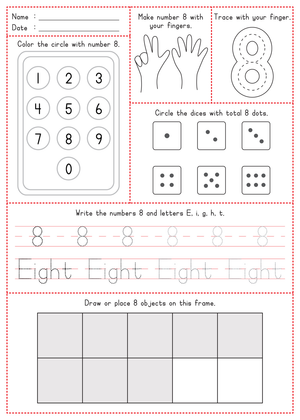
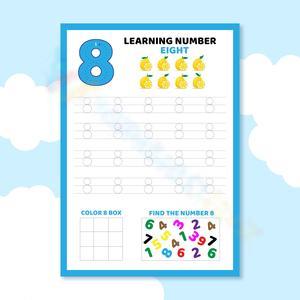
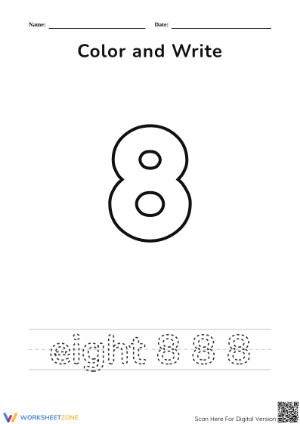
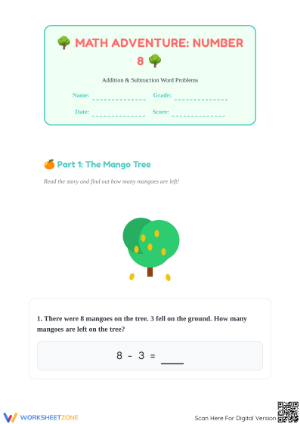
These kindergarten number 8 printable worksheets give teachers a focused set of practice resources targeting the three skills students actually need: forming the numeral correctly, counting sets of eight with accuracy, and reading a ten-frame without needing to count every dot. Each worksheet stands alone, so one can be pulled for a morning warm-up or dropped into a small-group rotation without reorganizing anything.
The Writing Challenge This Number Poses
Eight is one of the hardest numerals for a five-year-old to write, and the reason is specific: it demands a continuous S-curve that reverses direction and closes on itself. Students who handled 3, 5, and 6 without much trouble routinely stall here because those numerals, however curved, travel in one direction. The 8 doesn't. The near-universal first attempt is two stacked circles drawn separately — visually plausible but motorically all wrong. That habit sets fast. Once a student has written the 8 as two circles a few dozen times, the correct continuous motion feels counterintuitive.
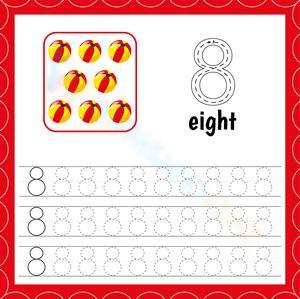
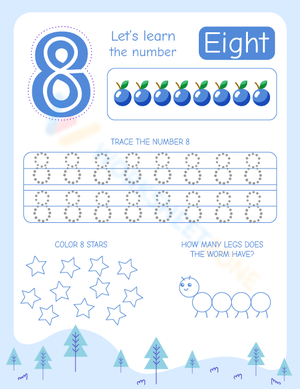
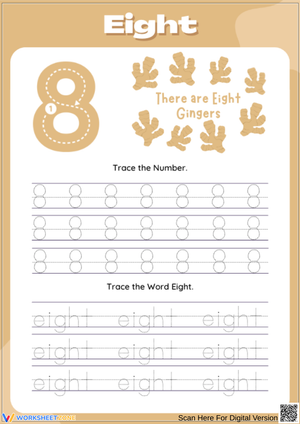
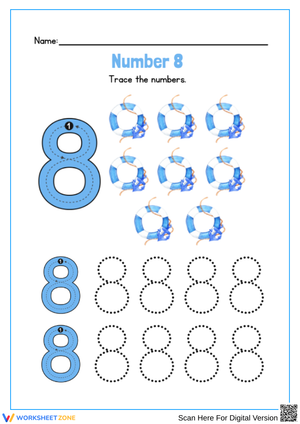
The tracing worksheets in the set use a single starting dot and directional arrows that leave no ambiguity about the path. Before students trace anything on paper, have them walk a large masking-tape 8 on the floor, following the S-turn with their whole bodies. That gross-motor experience gives them a body memory to consult when the fine-motor version feels uncertain.
Skills Covered Across the Set
The worksheets address the full range of what kindergarten number work requires for this numeral:
- Numeral tracing with directional cues, leading toward independent writing
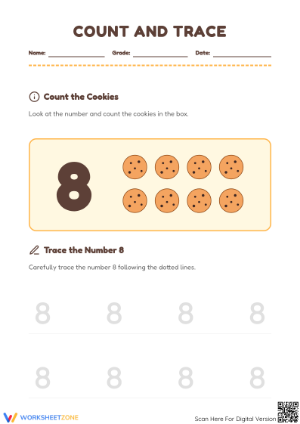
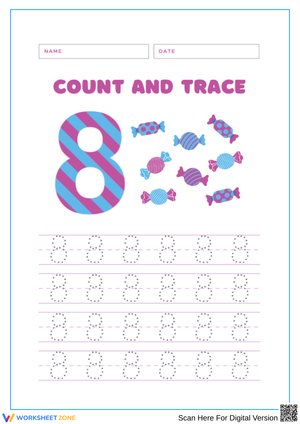
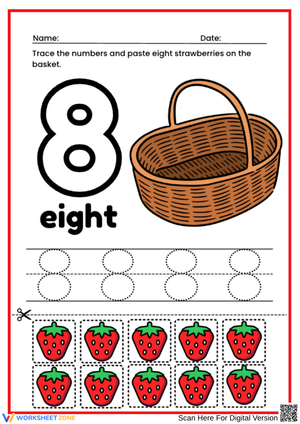
- Counting sets of eight drawn objects using one-to-one correspondence
- Ten-frame reading — identifying 8 filled squares as a pattern rather than counting each one
- Ten-frame filling — shading exactly 8 squares and writing the numeral below
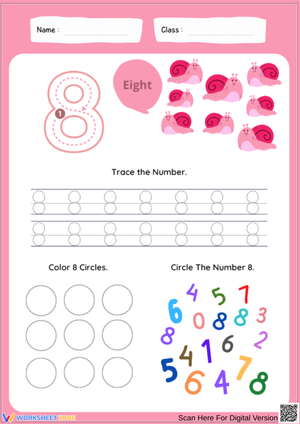
- Numeral identification among visually similar symbols (0, 3, 6, 9)
- Sequence completion: writing the missing number on a number line near 8
- Matching the numeral to the word eight
Counting tasks use drawn animals, shapes, and everyday objects rather than abstract dots. Students color each item as they count, which forces the one-to-one correspondence instead of letting them estimate from a quick visual scan.
Ten-Frame Work and Number Sense
The ten-frame is unusually useful for teaching 8 specifically. When 8 squares are filled in a ten-frame, students see one complete row of five and three more in the second row — which makes 8's distance from both 5 and 10 visible without any calculation. A student who looks at that filled frame and says "eight" without counting each dot has made the shift from procedural counting to pattern recognition. That shift is one of the clearer developmental markers in early number sense. Students who keep counting every dot — even on a clearly full first row — are showing that 5 hasn't clicked as a benchmark yet, and that's worth addressing directly before moving further into the 8 material.
Fitting These Worksheets Into Your Week
Formation practice belongs early in the unit — the first few days when the numeral is unfamiliar. After students can trace the path reliably, counting and ten-frame tasks become the daily work. A practical structure: open with whole-group instruction using physical manipulatives (counting bears, snap cubes, a ten-frame mat), then move into small-group rotations where different worksheets address different points in the skill progression, then close with a brief independent task as a formative check. The whole sequence runs in fifteen to twenty minutes of focused small-group time.
These kindergarten number 8 printable worksheets also work as morning work during the days around the 8th of the month — there's a real calendar hook there, and five-year-olds respond well when the number they're drilling appears in a genuine context. Snack time is another low-prep opportunity: give students exactly 8 crackers and ask them to arrange them in two equal rows. That doubles structure shows up again when addition begins later in the year.
Errors Students Make That Are Worth Catching Early
The stacked-circles writing error is the most visible mistake, but counting errors are equally common and sometimes harder to see. The pattern we observe most often: students counting objects arranged in a circle skip one item or loop back to count the starting object twice. A student who lands on "seven" or "nine" when the set has eight objects usually has a spatial tracking problem, not a quantity problem — they know what eight is, they just lost track of where they were. Worksheets where students color each object as they count interrupt this error in real time.
On ten-frame tasks, a separate mistake appears. Students who haven't internalized 5 as a unit count every filled square from the top-left corner, even when the first row is obviously full. They're following counting procedure faithfully — they just haven't yet learned to treat the full row as a chunk worth five. When a student does this repeatedly, going back to ten-frame work on the number 5 and explicitly naming "a full row equals five" will pay off more than continuing to push forward with 8.
Standard Alignment
The counting and quantity tasks on these worksheets address CCSS.MATH.CONTENT.K.CC.B.4, which requires students to understand that the last number named when counting a set tells the total — the cardinality principle. The numeral writing and recognition tasks connect to K.CC.A.3, which asks students to write numbers from 0 to 20 and represent a quantity with a written numeral. These two standards are often taught in parallel in kindergarten math units because writing the symbol and understanding the quantity it represents are not the same skill, and students need explicit practice linking them. The worksheets treat formation and counting as separate tasks within the same session rather than assuming one transfers automatically to the other.
Adjusting the Work Across Ability Levels
Students still developing fine motor control need the formation worksheets with the widest tracing lines and the most directional support — specifically, more tracing repetitions and fewer independent write-the-number boxes at the bottom. For these students, pairing each session with the floor-walking activity is worth the two extra minutes. The physical path reinforces what the arrows on paper are trying to communicate.
Students who have the writing motion under control benefit from tasks that raise the thinking demand: spotting the 8 among a row of 0s, 3s, 6s, and 9s for visual discrimination work; completing a number line with the missing numeral; writing the number from memory after looking away from the model. These kindergarten number 8 printable worksheets cover enough of this range that different students can work on different tasks during the same small-group block without requiring separate materials to be prepared.
Frequently Asked Questions
My student keeps drawing two stacked circles no matter how many times I correct it. What actually helps?
Start by taking the pencil out of the picture entirely for a few sessions. A sand tray, shaving cream, a finger tracing over a large printed 8 — any of these make the continuous motion physically obvious because the student can feel when they've lifted and restarted. Add a verbal anchor: "We start at the top and we never stop." When the student returns to paper, use the worksheet's starting dot and watch the first stroke. If the pencil lifts after the S, stop there and reset rather than letting the student finish and then correcting afterward. Catching the error at the moment it happens is what actually interrupts the habit.
At what point in the kindergarten year should number 8 work begin?
Most kindergarten programs reach 8 in late fall or early winter, after students are solid on 1 through 7. The practical readiness markers: consistent counting to 7 without skipping, mostly independent writing of earlier numerals, and the beginning of cardinality understanding — that is, the student grasps that the last number counted names the total. If a student is still uncertain about 6 or 7, consolidating those numbers first is more useful than pressing forward to 8.
Can a completed worksheet function as a quick formative assessment?
A counting worksheet with student work on it tells you a lot. A student who colors all eight objects and writes the numeral correctly has shown one-to-one correspondence and numeral formation together. A student who writes "6" after correctly coloring eight objects has a counting-and-cardinality problem, not a writing problem — they lost track of where they were. A student who writes "8" but left two objects uncolored reversed the error: they wrote a memorized number without completing the count. These kindergarten number 8 printable worksheets, collected after a small-group rotation, give you specific and actionable information about each student without requiring a separate formal assessment tool.













 Interactive Worksheet Maker
 Quiz Maker
 Word Search Maker
 Crossword Puzzle Maker
 Word Scramble Generator
 Sentence Scramble Generator
 Handwriting Worksheet Generator
 Name Tracing Generator
 Fill In The Blank Generator