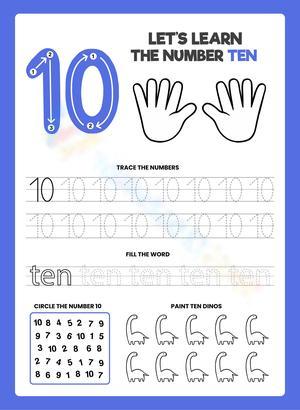
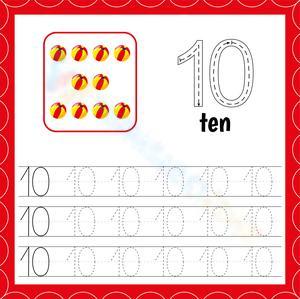
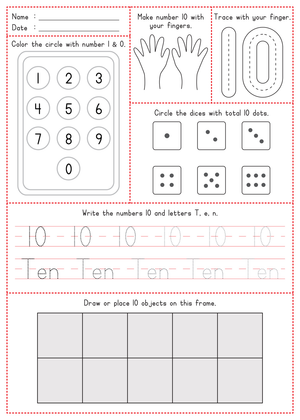
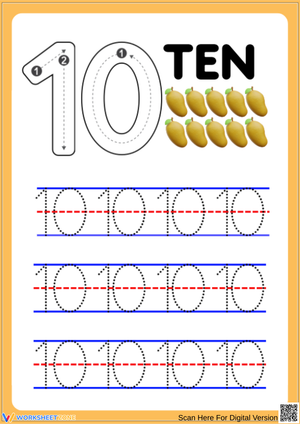
These number 10 worksheets for kindergarten give teachers a print-ready set of activities for one of the most consequential milestones in early math — the moment students step from single-digit counting into the base-10 system. The set covers numeral formation, ten-frame work, object counting, and visual number recognition, all built around formats kindergartners already handle independently.
The Specific Skills Targeted in This Set
Each worksheet in the number 10 worksheets for kindergarten set targets a distinct aspect of number 10 understanding rather than recycling the same format with different clip art. Activities across the set address five competencies:
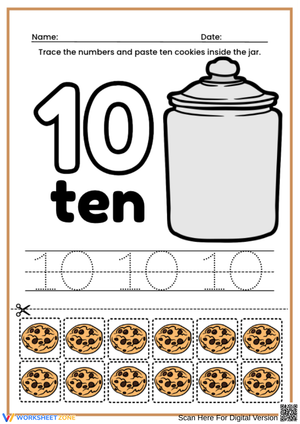
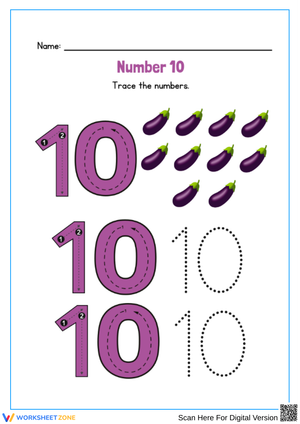
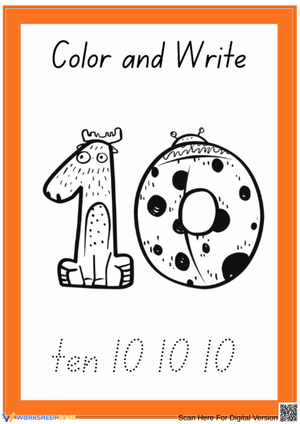
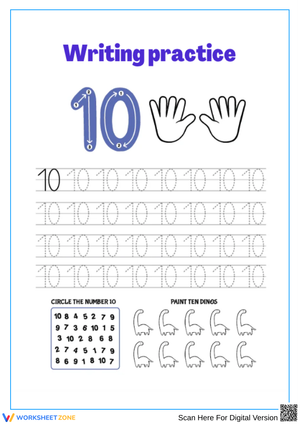
- Numeral tracing and formation: Students trace the digits 1 and 0 separately before combining them into the full numeral. Directional arrows and starting dots guide stroke order — the vertical line of the 1 first, then the closed oval of the 0. This sequencing prevents students from treating 10 as a single, indivisible shape.
- Ten-frame completion: Some worksheets present a partially filled frame and ask students to draw the missing counters. Others show a full ten-frame and ask students to write the number it represents. Both directions build the same concept from different entry points.
- Counting and cardinality: Students color, circle, or cross out exactly 10 objects within a larger field. These tasks check whether students understand that the final count word names the whole group's quantity — not just the last item touched.
- Number recognition: Find-and-circle tasks embed 10 among the distractors students most often confuse it with: 0, 1, 12, and 01. Scanning a field of numerals and marking only the 10s builds visual discrimination more durably than tracing alone.
- Drawing sets: Students draw their own group of 10 objects in response to a printed numeral or word prompt. This production task reveals whether understanding extends beyond recognizing an already-drawn set.
Mistakes Students Make That These Worksheets Surface
The most consistent writing error is digit reversal: students produce "01" instead of "10." A five-year-old who knows both digits separately does not automatically know which one belongs on the left. A student who reads 10 correctly and counts to ten with perfect accuracy will still write "01" from memory if left-to-right digit order has not been explicitly taught. The numeral-formation worksheets address this by color-coding the two strokes on early attempts — students trace the 1 in one color and the 0 in another before writing the combined numeral on their own, which forces them to confront the placement question directly.
Counting breakdowns tend to appear at nine or ten objects, not earlier in the count. Most students move through seven or eight items without difficulty and then lose their place in the final two — touching an object without saying a number, or saying "ten" and then continuing to eleven. This is not inattention; it is where one-to-one correspondence genuinely breaks down at this developmental stage. Printing objects in rows of five, as these worksheets do, gives students a natural stopping point that reduces drift without lowering the count target.
How to Build These Worksheets Into Your Lesson Plans
Morning work is the most natural home for this set during the two-week window when the class focuses on the number 10. Most kindergartners finish one worksheet in eight to twelve minutes — enough time to settle the room after arrival without cutting into whole-group instruction. Ten-frame worksheets work especially well as morning starters because they invite a brief counting conversation at the transition into the main lesson.
During math centers, slide a printed worksheet into a dry-erase pocket. Students fill in frames and trace numerals with a whiteboard marker, wipe it clean, and rotate. A single worksheet can serve an entire center period without reprinting. Save the counting and drawing worksheets for independent seatwork — those tasks need permanent pencil marks so you can check student work before planning the next session.
For take-home practice, the numeral-tracing and ten-frame activities from this number 10 worksheets for kindergarten set are the most self-contained. They require no additional explanation beyond what is printed on the page, which matters when a caregiver is sitting at the kitchen table at seven in the evening trying to help a kindergartner who has already been in school all day.
Standard Alignment
The numeral tracing and writing activities address CCSS.MATH.CONTENT.K.CC.A.3, which requires students to write numerals from 0 to 20 and connect written numbers to object quantities. The counting tasks connect to CCSS.MATH.CONTENT.K.CC.B.4, the standard covering one-to-one correspondence and the cardinality principle — the understanding that the final number counted names the total size of the set. In practice, teachers address these two standards together during the number 10 unit because writing the numeral and grasping what it represents are not separate learning events. Students who encounter both in the same lesson build faster, more connected understanding than those who practice writing and counting as disconnected drills.
Adjusting the Set for a Range of Learners
Students still consolidating single-digit numerals benefit from starting with ten-frame and object-counting worksheets before moving to numeral writing. Pairing a printed ten-frame with physical counters reduces the number of simultaneous demands: students fill the frame physically first, confirm the quantity, then draw or write. This concrete-to-representational sequence keeps the mathematical content intact while removing abstract symbolic pressure before students are ready for it.
Students who complete numeral-writing tasks quickly and accurately can extend the work by writing a number bond at the bottom of whichever worksheet they just finished — 6 + 4 = 10, 7 + 3 = 10, and so on. This goes beyond the formal kindergarten standard but builds the additive understanding of 10 that pays off immediately when addition is introduced. For students whose fine motor control makes pencil work difficult, a thicker grip or finger-tracing the stroke arrows before picking up a pencil brings the formation worksheets within reach without reducing the mathematical demand.
Frequently Asked Questions
Are all the worksheets in the set different from each other?
Each worksheet targets a specific competency — tracing, ten-frame completion, counting sets, number recognition, or drawing sets — so students are not moving through the same activity in a slightly different visual arrangement. The variety reflects the range of skills that make up actual number 10 fluency at the kindergarten level.
Can these be used for first-grade intervention?
Yes. The content aligns to the kindergarten counting and cardinality progression, but the task formats are clean and direct enough that a first grader revisiting this material does not encounter anything that feels below grade level. Students who missed cardinality or numeral writing the first time through benefit from returning to these formats without additional distraction layered in.
Do any tasks work for students who are not yet writing?
Several worksheets in the set require only coloring, circling, or placing counters — no pencil work at all. This number 10 worksheets for kindergarten resource includes enough non-writing tasks to keep students with limited fine motor control engaged with the number concept while the rest of the class works through numeral formation.













 Interactive Worksheet Maker
 Quiz Maker
 Word Search Maker
 Crossword Puzzle Maker
 Word Scramble Generator
 Sentence Scramble Generator
 Handwriting Worksheet Generator
 Name Tracing Generator
 Fill In The Blank Generator