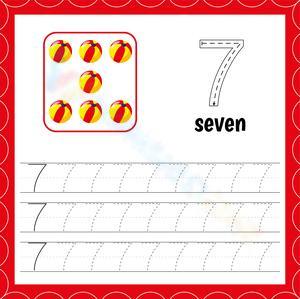
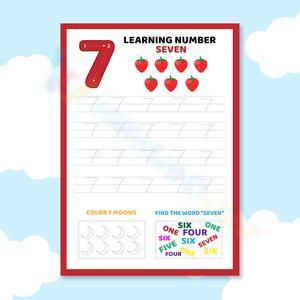
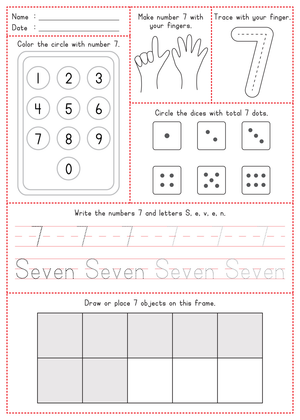
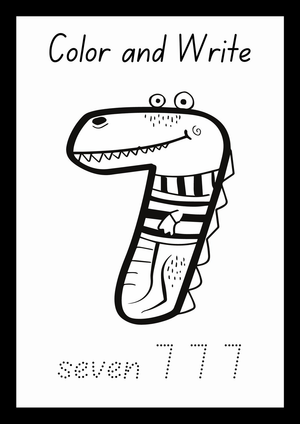
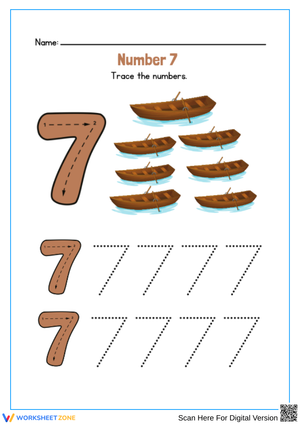
These number 7 printable worksheets for kindergarten cover numeral recognition, handwriting formation, one-to-one counting, and ten-frame representation — giving teachers a focused set of practice tools for one of the trickier single digits in the K–1 count sequence. Each worksheet targets a distinct skill, so teachers can select by lesson goal rather than moving through the set in a fixed order.
What Students Practice Across the Set
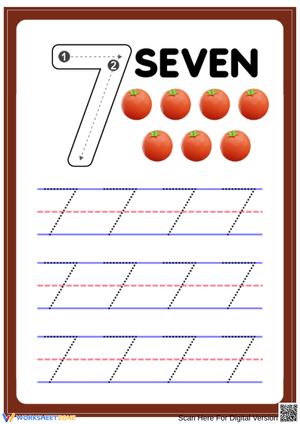
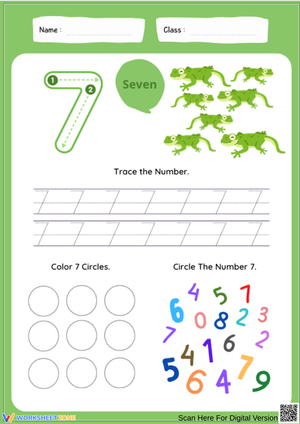
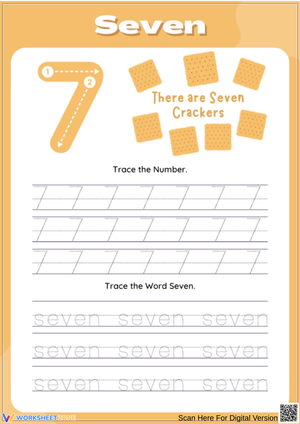
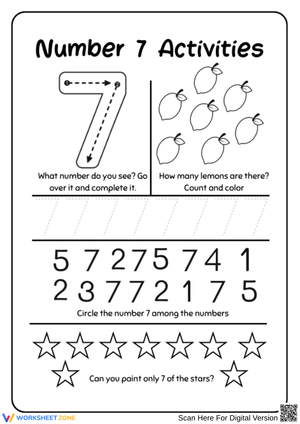
The activity types span the full range of early number understanding. Tracing and independent writing worksheets develop fine motor control and stroke sequence. Counting-set worksheets present groups of illustrated objects — students count and either circle the correct numeral below or write the quantity in a blank box. Number-hunt worksheets show a grid of mixed numerals; students find and mark every 7, which builds automatic recognition faster than repeated writing practice alone does. Ten-frame worksheets ask students to fill in or interpret a frame showing seven dots, connecting the quantity to its position relative to five and ten. Cut-and-paste tasks bring in scissor skills and categorization: students identify multiple representations of seven — a digit card, a tally cluster, a domino face — and paste them into a designated column.
Handwriting formation gets its own dedicated worksheets rather than appearing as a sidebar to other tasks. Students follow the two-stroke path: a horizontal line moving right from the top, then a diagonal pulling down to the lower left. Several worksheets also include the crossbar variant — the 7 with a small horizontal tick through the middle stroke — because students encounter this version on number lines and in published curricula and need to recognize it as the same numeral rather than a different character.
Error Patterns That Surface Across These Activities
The most common formation error with 7 is not a true reversal — it's a collapsed angle. Students start the top stroke correctly, moving right, but then pull the diagonal too steeply, producing something between a 7 and a 1. This shows up more often on counting or sorting worksheets than on dedicated tracing practice, because when the numeral is incidental to the main task, children write it quickly from a half-formed motor plan. Tracking this across multiple worksheet types, rather than only on formation drills, gives a more accurate picture of whether the stroke sequence is actually internalized.
On counting worksheets, the error to watch for isn't skipping an object — it's double-counting. A student's pointing finger and spoken count fall slightly out of sync, and the same object gets tagged twice, producing a total of eight when the set holds seven. This appears more reliably in rows of identical objects than in scattered or varied arrangements, because identical items blur together visually and one finger tap lands between two rather than squarely on one. That's a motor coordination gap, not a conceptual one, and it calls for different follow-up than a number-recognition intervention would address.
Where These Worksheets Fit in the School Day
Most teachers use number 7 printable worksheets for kindergarten as morning work during the active instruction window for 7 — typically three to five days in the number sequence — and then pull one or two worksheets again a week later as a brief warm-up check. The tracing worksheet works best early in the day, before fine motor fatigue sets in, and the repetitive motion is calm enough for students who arrive unsettled. Ten-frame and cut-and-paste worksheets belong later in the block, after a short whole-group lesson has verbally activated the concept. Students handle those tasks more meaningfully when the idea has already been touched in conversation, not cold off the desk.
For math centers, the number-hunt recognition worksheet runs without teacher presence. Students work through the grid independently and can self-check by counting their circled answers. That independence matters when you're running a small-group pull at the same time and need the rest of the class on a purposeful task rather than a decorative one.
Standard Alignment
The set aligns with CCSS.MATH.CONTENT.K.CC.A.3, which requires students to write numbers from 0 to 10 and represent a number of objects with a written numeral. In classroom pacing, 7 typically arrives in weeks three or four of a number unit — late enough that students have some one-to-one correspondence experience with smaller quantities, but early enough that number 7 printable worksheets for kindergarten still function as active instruction rather than review. The ten-frame activities also connect to the early groundwork for K.OA.A.3, which asks students to decompose numbers less than or equal to 10: a completed seven-dot frame makes the question visible — five filled, two more, and how many empty squares remain?
How to Use These Worksheets Across Readiness Levels
Students who are still solidifying numeral formation get the most from large-print dotted-line tracing worksheets with high contrast between the guide marks and the surrounding white space. One useful step before pencil touches paper: have these students trace the number with a finger first. One pass builds the motor plan without the added demand of grip and pressure control. Students who write the numeral confidently but still struggle with counting accuracy are better served by the ten-frame and counting-set worksheets, where the numeral is pre-printed and full attention goes to the quantity.
Students who are ahead of grade level in both writing and counting can extend any worksheet in the set by adding their own decomposition sentence at the bottom — writing 7 = 5 + 2 or 7 = 3 + 4 in blank space without a printed prompt. That's a concrete differentiation move that doesn't require pulling a separate worksheet, which is practical during a center rotation when switching materials mid-session disrupts flow for the whole group.
Frequently Asked Questions
When in a kindergarten number unit do these worksheets fit best?
After students have worked through 0–6 with some confidence, 7 gets its own instructional window — usually three to five teaching days. The worksheets fit into that window as daily practice, with one or two held back for spaced review after an interval of a week or two. Returning to a recognition or writing worksheet after a gap is one of the most direct ways to see whether the learning held or whether it was surface-level performance during instruction.
Do these worksheets work in a homeschool setting?
A parent working one-on-one can move through number 7 printable worksheets for kindergarten faster than a classroom teacher distributing one per day — two or three in a single session is reasonable. The practical signal to stop is the pencil stroke itself: when a child's 7s begin to flatten or lose their angle mid-session, that's fatigue rather than mastery. Alternating a writing worksheet with a cut-and-paste one resets the motor demand and extends productive work time without pushing past the point of diminishing returns.
How do I help students who can trace the number 7 but can't write it from memory?
This gap has a specific cause: the dotted-line gives so much visual information that students follow it without internalizing the stroke sequence. The most direct fix is to fade the prompt gradually — lightly highlight over the dots before printing so the guides are visible but reduced, then increase the proportion of fully blank boxes across successive sessions. Pulling the guide marks away all at once, or switching straight from a fully dotted worksheet to a blank one, reliably recreates the gap. The transition has to be incremental or the dependency on the dots simply reasserts itself.













 Interactive Worksheet Maker
 Quiz Maker
 Word Search Maker
 Crossword Puzzle Maker
 Word Scramble Generator
 Sentence Scramble Generator
 Handwriting Worksheet Generator
 Name Tracing Generator
 Fill In The Blank Generator