These kindergarten number 6 worksheets give teachers a print-ready set that addresses the number from multiple directions: numeral writing, counting with one-to-one correspondence, ten-frame work, and early quantity comparison. The set holds up because six sits right past the benchmark of five, and students need consistent, structured practice to make that transition feel solid.
What's Inside Each Worksheet
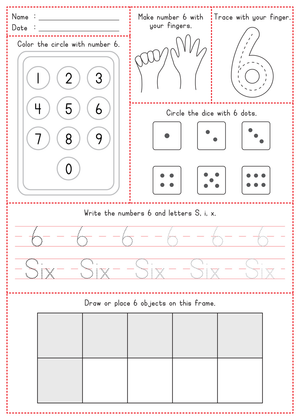
The activities in this set of kindergarten number 6 worksheets cover distinct skill areas rather than repeating the same format in different packaging. Here's what teachers find across the set:
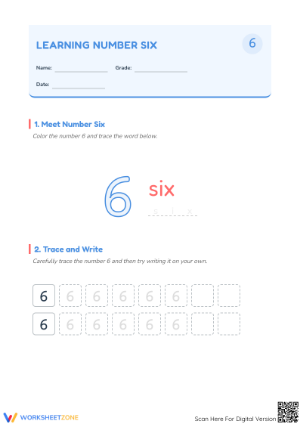
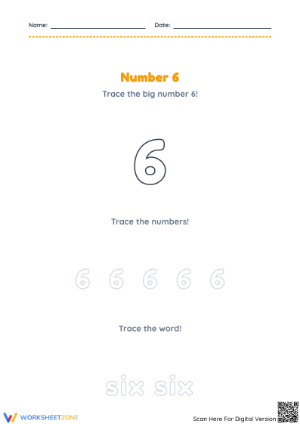
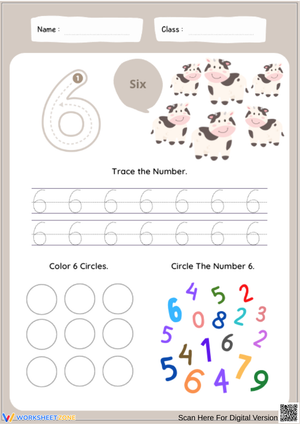
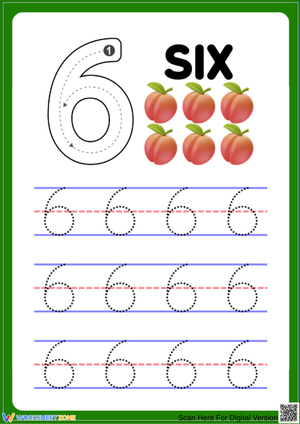
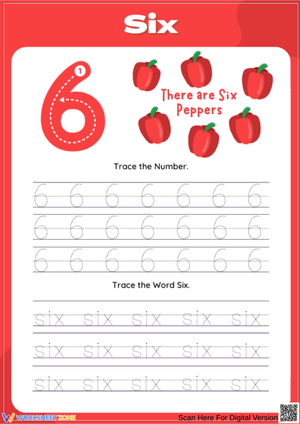
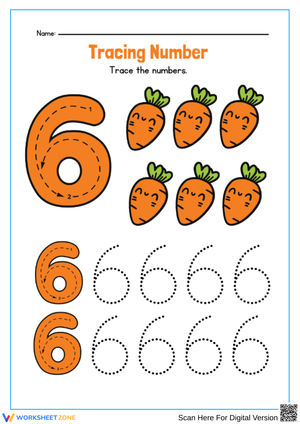
- Numeral tracing and formation: Starting-point cues guide the stroke — begin at the top, curve left and down, close the loop at the bottom. Getting this motion right early prevents the 6/9 reversal from becoming a habit.
- Counting and marking sets: Students count groups of objects and circle or color the ones that show exactly six, targeting one-to-one correspondence and cardinality.
- Ten-frame work: Filling in a frame with six counters — five across the top row, one on the bottom — makes the five-plus-one relationship visible rather than abstract.
- Numeral recognition: Finding and marking the numeral 6 within rows of mixed figures builds visual discrimination, especially against the 9.
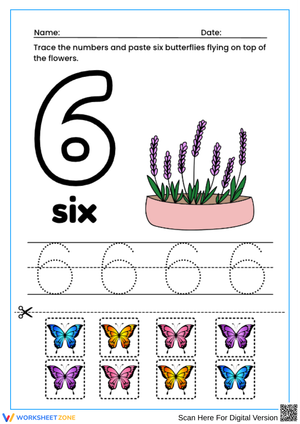
- Cut-and-sort activities: Students separate picture groups by quantity. The task is self-paced and holds up well as an independent center.
Common Misconceptions to Watch For and Correct
The 6/9 reversal appears far more often than most teachers expect. The motor sequence for writing 6 — curve left, sweep down, close the loop at the bottom — is essentially the inverted version of 9. Students who write the numeral correctly on Monday will flip it by Wednesday when the stroke isn't yet automatic. More tracing rarely fixes this. A verbal anchor works better: "Six has a belly on the bottom." That phrase gives students a self-correction cue they can use mid-stroke without stopping to look at a model.
A second error shows up in counting tasks. Students who count six objects correctly in a neat row will often recount a shuffled arrangement of the same objects and arrive at a different number. This isn't carelessness — it reflects a gap in conservation of number, the understanding that quantity doesn't change when objects move. When you see this on a completed worksheet, it tells you the student has sequential counting down but hasn't yet grasped that rearranging a group doesn't change its size. That's a meaningful diagnostic signal, not just a wrong answer to mark.
Six as a Turning Point in Early Numeracy
Five functions as a perceptual anchor. Students can look at a standard die face and recognize five dots without counting each one — that's subitizing, and most kindergarteners arrive with it. Six requires "five and one more," which is the first time in the counting sequence where a benchmark supports mental reasoning rather than rote counting from one. Ten-frames make this visible: when the top row is full at five and students place the first counter on the bottom, they see the transition rather than just counting past it. That visual model is worth returning to repeatedly because the five-plus-one relationship becomes a building block for addition strategies in first grade.
Building These Worksheets Into Your Lesson Plans
Before handing out any worksheet, spend three minutes having students build six with linking cubes and pull the group apart into different pairs: five and one, four and two, three and three. When students move to the paper task afterward, they're reinforcing something they've already handled physically. That concrete-to-representational sequence makes retention noticeably stronger than jumping straight to pencil-and-paper practice.
Within the lesson block, numeral-formation worksheets work best as guided practice immediately after teacher modeling — while the stroke sequence is fresh and you're still circulating to redirect bad habits before they stick. Counting and ten-frame worksheets fit better as independent work toward the end of a block, once students have talked through the concept aloud. The cut-and-sort worksheet is a strong center task: self-paced, gives students something to move, and frees you to pull a small group without the center falling apart. Using kindergarten number 6 worksheets as a Tuesday morning warm-up — the day after initial instruction — also works well for low-stakes retrieval before the class moves to new content.
Standard Alignment
These worksheets target CCSS.MATH.CONTENT.K.CC.A.3, which requires kindergarteners to write numbers from 0 to 20 and represent quantities with a written numeral. In classroom terms, that standard has two distinct components: the motor control to form the numeral and the conceptual understanding of what six objects actually looks like. Tracing and independent writing activities address the first; counting sets, filling ten-frames, and identifying quantities address the second. The worksheets also connect to CCSS.MATH.CONTENT.K.CC.B.5, covering "how many?" questions for arrangements of objects up to 20. Any task that asks students to count a set and record the total provides direct practice toward that standard.
Differentiating These Worksheets Across Ability Levels
For students still building one-to-one correspondence, start with worksheets that present objects in a straight row rather than scattered arrangements. Linear layouts are easier to track, and succeeding with that version first prevents the frustration of losing count mid-set. Encourage these students to physically touch or cross off each object as they count — something the format accommodates naturally, and a habit that pays off when sets get larger.
Students who already write the numeral correctly and count six without hesitation need to move toward comparison and flexible thinking. Blank ten-frames — no printed counters, no dotted guide — ask them to represent six independently. Better still, kindergarten number 6 worksheets that include comparison tasks (marking groups that show fewer than six, or identifying which set has more) push the concept toward number relationships, which is exactly where stronger students need to go before the unit ends.
Frequently Asked Questions
Do these worksheets work for students who haven't yet mastered numbers 1 through 5?
Not reliably. A student who loses count at four, or who doesn't understand that the last number named tells the total, will struggle with the counting tasks in this set. Before introducing these worksheets, do a quick check: ask the student to count a group of five objects in front of you. If they count accurately and state the total without recounting, they're ready. If not, more time on numbers 1 through 5 will pay off faster than pushing forward.
How many worksheets should a student complete before moving on to 7?
Quantity of worksheets isn't the right measure. Watch for two things: Can the student write the numeral 6 from memory with correct stroke direction and no reversal? Can they count a scattered set of six objects and state the total on the first attempt? When both are consistent across two or three separate check-ins on different days, move forward. Some students are ready after three worksheets; others need closer to a week of practice spread across multiple sessions.
What's a realistic timeline for introducing number 6 in kindergarten?
Most pacing guides reach six in late September or October, after several weeks on numbers 1 through 5. What matters more than calendar timing is how solid the number 5 feels for your class. Teachers who spend an extra two or three days cementing five as a benchmark before jumping to six typically find the six unit moves faster — students already have the mental anchor they need, and the transition to "one more than five" clicks more quickly.













 Interactive Worksheet Maker
 Quiz Maker
 Word Search Maker
 Crossword Puzzle Maker
 Word Scramble Generator
 Sentence Scramble Generator
 Handwriting Worksheet Generator
 Name Tracing Generator
 Fill In The Blank Generator