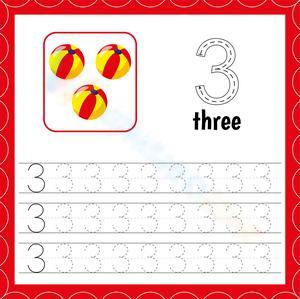
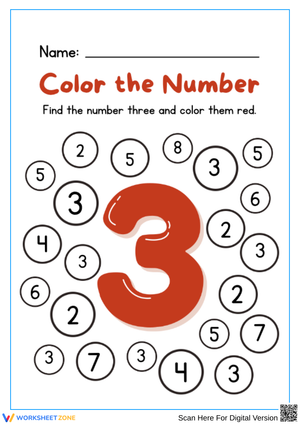
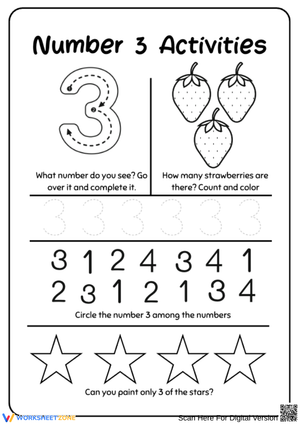
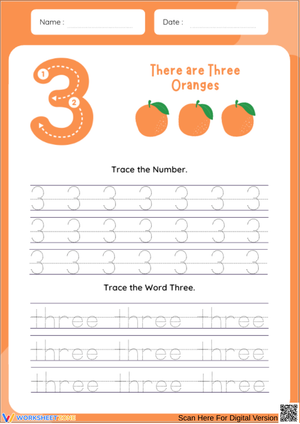
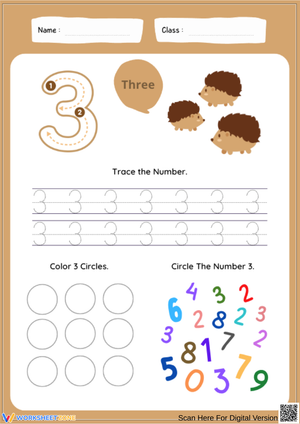
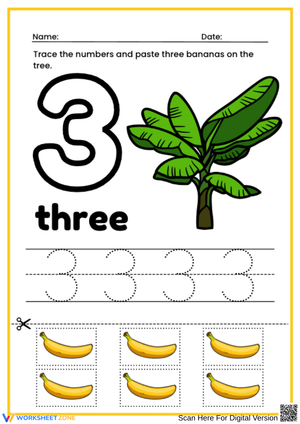
These kindergarten number 3 worksheets give teachers a targeted set of standalone printables for building numeral recognition, correct formation, and early quantity sense around one of the first numbers children are expected to master. Each worksheet focuses on a specific skill — tracing, counting, subitizing, or sorting — so you can drop individual resources into a lesson without reworking your whole plan. The set runs from controlled tracing practice to open-ended drawing prompts, covering the range of ways children actually need to interact with the number three before it sticks.
Skills These Worksheets Build
The set covers more ground than simple tracing. Students practice forming the numeral with stroke-sequence guides, then move to counting activities where sets of three objects appear in deliberately varied arrangements — scattered across the worksheet, stacked vertically, grouped in clusters — so children can't rely on spatial memory alone. One task type that consistently proves useful presents a mix of quantities from one through five and asks students to circle only the groups that show three items. That exercise reveals exactly which children are counting carefully and which are guessing by arrangement.
Subitizing practice threads through multiple worksheets. When students see three dots on a die face or three tally marks, the goal is instant recognition rather than recounting. Ten-frame representations help here: three filled circles in the top row give children a consistent visual anchor that carries forward into first grade. The set also includes drawing prompts — "draw three animals," "draw a shape with three sides" — which connect the numeral to real-world quantity and to basic geometry simultaneously. Counting the sides of a triangle while writing the numeral next to it does double work without adding a separate lesson.
Standard Alignment
Standard K.CC.A.3 requires kindergarteners to write numbers from 0 to 20 and represent a quantity of objects with a written numeral. The number three sits early in that progression, and mastery here sets the foundation for everything that follows. Teachers who address K.CC.B.4 alongside K.CC.A.3 — pairing cardinality with numeral writing — find the combination clicks faster when students have a concrete, well-practiced anchor number like three to return to during whole-group instruction.
Common Mistakes Students Make That These Worksheets Help You Catch
The most persistent error with the number three is reversal — students produce a mirror image that looks like a backward "E" with rounded curves. This isn't carelessness; it reflects how the kindergarten brain still processes left-right orientation. Worksheets that include a starting dot at the top center of the numeral and a small curved arrow showing the direction of the first stroke cut reversal rates noticeably. Without that directional cue, some students develop a habit of starting at the bottom and curving upward, which produces threes that look passable in isolation but fall apart when students try to write quickly.
A second error that's easy to miss: students who count to three correctly while pointing at objects will sometimes miscount when the same objects are partially obscured or printed with light ink. They say "three" because they hear themselves counting, not because they've verified the quantity. Watching whether a child recounts after circling a group tells you more about their cardinality understanding than the completed worksheet alone. The counting worksheets in this set include both neatly arranged and scattered configurations precisely to surface this distinction.
Fitting These Worksheets Into Your Instructional Week
A kindergarten number 3 worksheets works well as morning work on the day you introduce the numeral — project the tracing worksheet on the board, model the stroke sequence three or four times while narrating aloud ("start at the top, curve around, come back to the middle, curve around again"), then hand out the printed version while the model is still visible. That gradual release from teacher demonstration to independent practice takes about twelve minutes and leaves students with a reference they completed themselves.
Math center rotations are where most of these worksheets earn their repetition. Slide a tracing worksheet into a dry-erase pocket and students can practice formation five or six times before you need to print another copy. Counting and sorting worksheets run better as paper tasks — students mark their work by circling, crossing out, and drawing lines, and leave a record you can review. The completed worksheets from centers give you a quick snapshot of where each table group is without running a separate assessment. For end-of-unit review, pull one counting worksheet and one numeral identification worksheet side by side: a student who writes the numeral confidently but still struggles to identify three items in a mixed set has a specific gap you can address, not just a vague "needs more practice with three."
Adapting the Set Across Ability Levels
Students who are still building fine motor control benefit most from worksheets that use larger tracing models — a numeral three that fills at least a third of the writing space rather than sitting in a small lined box. Thicker pencils or crayons paired with a larger format make the task less frustrating without changing the learning target. It also helps to treat numeral writing and quantity recognition as two separate skills: a student who counts accurately but can't yet produce a legible three needs different practice than one who writes the numeral neatly but hasn't connected it to a quantity.
For students who form the numeral accurately and count groups without errors, extend the work by introducing the kindergarten number 3 worksheets alongside comparison tasks: "color the group that has fewer than three" or "draw one more dot to make three." This keeps the number three as the reference point while pushing number sense forward. Some students at this stage are also ready to write the word "three" below the numeral — a small addition that starts bridging numeral and word form earlier than most curriculum sequences expect.
Frequently Asked Questions
A student writes threes that look like backward E shapes. What's the most direct fix?
Start with a worksheet that has a pronounced starting dot at the top of the numeral and a directional arrow curving right. Before the student touches pencil to paper, have them trace the number in the air at arm height — large, sweeping motions — while you narrate the direction. That air-tracing step removes most of the fine motor demand and lets the student focus purely on directionality. Once they've done it in the air three or four times, the transition to the printed worksheet goes more smoothly. Consistent, specific correction during the first few attempts matters more than additional practice after the reversed habit has already formed.
How does teaching the number three connect to shape work in the same unit?
A triangle has three sides and three vertices, so any time students trace or draw a triangle during shape study, they're also counting to three. Some worksheets in the set lean into this directly by asking students to write the numeral next to a triangle they've drawn or to count the corners and record the number. Most kindergarten math programs introduce basic shapes during the same instructional period as early numerals, so the timing allows teachers to reinforce both concepts in a single short activity rather than treating them as separate topics.
Which manipulatives pair best with these worksheets?
Two-color counters and linking cubes are the most practical. Students can place three counters directly onto a printed ten-frame, build a tower of exactly three cubes and compare it to printed sets, or sort counters into groups while marking a counting worksheet. The key is keeping the manipulative task and the worksheet task visually connected — students should be looking at the printed numeral while handling the physical objects, not alternating between them as two separate activities. That simultaneous connection between concrete quantity and abstract symbol is exactly what a kindergarten number 3 worksheets is meant to reinforce, and manipulatives do the bridge-building work that print alone can't accomplish.













 Interactive Worksheet Maker
 Quiz Maker
 Word Search Maker
 Crossword Puzzle Maker
 Word Scramble Generator
 Sentence Scramble Generator
 Handwriting Worksheet Generator
 Name Tracing Generator
 Fill In The Blank Generator