


























Views
Downloads
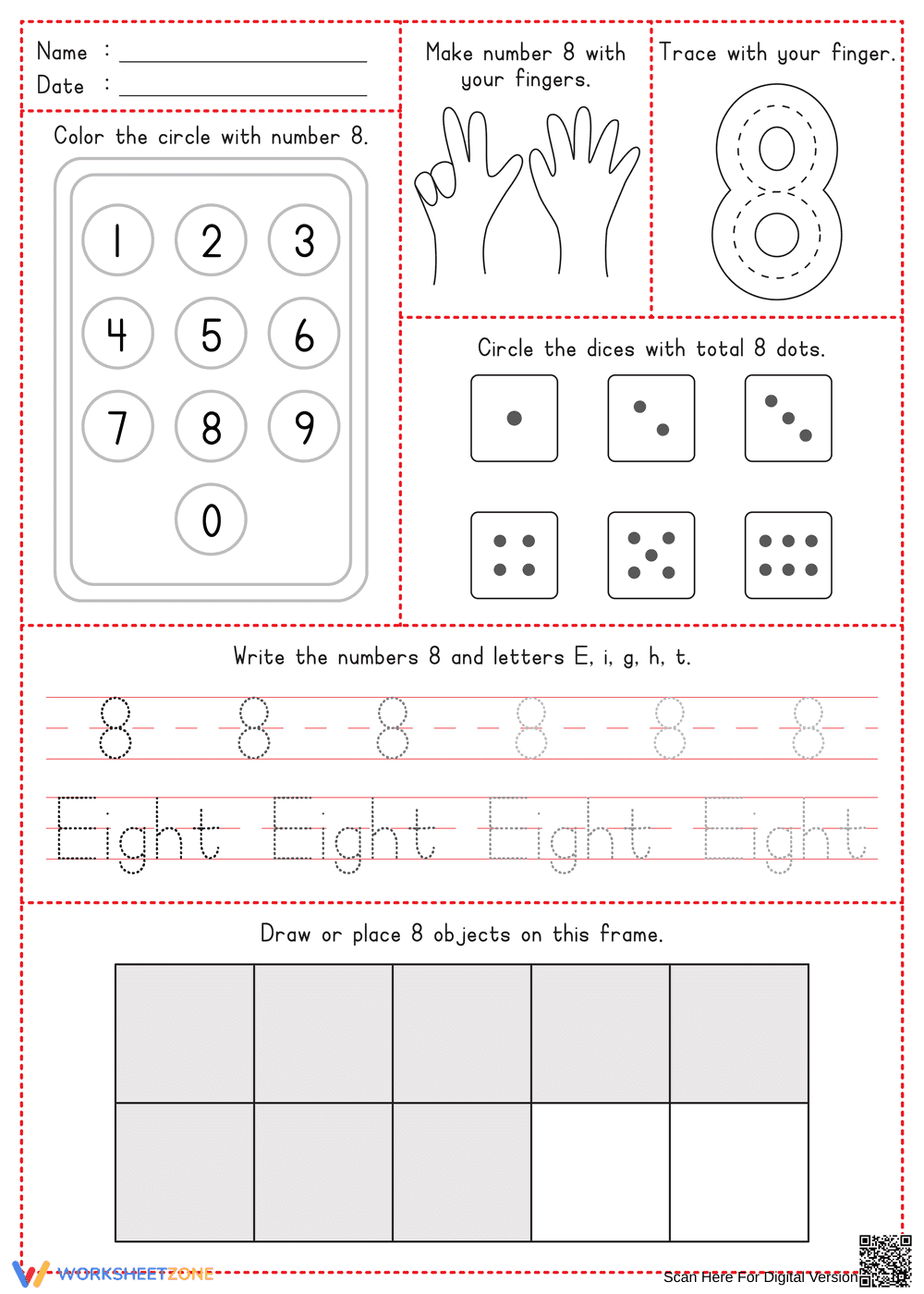

Printable Number 8 Worksheet | Kindergarten Math
Paste this activity's link or code into your existing LMS (Google Classroom, Canvas, Teams, Schoology, Moodle, etc.).
Students can open and work on the activity right away, with no student login required.
You'll still be able to track student progress and results from your teacher account.
This printable Kindergarten math worksheet provides focused practice on recognizing, tracing, and counting the number eight. Students build foundational number sense and fine motor skills through engaging, multi-sensory activities. The single-page format ensures young learners master early counting concepts without feeling overwhelmed.
At a Glance
- Grade: Kindergarten · Subject: Math
- Standard:
CCSS.MATH.CONTENT.K.CC.A.3— Write numbers and represent quantities with written numerals- Skill Focus: Number 8 recognition and tracing
- Format: 1 page · 6 problems · No answer key · PDF
- Best For: Independent practice or morning work
- Time: 10–15 minutes
This comprehensive single-page resource features six distinct task types designed to reinforce number eight. Activities include a number pad identification exercise, finger counting visuals, large finger-tracing numerals, dice dot counting, structured handwriting practice for both the digit and the word "eight," and a ten-frame drawing task. The varied formats keep young students engaged while targeting different learning modalities.
This worksheet is designed for a seamless, zero-prep classroom workflow. Print (1 minute): Simply download the PDF and print a class set. Distribute (1 minute): Hand out to students with pencils and crayons. Review (3 minutes): Quickly check the ten-frame and dice sections for accuracy. Total teacher prep time is under two minutes, making this an ideal, self-explanatory resource for emergency sub plans or quick morning work routines.
This activity aligns directly with CCSS.MATH.CONTENT.K.CC.A.3: "Write numbers from 0 to 20. Represent a number of objects with a written numeral 0-20 (with 0 representing a count of no objects)." It also supports early counting and cardinality goals by having students match quantities to the written numeral. Both standard codes can be copied directly into lesson plans, IEP goals, or district curriculum mapping tools.
Deploy this worksheet during independent math centers after direct instruction on the number eight. It also serves perfectly as a morning bell-ringer activity to settle students into the day. While students work, teachers can use the ten-frame drawing section as a quick formative assessment to observe one-to-one correspondence skills. Expected completion time ranges from 10 to 15 minutes depending on the student's fine motor writing speed.
This resource is primarily designed for Kindergarten students developing early numeracy skills, though it serves as excellent remediation for first graders needing foundational review. For students requiring extra support, provide physical manipulatives like counting bears to place on the ten-frame before drawing. Pair this worksheet with a whole-class anchor chart focusing on the number eight or a read-aloud counting book to reinforce the concepts.
Mastering early numeracy skills, specifically writing numbers and representing quantities with written numerals as outlined in CCSS.MATH.CONTENT.K.CC.A.3, forms the critical foundation for all subsequent mathematical learning. According to a recent EdReports 2024 analysis, students who engage in multi-modal number practice—combining tracing, visual identification, and physical counting—demonstrate significantly higher retention rates in early math concepts. This worksheet integrates these exact modalities, moving students from abstract numeral recognition to concrete quantity representation using dice and ten-frames. By providing repeated, varied exposures to the number eight, educators can ensure students build the automaticity required for more complex addition and subtraction tasks in later grades. Consistent practice with targeted, standards-aligned materials reduces cognitive load, allowing young learners to focus on skill acquisition rather than task comprehension.


