


























Views
Downloads
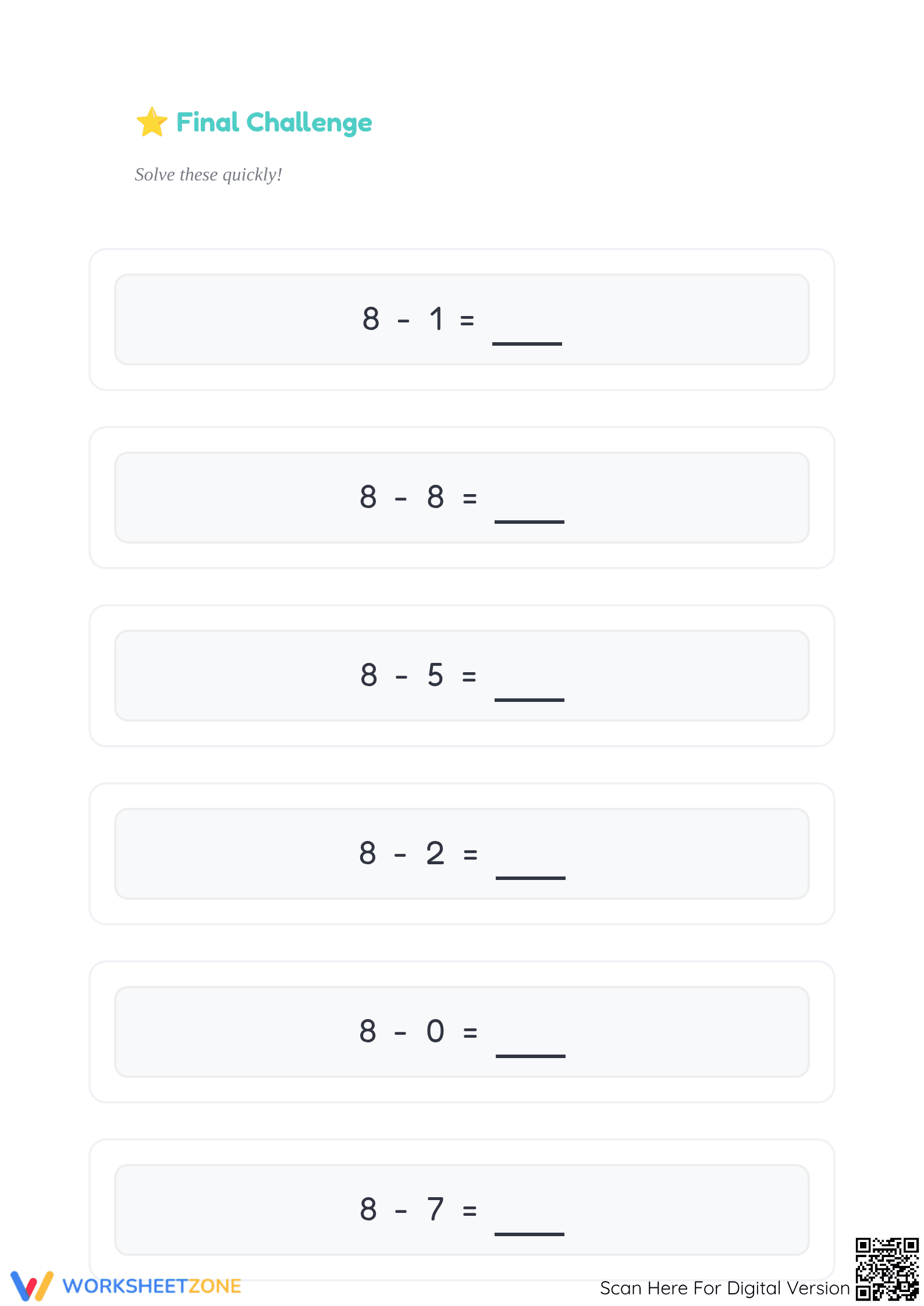

Grade 1 Number 8 Math — Printable No-Prep Worksheet
Paste this activity's link or code into your existing LMS (Google Classroom, Canvas, Teams, Schoology, Moodle, etc.).
Students can open and work on the activity right away, with no student login required.
You'll still be able to track student progress and results from your teacher account.
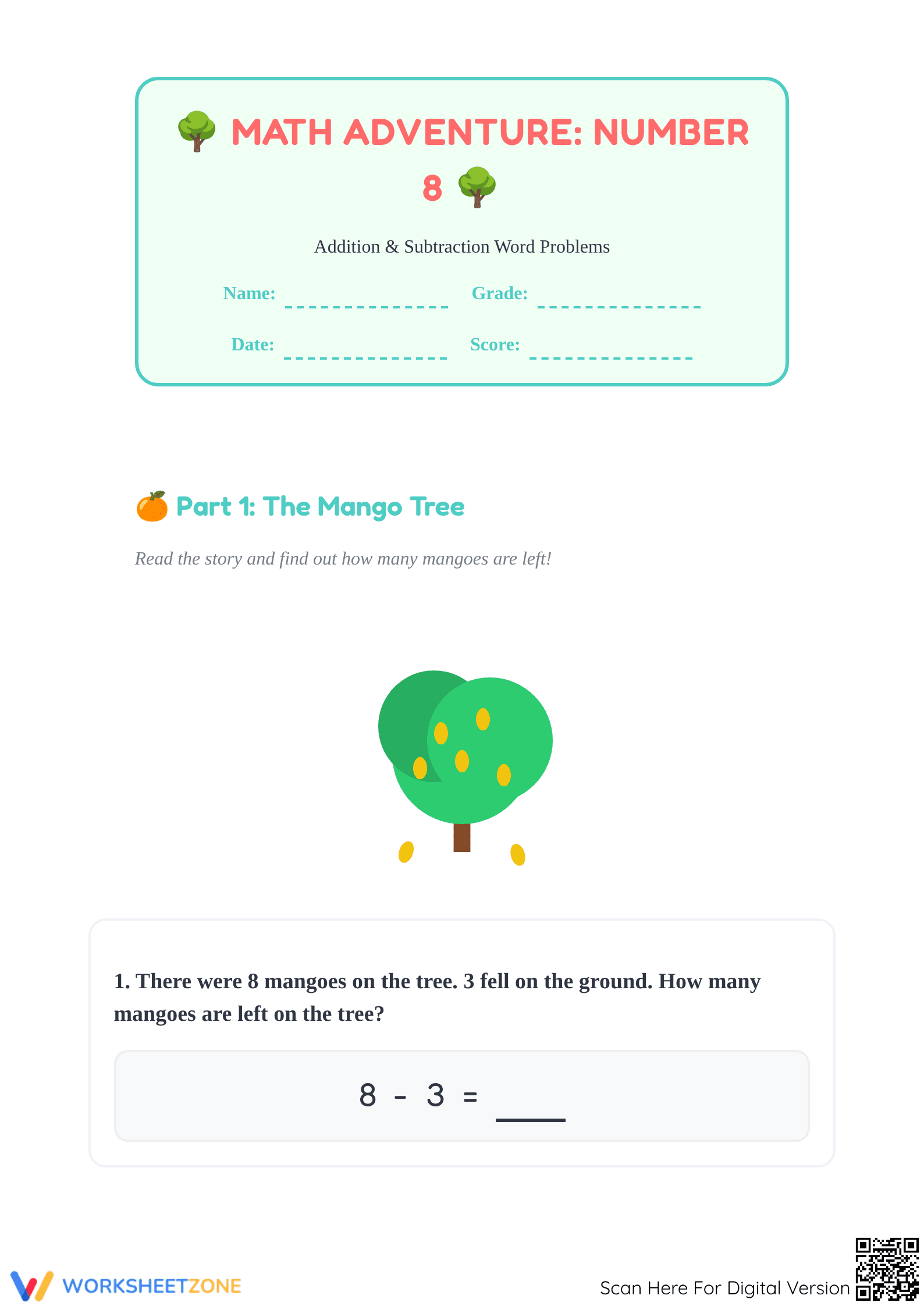
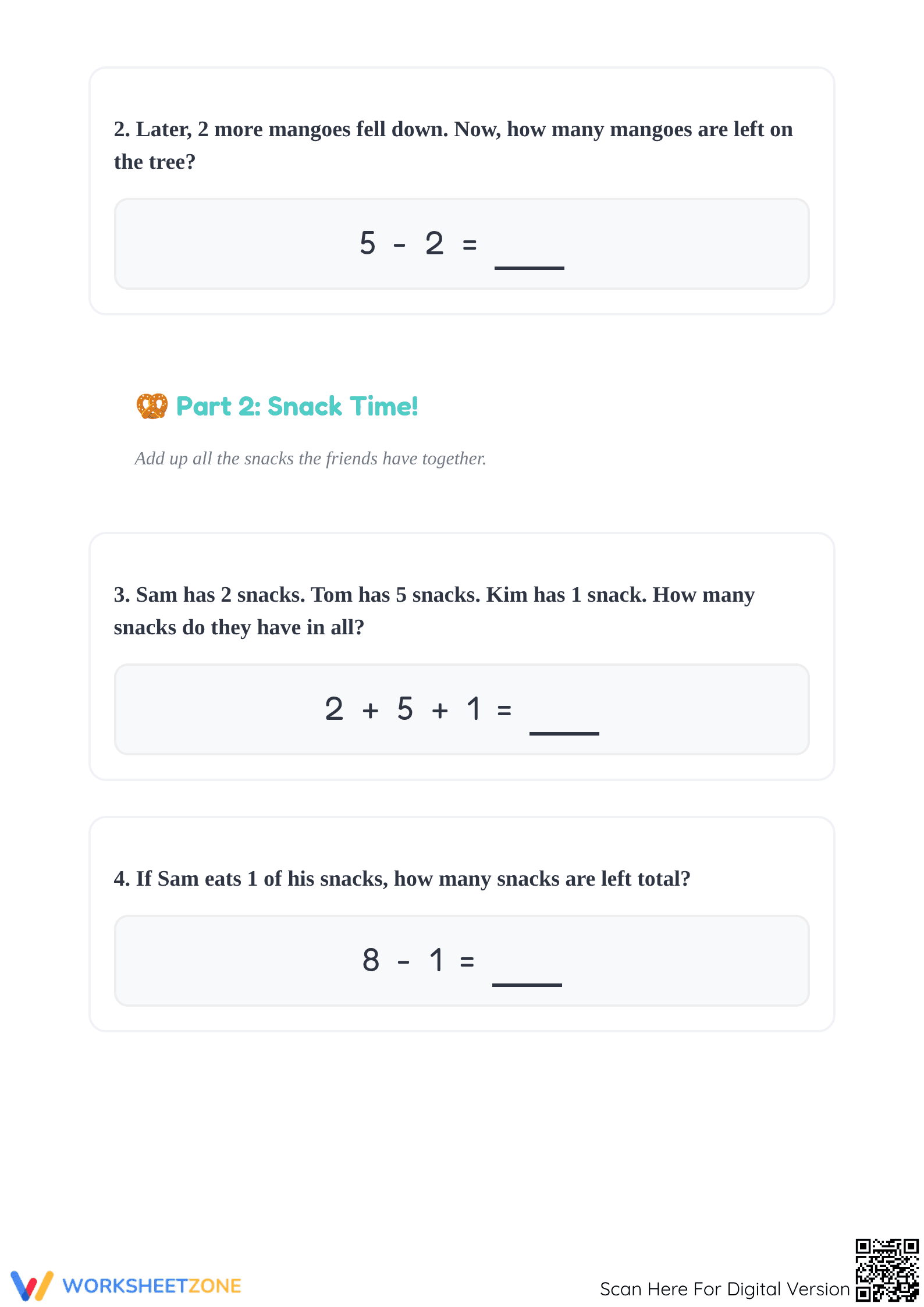
This comprehensive Number 8 math adventure worksheet provides students with targeted practice in solving addition and subtraction word problems. By engaging with relatable scenarios involving mango trees and snacks, learners master operational fluency and critical thinking. This resource ensures students can confidently represent and solve problems involving the number eight in various contexts.
At a Glance
- Grade: 1 · Subject: Math
- Standard:
CCSS.MATH.CONTENT.1.OA.A.1— Solve addition and subtraction word problems within twenty- Skill Focus: Addition and subtraction facts for the number eight
- Format: 5 pages · 15 problems · Answer key included · PDF
- Best For: Early finishers, homework reinforcement, or math center rotations
- Time: 25–35 minutes
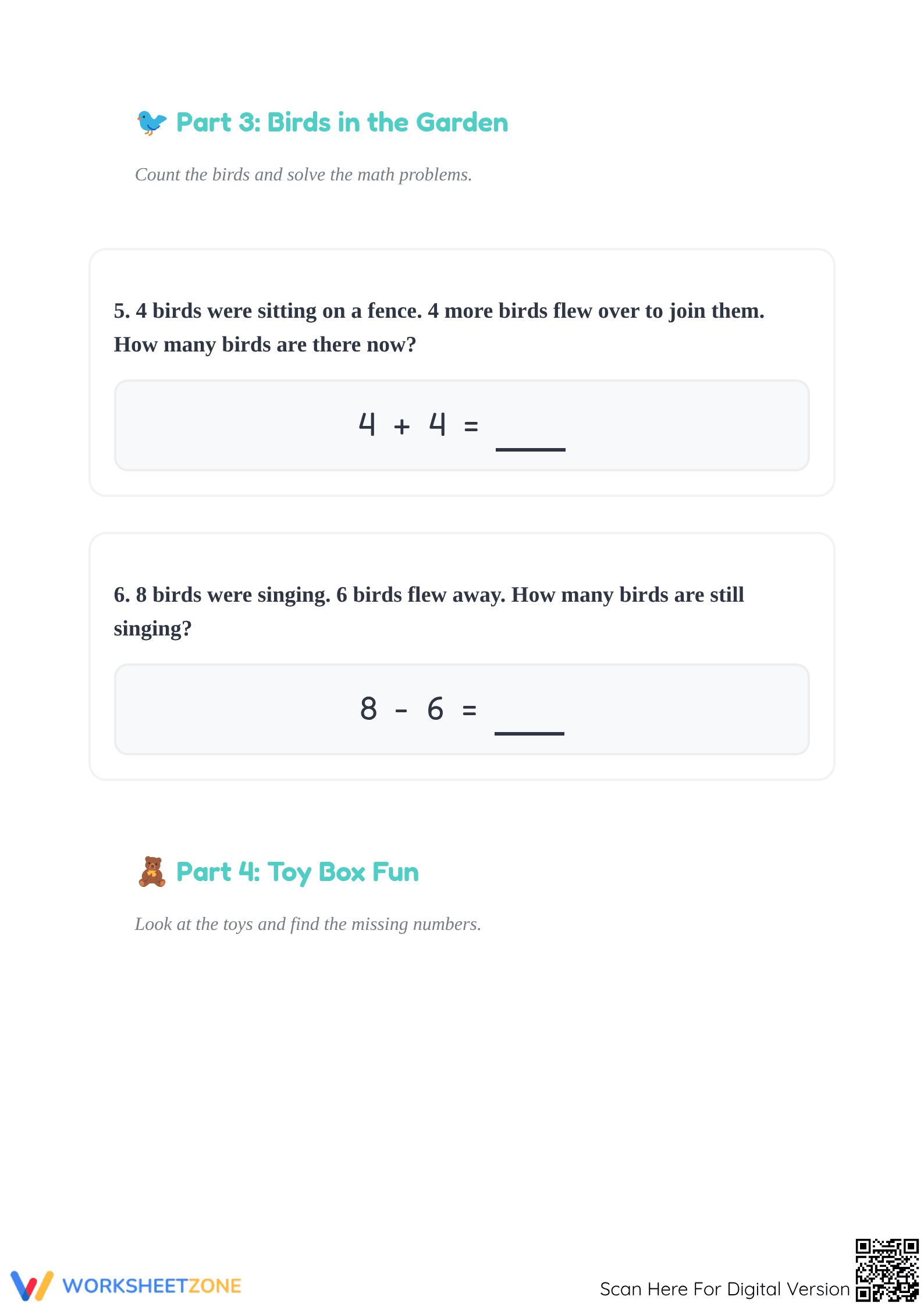
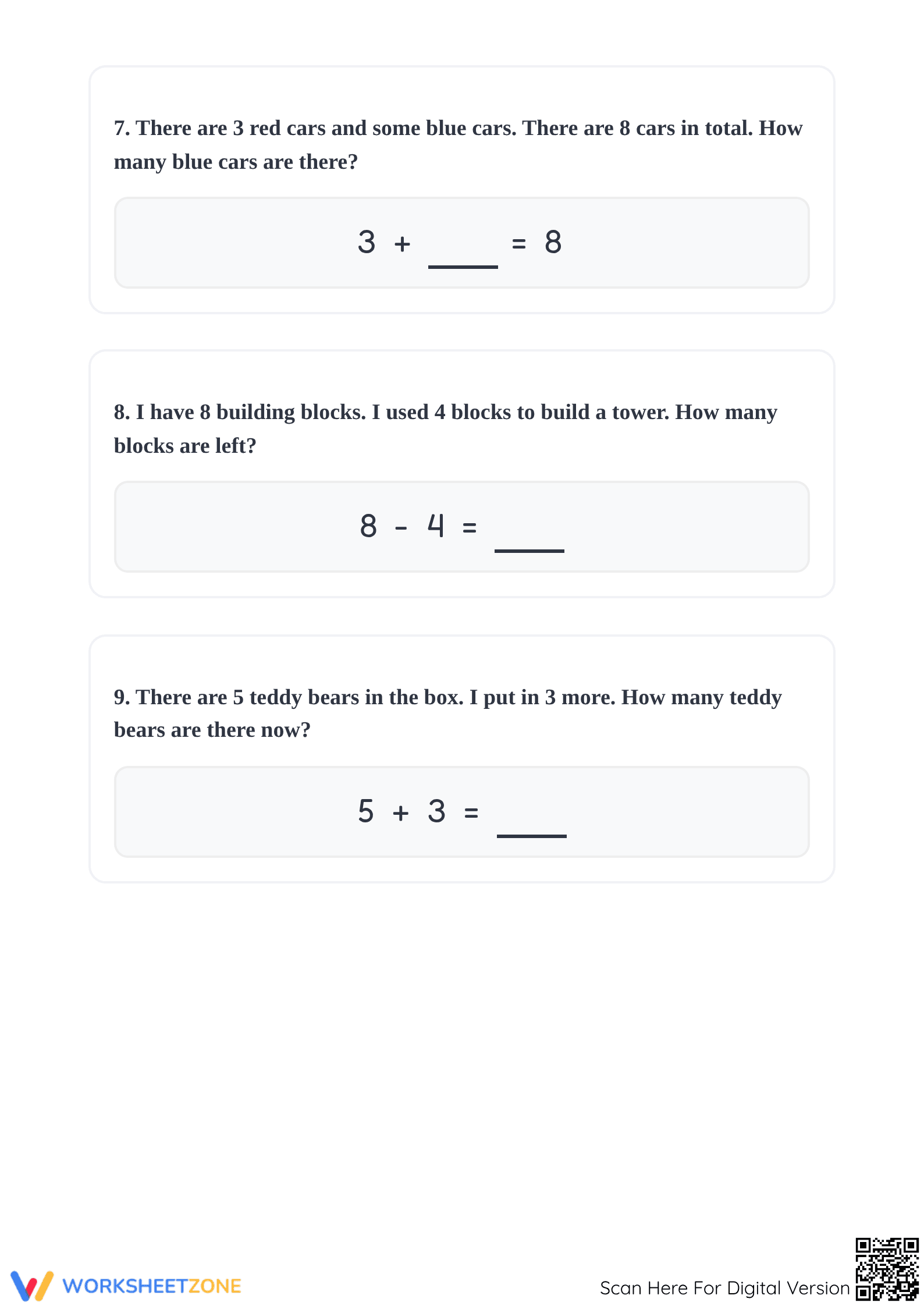
This 5-page PDF contains 15 carefully sequenced tasks. The first four parts use thematic word problems to bridge conceptual understanding with numerical operations. It includes addition, subtraction, and missing addend scenarios. A "Final Challenge" section offers six rapid-fire subtraction facts to solidify fluency. A complete answer key is provided for immediate grading and student feedback.
Zero-Prep Workflow
- Print: Select the 5-page PDF and hit print to create immediate student packets (30 seconds).
- Distribute: Hand out the thematic packets to students for independent, pair, or small-group work (1 minute).
- Review: Use the provided answer key to quickly check student work or facilitate a peer-review session (Under 2 minutes).
This streamlined workflow makes the resource ideal for substitute plans or unexpected schedule changes.
Standards Alignment
Aligned to CCSS.MATH.CONTENT.1.OA.A.1: Use addition and subtraction within 20 to solve word problems involving situations of adding to, taking from, putting together, taking apart, and comparing. This worksheet specifically addresses the "within 10" subset of this standard, focusing on the number 8 to build a solid foundation. Both standard codes can be copied directly into lesson plans, IEP goals, or district curriculum mapping tools.
How to Use It
Use this worksheet during the independent practice phase of a lesson on basic operations. It works well after students have used manipulatives to model addition and subtraction. For a formative assessment observation, watch how students translate the word problem text into the provided equation frames; this reveals their understanding of operational keywords like "left" or "in all."
Who It's For
This resource is designed for Grade 1 students, but serves as an excellent challenge for Kindergarteners or a remedial review for Grade 2 learners. It is particularly effective for students who benefit from visual cues and thematic storytelling to stay engaged with mathematical concepts. It pairs naturally with a number line or a set of counting blocks.
Research highlights that integrating thematic storytelling into mathematical tasks significantly improves student engagement and retention of operational concepts. According to EdReports 2024, high-quality instructional materials that provide structured, sequenced practice within a consistent numerical range—such as the focused Number 8 exercises in this packet—allow students to develop deeper conceptual mastery rather than rote memorization. By utilizing the CCSS.MATH.CONTENT.1.OA.A.1 standard as a framework, this worksheet bridges the gap between abstract arithmetic and real-world application. The inclusion of word problems requiring addition, subtraction, and missing addend identification aligns with best practices for multi-modal learning. This specific resource provides the stability required for diverse classroom settings, ensuring that teachers can deliver standard-aligned instruction without additional preparation time. This approach is supported by longitudinal studies emphasizing the importance of operational fluency in early elementary grades for future success in higher-order algebra.


