These concepts of print printable worksheets for kindergarten give teachers targeted, ready-to-use materials for one of the least glamorous but most consequential parts of early literacy instruction — teaching children that text itself has rules. The set covers book handling, directionality, word boundaries, and punctuation recognition through formats that ask students to mark, sort, circle, and trace rather than simply sit and listen.
What Each Worksheet Covers
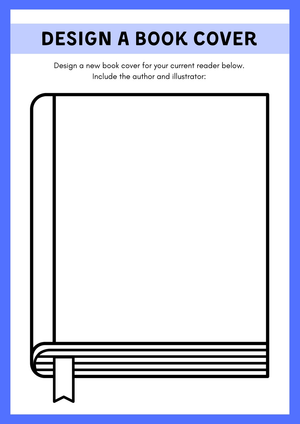
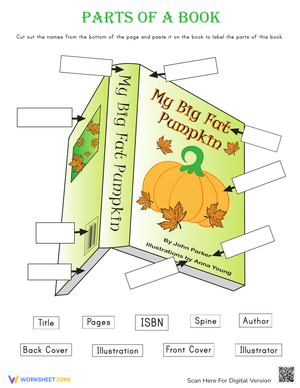
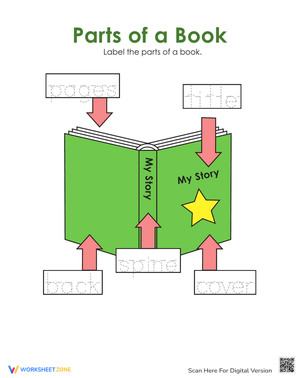
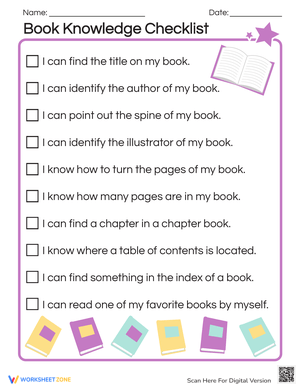
Book handling worksheets anchor the sequence. Students label a book diagram — front cover, back cover, spine, title page — and answer questions about the difference between an author and an illustrator. This is genuinely new knowledge for many kindergarteners, not review. A surprising number enter the year without knowing that a specific person wrote the words they hear read aloud, or that the book has a deliberate starting orientation.
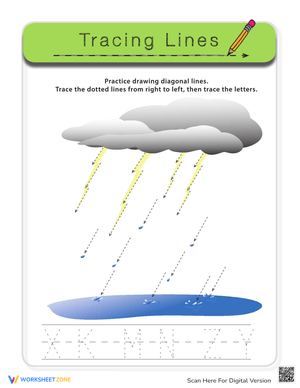
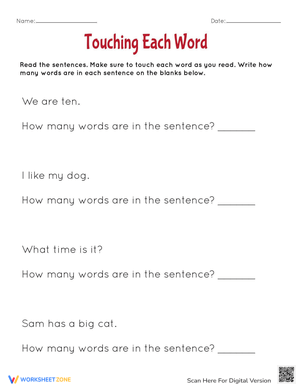
Directionality worksheets use arrow-traced paths and one-to-one pointing tasks. Students follow a printed line, tapping a dot placed beneath each word as they read aloud. The dot-tapping breaks the common habit of sliding a finger across the whole line in one continuous sweep — which tells you nothing about whether a child is tracking individual words or just moving their hand. Sentence arrangement tasks ask students to cut and paste word cards into correct left-to-right order, reinforcing that sequence matters in written English in a way that spoken conversation does not always make obvious.
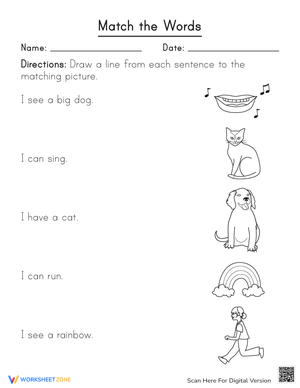
Letter, word, and sentence sorting rounds out the skill set. Students mark examples with different-colored crayons — one color for a single letter, another for a complete word, a third for a full sentence — then count the words between a capital letter and a closing period. Punctuation hunt worksheets ask students to circle every period, underline every question mark, and place a star beside exclamation points, which trains the eye to read a full line rather than anchor on the first word and skip the rest.
Frequent Student Errors Worth Catching Early
The sharpest error pattern in letter-word sorting involves single-letter words. A child who has spent weeks learning to name the letter "I" will frequently place the word "I" in the letter column of a sorting exercise, because it looks exactly like what they have been calling a letter. Same with "a." These are not careless mistakes — they reveal a genuine gap in understanding that letters combine to create a different category of thing. Naming this distinction explicitly before students begin the sort, and then discussing the misplaced examples together afterward, moves students further than simply marking them wrong.
Directionality errors cluster at the return sweep — the moment a reader finishes one line and moves to the start of the next. Students who track within a line correctly will sometimes jump to the wrong starting position on line two, or skip a line entirely. The arrow-tracing exercises make this visible in a way that whole-class shared reading cannot, because every student is working simultaneously and you can walk the room and catch the problem in real time.
A third pattern appears specifically on book-handling tasks: some children point to the illustration when asked where to read. Pointing to the picture is developmentally expected before age four but needs direct correction by mid-kindergarten. The worksheets that ask students to circle "the words" versus "the picture" address this directly, though they work best after a brief model — without one, several students will circle whichever element looks larger on the worksheet rather than thinking through the distinction.
How to Work These Worksheets Into Your Literacy Week
Concepts of print printable worksheets for kindergarten slot into the literacy block differently depending on which sub-skill is being introduced that week. Directionality and one-to-one correspondence work fits well as a morning warm-up during the first six weeks of school, when establishing left-to-right habits is still an active instructional goal. Five minutes of whole-group modeling — teacher pointing while reading aloud, students mirroring with their own copy — followed by three minutes of independent practice gives enough repetition without losing the room. Most worksheets in this set take under ten minutes for a kindergartener working at a typical pace.
Small-group guided reading time is where the sorting exercises pay off most. Sitting with four or five students as they categorize letters, words, and sentences reveals who truly understands visual word boundaries in a way whole-class instruction rarely does. A student who places "the" in the letter column needs a different follow-up than one who sorts correctly but freezes when asked to explain the reasoning — the first gap is conceptual, the second is linguistic, and the intervention looks different for each.
Literacy centers are a strong fit for punctuation hunts and book-handling exercises once students know the format. Slip each worksheet into a dry-erase sleeve with an expo marker, and the same resource cycles through multiple rotations without reprinting. Students who finish early can flip the sleeve and write their own examples in the margin — a no-prep extension that deepens the work without adding anything to the teacher's preparation time.
Standard Alignment
The worksheets address CCSS.ELA-LITERACY.RF.K.1, the foundational standard requiring kindergarteners to demonstrate understanding of the organization and basic features of print. Its sub-standards map directly onto the resources: RF.K.1a covers left-to-right, top-to-bottom reading and page-by-page sequencing; RF.K.1b distinguishes printed words from illustrations; RF.K.1c addresses the difference between letters and words; RF.K.1d introduces recognition of sentence-ending punctuation. Because each worksheet isolates one or two sub-standards rather than blending all of them together, teachers can use individual worksheets as documentation for specific skill checkpoints — useful for progress monitoring, parent conferences, or IEP goal tracking.
Differentiating the Set Across a Classroom Range
Students who enter kindergarten already tracking print correctly — typically those with substantial pre-K read-aloud exposure — benefit most from the punctuation hunt and word-boundary sorting work. The basic directionality tracing will feel too easy for that group, and easy tasks in whole-class settings tend to generate restlessness before the lesson is even finished. Pull the more cognitively demanding worksheets for those students first, and reserve the arrow-path tracing for explicit remediation rather than universal practice.
For students still developing fine motor control, the tracing exercises can be completed with a finger on a laminated copy before transitioning to a pencil. Removing the grip requirement lets you isolate the print concept from the motor skill — which matters when you need clean data on whether a child understands directionality versus simply cannot yet control a writing tool on a narrow path.
Concepts of print printable worksheets for kindergarten also serve first-grade intervention well. A first-grader who cannot yet locate the first word in a sentence of decodable text needs exactly this skill addressed directly, not worked around. The larger text size and minimal visual clutter in these exercises make them more appropriate for that intervention context than materials written for students a year older.
Frequently Asked Questions
Which worksheet should I introduce first?
Start with book handling — front cover, back cover, author, illustrator. It anchors students in the physical object before moving into the more abstract concepts of word boundaries and sentence structure. Most teachers cover these terms during the first week of read-alouds anyway, so the corresponding worksheet pairs naturally with what is already happening in the room.
Can I use these worksheets as formal assessment documentation?
Each worksheet gives you a dated, skill-specific artifact. The sorting exercises show at a glance whether a student distinguished letters from words at a given point in the year. For IEP documentation or formal portfolio evidence, attach a brief anecdotal note about whether the student required verbal prompting — the worksheet alone does not capture that difference, and it matters for determining next steps.
What should I do when a student finishes quickly but made several errors?
Resist the impulse to have them redo the same exercise immediately. A short conversation — "tell me how you decided where to put this one" — usually reveals more than the paper does. Many kindergarteners guess correctly on a first pass and cannot explain the reasoning, which means the concept is not yet internalized. That conversation helps you decide whether another worksheet moves them forward or whether small-group discussion is what they actually need first.
Do these worksheets work for students still developing English proficiency?
The directionality and book-handling worksheets are largely language-independent — following an arrow path or labeling a book diagram does not require English fluency. The sentence-level sorting and punctuation work is more demanding for students still building oral English. For that group, concepts of print printable worksheets for kindergarten are most effective when introduced alongside shared reading in the student's home language first, if that resource is available, so students understand that print carries meaning before they encounter the specific conventions of English text.












 Interactive Worksheet Maker
 Quiz Maker
 Word Search Maker
 Crossword Puzzle Maker
 Word Scramble Generator
 Sentence Scramble Generator
 Handwriting Worksheet Generator
 Name Tracing Generator
 Fill In The Blank Generator