


























Views
Downloads

Printable Welcome Banner Letters | PreK-5 Decor
Paste this activity's link or code into your existing LMS (Google Classroom, Canvas, Teams, Schoology, Moodle, etc.).
Students can open and work on the activity right away, with no student login required.
You'll still be able to track student progress and results from your teacher account.
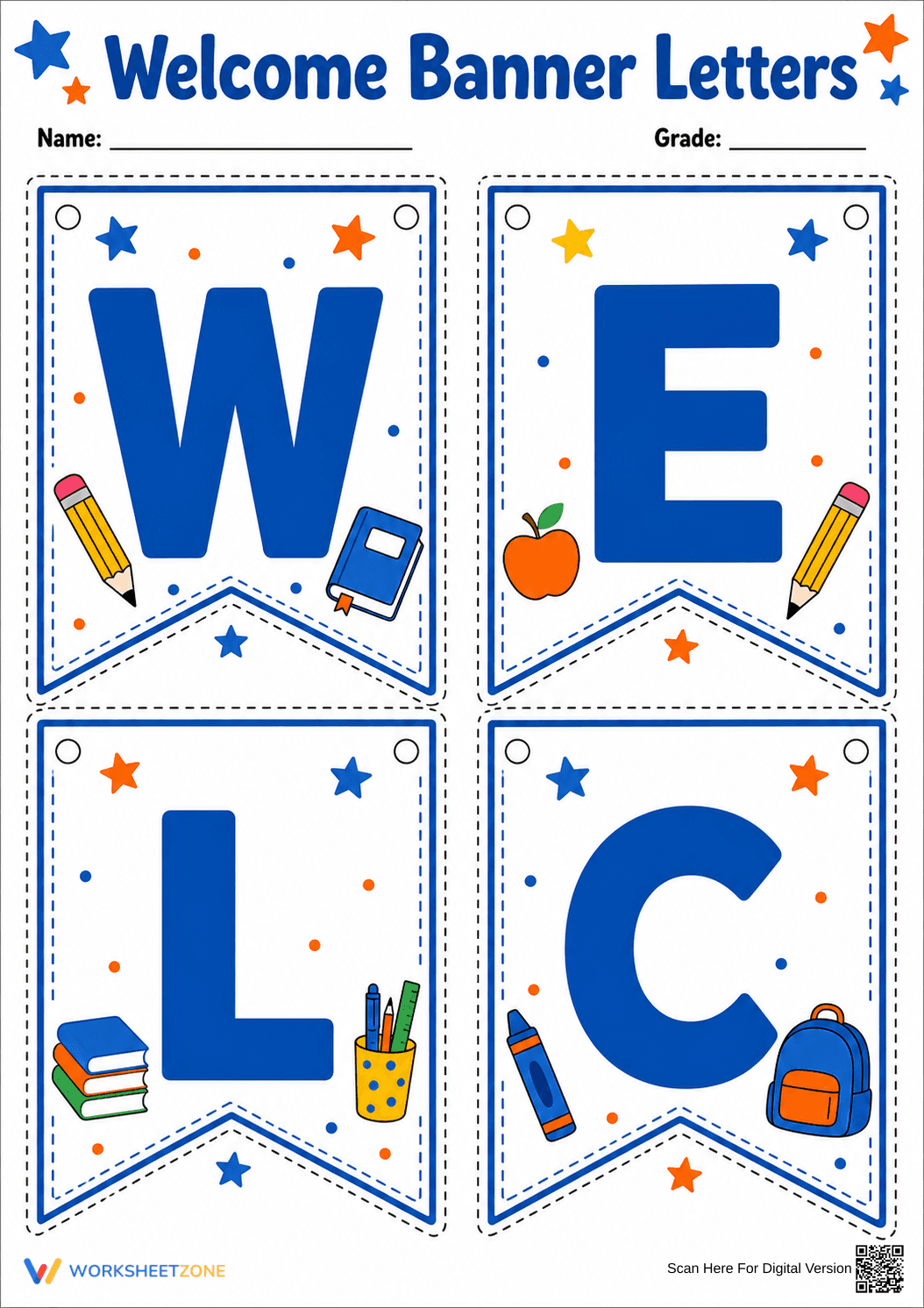
This printable welcome banner provides teachers with an immediate way to establish a positive classroom environment. Students feel invited into the space while early learners gain exposure to clear alphabet models. Set up your room quickly with this vibrant decor piece.
At a Glance
- Grade: PreK-5 · Subject: Classroom Decor
- Standard:
CCSS.ELA-LITERACY.RF.K.1.D— Recognize and name uppercase letters- Skill Focus: Classroom Environment
- Format: 1 page · 4 tasks · No answer key · PDF
- Best For: Back to school setup
- Time: 10–15 minutes
Inside this resource, educators will find a single page containing four large banner flags featuring the letters W, E, L, and C. Each flag includes dotted cut lines for precise trimming and hole markers to guide stringing. The design incorporates bright accents alongside familiar school icons like pencils and books, creating a welcoming aesthetic without requiring expensive store-bought materials.
This resource is designed for maximum efficiency.
- Print (1 minute): Generate the PDF in color on standard A4 or cardstock.
- Distribute (5 minutes): Cut along the dotted lines and punch holes in the corners.
- Review (5 minutes): String the letters together or staple them to a bulletin board.
Total teacher prep time is under 15 minutes, making it an ideal addition to any classroom setup checklist.
Aligned to CCSS.ELA-LITERACY.RF.K.1.D, this decor piece supports early literacy by displaying clear, easily identifiable uppercase letters. While primarily a classroom management and environmental tool, exposing young students to bold print reinforces foundational reading skills. Both standard codes can be copied directly into lesson plans, IEP goals, or district curriculum mapping tools.
Teachers can utilize these welcome banner letters to enhance the physical learning space. Hang the completed banner above the classroom entrance before the first day of school to greet incoming students. Alternatively, use the individual letter flags as a visual anchor during the first week of instruction, asking kindergarteners to identify the letters. This serves as a quick formative assessment of basic letter recognition. Expected completion time for setup is 10 to 15 minutes.
This printable is perfect for general education teachers, special educators, and interventionists setting up their rooms for the new academic year. The clear, uncluttered font provides excellent differentiation for students with visual processing needs, ensuring the text remains readable from across the room. Pair this banner with a matching daily schedule anchor chart or a direct instruction lesson on classroom routines to establish a cohesive, structured environment from day one.
Establishing a welcoming physical space is a critical component of effective classroom management and student engagement. By integrating clear text, such as the uppercase letters aligned to CCSS.ELA-LITERACY.RF.K.1.D to recognize and name uppercase letters, educators create a print-rich environment that passively reinforces early literacy. According to Fisher & Frey (2014), the physical design of a classroom significantly impacts student behavior, instructional flow, and overall academic achievement. When students enter a room that feels organized and inviting, their affective filter lowers, allowing for more effective learning and peer interaction. Utilizing printable decor like these welcome banner letters allows teachers to quickly build this positive atmosphere without sacrificing valuable instructional planning time. This approach ensures that the classroom environment itself acts as a secondary teacher, constantly modeling clear communication and structured organization for all learners.


